
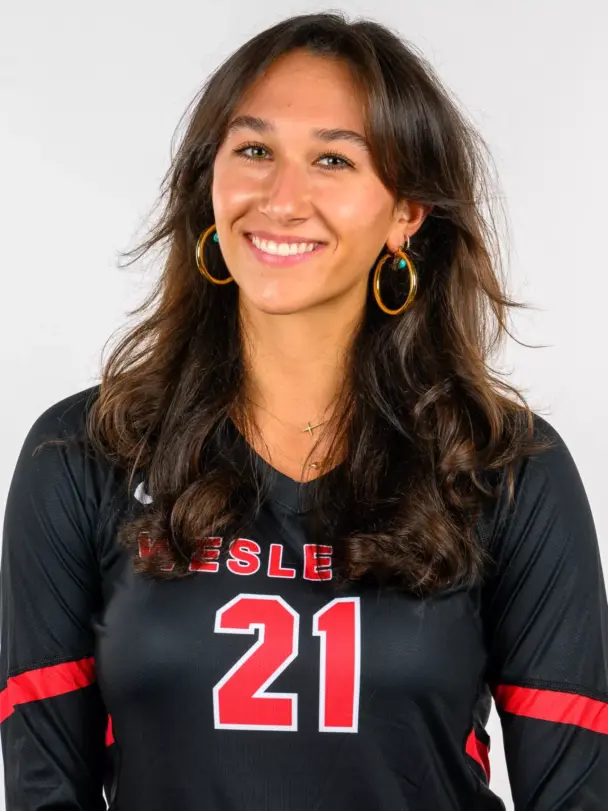
WesCeleb: Sophia Lindus ’26 on “Killing” It On and Off the Court
Bump, set, spike! This week, The Argus sat down with two-time All-American Athlete and women’s volleyball captain Sophia Lindus ’26. Beyond discussing a plethora of volleyball information, including what a “kill” is, Lindus chronicled her past Parisian adventure, future finance ambitions, and her present mental state: savoring the end of beginning.
The Argus: Why do you think you were nominated for WesCeleb?
Sophia Lindus: I feel volleyball has probably been the thing that a lot of people know me for on this campus, and I’m really grateful for the opportunity to have played with such amazing girls and [to have] experienced individual and group success. It’s really shaped the way I am today, and I feel I’ve matured so much over the past four years.
A: On that note, can you tell us about your relationship with volleyball?
SL: I’m from Los Angeles, Calif., so all the girls play either volleyball or basketball. I did volleyball with my elementary school, and I was like, wait, I really like this. I played intense club volleyball at Sunshine Volleyball Club since fourth or fifth grade, and then when I was in high school, I realized I wanted to continue and play in college. You get this competitive outlet by playing a sport. You get to work with your teammates and build that trauma bond, almost. Volleyball has taught me how to compromise with people, and how to put your self interest behind the team’s common goal. At the University specifically, it’s such a great balance of playing a sport because you’re also a student. When you’re not fully enveloped in the season, you can meet so many different people. I live with three film majors. I don’t live with any other athletes.
A: How did you meet your roommates?
SL: My first year, we got really close just by seeing each other in Usdan all the time and getting lunches. A lot of people think there’s this huge divide between athletes and non-athletes, and I think that some people like to perpetuate that divide a little bit more, just to make themselves feel a little cooler. I think that’s super silly, and I’ve always thought that there’s a lot that you can learn from people here. Everyone’s so passionate about their niche that it’s really nice to branch out and not just hang out with the same people you see every day.
A: Collegiate athletics are intense. What was your in-season day in the life?
SL: During the season, it would be Monday morning, 7 a.m., in the weight room with the rest of the team wearing all black, hitting our team lift. Then, I’d probably have one or two classes in the morning. I’m a government major and data analysis minor, so a lot of those classes are in the afternoon, unfortunately. On Mondays, we would have practice at 3:30 p.m….practice is an hour and a half to two hours, but it would end up being a four-hour ordeal. We get there an hour early, set up the nets, practice, and then shower, change, get post-practice treatment in the training room, and probably catch dinner by 6:30 p.m. or 7 p.m., which isn’t that bad. You really hit your homework that you didn’t do during the day at 8 or 9 p.m.
Game days are different. We’ll have games on Friday and Saturday, playing two teams each weekend. Sometimes we’ve done three. If it’s a home game, we’ll start warm-ups probably around 3 or 4 p.m. It’s really nice to get warmed up and in the mindset. On Fridays, since I didn’t have classes, I would get my coffee and New York Times crosswords and bang out some homework. Then we’ll have the game from 7 to 9 p.m. Saturdays are pretty much that same schedule, just expedited a little bit, because our games are at 3 p.m.
A: Now that you’re out of season, are you still training?
SL: I’m not going to be playing volleyball again…but the rest of the girls are doing 7 a.m. lifts on Tuesday and Thursday…something on Monday morning, practice at 6 a.m. on Wednesday mornings, and then lift at 5 a.m. on Fridays.
A: Why so early?
SL: Over the years we’ve realized that it’s so important to be disciplined. The off-season is when you’re building muscle, connecting as a team, both on and off the court. It’s time for the leaders to take charge and make their presence known, and for people to fit into new roles. The gym is a little bit emptier at seven in the morning, which is nice. But also, the act of getting up early and showing up for your other teammates is so important.
A: You’re an outside hitter—what is that like? Can you give readers a non-sports analogy?
SL: Covering the deep corners is a really interesting perspective of the court and a lot of ground to cover. Having an outside hitter in the back row was kind of a secret weapon because certain teams weren’t used to seeing that. A metaphor for an outside hitter is that we’re definitely the divas of the team. We’re the ones that get the most balls…our egos are huge, and we really like the spotlight.
A: Upon looking at your stats, I noticed you have a lot of “kills.” How would you explain a kill to someone who does not know?
SL: So a kill is something that I hit that scores a point automatically. I could hit the ball, and it just touches the ground—that’s our point, that’s a kill for me. That’s how we’re judged statistically as being a hitter. Not every hit is going to be a kill, or else you’d be a god. We’ll do scouting reports of really difficult teams a few days before the game and then work on these shots in practice. By game time, you don’t really think about it; you’re kind of in a flow state. Over the years, you just develop a little more confidence in shots, and you have your “toolbox” that you can utilize.
A: What are your go-to pre- and post-match meals?
SL: I think my pre-match meal from Usdan is a hamburger patty from the Grill Station with cabbage slaw that’s next to Vegan. I’ll also peruse what Classics or Vegan has and then get veggies and maybe some yogurt, cereal, or a piece of bread. Post-game, especially if it’s a really long match, the chicken penne from Mondo is the best thing ever with cheese pizza and caesar salad. Definitely carb loading, just get food in your system.
A: What has been your favorite part of being on the volleyball team?
SL: At the University, the people that I met through volleyball are my closest friends. It feels like your circle grows by six people each year because of the new classes that come in. We always joke that we’re Wesleyan Volleyball girls, like that means something to us. We just have this similar mindset: work hard, play hard. Shout-out to our coach for knowing what culture to build, but also shout-out to the girls for giving into it.
A: You got injured your sophomore year, and your first season back was this year. What was that adjustment like?
SL: My first year and sophomore seasons were really great seasons for me. Tearing my knee in the semifinals before our NESCAC championship game was really difficult. I helped us get to that point, and then to not be in the match on championship day was hard. But just because our starting outside hitter was gone didn’t mean that we were going to lose. We had so much depth on our team that anyone could have stepped into that role and crushed it, and they did.
In sophomore off season, I wasn’t really doing much with the team. I was doing my P.T., getting off crutches, and learning to run again. I think that showed me that I could face anything.
Then, not being able to play at all junior year was really, really difficult, because we had a big group of first years coming in, and it’s just nice to have one more upperclassman playing and showing them the ropes. Words only go so far. I couldn’t lead by my actions because I wasn’t playing, so I did everything that I could on the sidelines to keep a good spirit and focus on things that the team was doing poorly.
A: What’s something about volleyball you think most people either misunderstand or don’t know?
SL: I think the physicality of it is something that a lot of people don’t understand because we’re injured all the time, or we’re aching and we’re bruised. People say it’s not a contact sport. But it is contact with the ground! Diving takes a toll on you. The jumping movements, the jerking movements, the quick twitch reflexes that you need in the sport are really difficult to grow and maintain, but they’re also super prone to injury because your body’s not supposed to move like that.
A: What class was unexpectedly your favorite?
SL: Oh, that’s “Drawing I” [(ARST131)], for sure. It is so much work out of class and in class. It’s just drawing, drawing, drawing. But it was great because it was a creative outlet for me, which I really needed. I realized it was something that I was awful at, that I had to work really hard to get better at, and it was a great way to meet new people and to experience a different building on campus and a different part of University life. You’re also looking at the nude models from such an objective lens that it takes away any sex or pleasure out of what you’re looking at. It’s just like, this is a body, this is anatomy. I think that girls, especially athletes—I’m in my spandex all the time—put so much pressure on what we look like, and that was a really good class to take a lot of that expectation away.
A: You studied abroad last year in Paris. Can you describe your experience in five words or phrases?
SL: 1. Fight or flight, 2. super new, 3. resilience, 4. learning curve, 5. the literal best experience ever.
A: Tell us more about your experience.
SL: I was matched with a host family in Paris in the 20th District, which is the furthest east side of the city. I lived with this woman named Fabienne, who was a retired labor economist and current pilates teacher. She was literally perfect for me…I was taking classes at la Sorbonne and then at Reid Hall, which is Columbia’s campus in Paris.
A: What are your post-grad plans?
SL: Post-grad, I’ll be in New York working in finance, and I’m really excited. I have to prep for all these brokerage tests to get my license. That’s definitely nerve-wracking. I’m going to be working in Debt Capital Markets at J.P. Morgan.
I have training for a few weeks in the summer, and then it’s time to work 15-hour days for the rest of my life, and that’s gonna be a lot. Last summer, I had another internship in finance. Pretty much doing the same thing, and it gets kind of addicting. I really loved what I was learning about. Finance combines all my major areas of interest: geopolitical events, the macroeconomy, and its deep, analytical way of thinking.
A: What are you looking forward to in your final semester?
SL: I’m looking forward to just spending time with everyone. These past few weekends have been so fun, just hanging out and cherishing the last semester. Everyone’s in such a good mood because we know this is kind of the end of the beginning and the beginning of the end. I think that when you’re younger at the University, you think that there’s a lot more pressure on you to act a certain way, be friends with certain people, take certain classes, whatever it is. And I think once you’re a senior, you realize that no one cares that much about you. They’re just caring about themselves, which is super freeing.
A: Do you have any advice for your freshman self?
SL: I think advice for my freshman self would be that nothing is that serious. I say this to myself now: it’s not that deep, it’s not that serious. Just be true to yourself. If it doesn’t feel right, don’t do it. Another thing is to really think about how your actions are affecting other people. Don’t put on a show. You don’t need to be like Hannah Montana, living a double life.
A: Any parting reflections?
SL: Something I’ve been thinking about recently is to prioritize short-term pain if that means long-term satisfaction. I think a lot of us in our society are chasing short-term dopamine highs, and in the end, we’re just going to be a lot worse off in the future. Whether it’s not eating healthy, procrastinating your schoolwork, or with relationships, being in something toxic, all of that will affect you more in the long run if you don’t deal with it now. Recently, I’ve been able to prioritize myself and my health and wellness. I think that that’s really important for all of us to realize.
This interview has been edited for length and clarity.
Jade Acker can be reached at jacker01@wesleyan.edu.



Leave a Reply