
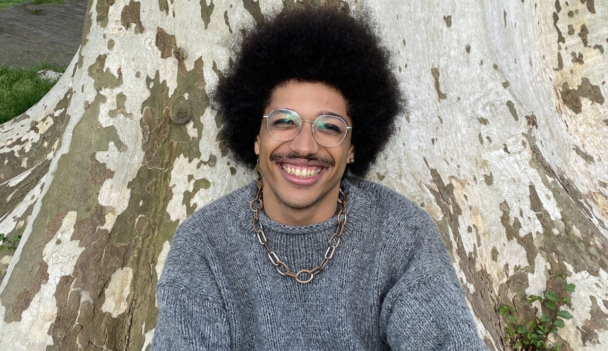
Office Hours: Professor Nicholas Whittaker on Film, Philosophy, and the Value of Confusion
Nicholas Whittaker is an Assistant Professor of Philosophy at Wesleyan University whose research focuses on race, aesthetics, selfhood, and sociality. They have been published in several academic journals and have forthcoming work in the “Oxford Handbook of Asian American Philosophy” and “An Introduction to Contemporary Aesthetics.” The Argus sat down with Professor Whittaker to discuss their approaches to aesthetics, transitioning from graduate school to teaching at Wesleyan, and, of course, film.
The Argus: Thus far, I’ve taken both “Horror Film and Philosophy” (PHIL224F) and “Aesthetics and Race” (PHIL285) with you. What do you hope students will learn from these classes and other ones that you teach?
Nicholas Whittaker: The first and most important takeaway is something I often start my classes by acknowledging, which is the value of dizziness and confusion. When talking about both race and other social categories like gender, and about art, a lot of people are pretty sure they have a good grasp on art and are pretty sure they know what race is or isn’t, or what gender is or isn’t. They also feel pretty confident in their judgments of particular artworks and aesthetic experiences, if they’re valuable or not, skilled or not, etc. I want to carve through that sense of security and leave students in a space beyond litigation. That’s sort of the word I like to use. I want students to leave with these skills and these orientations and these moods and feelings that help us through the process of living in a world with race, a world with gender, a world that is aesthetic: to be in this complicated sort of situation, far less so than to solve it or understand it.
A: Very cool. I definitely get that from your classes.
NW: Good. I like seeing faces of confusion every day.
A: Could you talk a bit about the paper you are currently writing about Asian American cinema?
NW: This paper sort of started with my partner, who is currently editing the first-ever Oxford Handbook on Asian American philosophy; it’s really remarkable that this is only the second such collection in existence. The cool thing about these handbooks is, I use the word encyclopedia, and that’s really what they feel like, right? They’re these opportunities for academics to step back and take stock of the work that’s been done, to catalogue it, get a view of the terrain. In fact, in my pretty extensive research for this paper, I’ve yet to encounter a paper written by an academic tenured in a philosophy department on Asian American cinema. It’s really been interesting to realize that whatever unique thing philosophy does has yet to really be turned to the phenomenon of Asian American cinema. And so I’m trying to catalog what’s been beyond philosophy to give philosophers a leg to stand on.
A: As I’ve gathered from your classes, you’re very into film. How can we use film to guide our philosophical approaches?
NW: There are a lot of possible answers to this question, and my dissatisfaction with what’s called “philosophy of film” is that most of it rests on an assumption that whatever our minds are doing when we read a philosophical text, they’re doing something radically different when we watch a film. But my experience of films and philosophical texts doesn’t feel radically different. I experience them as asking the same thing of me. They’re asking me to slow down, to pay very close attention to what’s in front of me, to let my mind wander and consider possible ways of interpreting what’s in front of me. And so I don’t just see film and philosophy as sort of complementary. I see them as identical or co-constitutive.
I’m really interested in how and why these two sets of artifacts or practices are treated as separate, and how that really rubs against my first personal experience of them.
A: What are some of your favorite movies, and why?
NW: We could spend hours sitting here and chatting about our favorite movies, so I’ll give the simplest possible set of answers: my Letterboxd top four films. These are films I’ve watched at least five times and a couple I’ve watched, nearing now, 10 times. They’re films you can lose yourself in.
Herk Harvey’s 1960 “Carnival of Souls” is a bizarre horror film released in the same year as “Psycho.” Some of my favorite images and sounds I’ve experienced in a theater.
Anna Biller’s “The Love Witch.” Billar is possibly the most technically impressive filmmaker we’ve got today: Her credits for the film include direction, writing, production, editing, music, sets, props, and costumes (many of the latter three she made from scratch). And the film proves the lie of “jack of all trades, master of none”: Every inch of the film is a masterpiece. It doesn’t hurt that the film is one of the most sophisticated and genuinely radical feminist horror films (and horror films) of the 21st century.
I can’t say much about the next film: Bill Gun’s “Ganja & Hess.” I’ve referenced it in almost everything I’ve ever written, and I think the less said about it here, the better. It’s remarkable. Everyone should see it. It changed my life. It changes my life every time I watch it.
Jacques Demy’s “The Young Girls of Rochefort” is a gorgeous, surreal film that ostensibly transposes ’40s, ’50s American musicals to post-New Wave, ’60s Mediterranean France. The entire film is this really sad story of thwarted and just-missed romantic connections that never actually consolidate by the end of the film. It’s a romantic melodrama that’s all buildup, all escalation, no climax. And so, although it’s this colorful, bright musical, there’s this sense of melancholy and uncanniness and, almost, panic throughout the entire thing that really connects it to horror films.
A: That’s very interesting. I haven’t seen any of Demy’s films, but from what I know of them, I would never think of a connection to horror.
NW: There’s a really interesting bit in “The Young Girls of Rochefort” where, after watching song and dance after song and dance and sunlit scenes of chatting and romancing, at the end of the film, we learn from an offhand remark that a friendly, quiet regular of the film’s central cafe is a serial killer who, it turns out, has been plaguing the town throughout the entire film. And then the movie just goes on. There’s no sense of moral panic or emotional crisis. Even the way the shop owner says it is very sort of, “Oh my God, but we had lunch with him just yesterday! Anyways, check the croissants…” And I think that by itself is spooky, right? It’s surreal, and the surrealism is all bound up with the horror. Films like Demy’s show us why that relationship is so interesting.
A: How has your transition to Wesleyan been?
NW: Coming straight to teaching out of graduate school is definitely an education. It’s really difficult for me to still get square with the fact that I was still in a classroom less than four years ago, but on the other side. The most notable element of the transition has really been building a sense of confidence in my new positionality in the classroom. I think “comfort” is a far better word…I’ve been teaching since my second year of graduate school, but teaching without also being a student is new. Part of that has been accepting changes in how I operate, but also becoming comfortable with consistency across this new transition and what happened before. As many of my students know, I still don’t feel comfortable being called “Professor.” I don’t mind it, but I tell people to call me “Nicholas.” I think that classrooms really would be at their best if their hierarchies were abolished. That’s impossible in this world, but those hierarchies can still be reckoned with, acknowledged, and negotiated with in ways that make both members of the team—the professor and the student—feel like they’re involved in this negotiation process. I learned this from all of my teaching mentors, and so I think the transition has really been implementing those ideas that’ve been lurking within my classroom experience since, frankly, undergrad.
A: I like what you said about the teacher and the student being a team. That really resonates with me.
NW: I’m glad, because that’s what I want. And I hope every student gets to feel that way at least sometimes. Hierarchies don’t and shouldn’t imply unidirectionality. Maybe we can dream of a university without grades, but we have grades, I give them, and your grades decide whether or not you continue learning; you don’t grade me, right? And so the question isn’t, “How can we get rid of these features of the classroom?” which might be impossible for now, but rather, “How can we make sure that that hierarchy isn’t unidirectional?” There are things I am particularly positioned to be able to take responsibility for in the classroom, but the same can be said for the students. And instead of seeing those as two different projects, my goal is to be the best professor for these students right now in this classroom, and I only know how to do that if we are, in fact, a team.
A: What drew you to teach at Wes?
NW: I have these very crystalline and clear memories of my job interview and job talk on campus. They really stuck with me. I work on radically different things than many of my colleagues, in some sense; and it’s not just that that’s never been a problem, but what was also clear then is that this gap or difference was consistently being treated for mutual learning and growth. That’s not the case everywhere. The more time I spend here, the more affirmed I feel in those initial memories. This is a place where I’m going to be more than just tolerated, where anyone who has a sort of particularly unique approach or project will be more than tolerated. Everyone has unique and particular projects and is engaged with, taken seriously, loved, and appreciated precisely because of that radical singularity.
A: What do you like to do outside of work? What are some of your hobbies besides watching movies?
NW: Well, obviously films take out about 30% of my free time. I’m a big believer in not doing too much of one thing. So one of the things I like to do is play music. I play guitar, piano; I have classical training in them, but I am not very good at the classical bits. I’m far more interested in screwing around and making sounds that are strange and make you feel weird, and seeing what experiments I can perform with sound. I love to cook. I particularly love pasta. My mother’s Italian, and so red sauce runs through my veins, so to speak. I do yoga, which I started at a time when I just couldn’t imagine finishing the PhD; I was in quite a bad mental spot.
To give my answer a bit less of a cosmopolitan tenor, I love superhero comics. Batman, the X-Men, Green Lantern, Wonder Woman: These are some of my favorite superheroes. My grandfather was a massive Wonder Woman fan, and I first really became aware of who she was through his stupid plushies and random Lynda Carter art on the walls. He also went to college at The City University of New York (CUNY), where I went to graduate school. So there’s this cool sense of sort of connection I feel between my experience at CUNY and my grandfather’s. Another hobby I have is that I love collecting tattoos. And my next tattoo is going to be a Wonder Woman lasso in his honor.
This interview has been edited for length and clarity.
Julia Podgorski can be reached at jpodgorski@wesleyan.edu.

Leave a Reply