
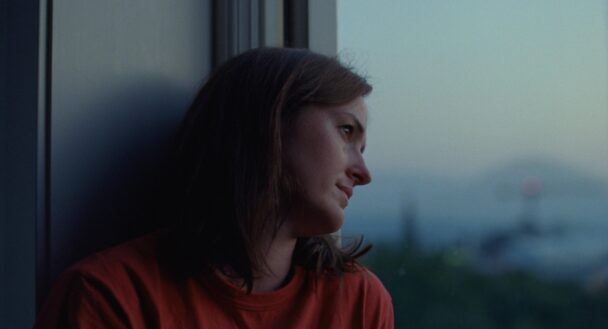
Exclusive: The Argus Interviews “Sentimental Value” Director Joachim Trier at Critic Colloquy

It’s shaping up to be a busy couple of months for Joachim Trier. The Norwegian filmmaker has been working for almost 20 years at this point, but from the reception to his last couple of films, you might not know it.
“The Worst Person in the World” was greeted with a sort of where-did-this-come-from awe in large part because of Renate Reinsve’s revelatory performance at its center, for which she won the Best Actress Award at Cannes. Reinsve and Trier were back at Cannes this year with “Sentimental Value,” which won the Grand Prix and immediately became one of the most acclaimed films of the year, with particular love for a career victory lap performance from Stellan Skarsgård. I abstain from Oscar prognostication on principle, but the film is poised to be a major threat.
In spite of what must already be a very involved press run, Joachim Trier and his recurring co-writer Eskil Vogt sat down for a roundtable discussion with student journalists from across the country to answer questions about the film, which I got to see early at the Wesleyan Film Series on Nov. 8, courtesy of distributor NEON’s ongoing involvement on college campuses. At the generosity of NEON campus ambassador Sam Birtwistle ’28, I was lucky enough to participate in the roundtable, which offered a far reaching discussion of Trier’s process, the film’s themes, and what makes “Sentimental Value” distinct in the filmmaker’s oeuvre.
Right off the bat, Trier and Vogt were a strikingly generous and personable duo, giving extremely involved, thoughtful answers after going out of their way to express their appreciation for student publications.
“Just to say first, thank you all for wanting to meet us and talk to us,” Trier said. “We appreciate it. Eskil and I are big fans of university newspapers. We always like Universitetet, the University of Oslo, and I think we’ve done it endless times, and we really think it’s good to communicate with sort of the next generation of intellectuals.”
Intellectualism, it should be said, is a topic much explored in Trier’s cinema. Even as he takes aim at broader issues, his characters are always well-read and well-versed in cinema, with bookshelves to be envied (not unlike the one over Vogt’s shoulder in the Zoom window). The gap between his characters’ intellectual or artistic pedigree and their ability to know one another—or themselves—is a recurring theme, one which reaches its most personal iteration in Gustav Borg, Skarsgård’s character in “Sentimental Value.” Gustav is a successful filmmaker who makes works of art out of his family history, yet fails to communicate with his living kin.
“We want these characters to be great at what they do, and therefore the drama of both Gustav and [Reinsve’s character] Nora—who are actually such similar characters, even though they don’t know how to communicate—becomes so much larger when you see that they’re actually doing good in their art and their creative work and that they have such a difficult time finding connection in their private life in terms of creating a home,” Trier said.
“Here was someone who could be very sensitive and communicate a lot of nuanced emotions and complexity in his films, but in life, he didn’t have that language,” Vogt said, adding on to Trier’s thoughts about Gustav. “He didn’t have that way of speaking to people, especially the people closest to him. That was true to a lot of men and artists of his generation. So we felt that was a fascinating thing to explore.”
By Trier’s own admission, the film deals with grander issues than his work has to this point. Parental relationships, sibling relationships, generational trauma, and the ethics of autobiography swirl around the film with a heavy dose of meta-fictional commentary on the state of the film industry. These topics could yield great depth, but they also threaten to take Trier away from the specificity that makes films like the terrifically underrated “Oslo, August 31st” special. Trier was keenly aware of this challenge.
“We’re out on a limb a bit, because we are trying to do something [both] simple and complicated at the same time,” he said. “We want to talk about the fundamental things in the family, but we’re trying to do a formal, entertaining film where [we explore] the polyphonics of having all these different characters and trying to see if we can draw one story out of so many character journeys parallel with each other.”
“It’s been such a pleasure to see how universal these kinds of stories are,” Vogt added. “The more specific we get about living in this kind of family in Oslo in Norway today, the more people seem to relate. You know, it’s not like you have to make abstract generalizations to communicate. Quite the opposite, you find that details communicate.”
The America of it all is, of course, something Trier needed to wrestle with too: “The Worst Person in the World” was as symphonic a representation of Oslo as Woody Allen attempted with “Manhattan,” so to have an American star (Elle Fanning) take up so much space in the film—and to force so many scenes within it to be spoken in English—threatens to dilute one of Trier’s principle talents. The filmmaker insisted that this was a misunderstanding of the film and of Fanning’s role in it.
“I know some people interpret the fact that Elle Fanning’s character comes and she doesn’t quite fit in to be about culture,” Trier said. “I would suggest that an American actor like Elle, by proof of her performance in ‘Sentimental Value,’ [proves] that she can actually be wonderful in a Norwegian film. So it’s not about culture, it’s about the personal stories of a very complicated family dynamic with a father who is longing to connect with his daughter and poor Rachel Kemp—Elle’s character—dropping into the middle of that and feeling that maybe she’s a little bit out of her depth. So I feel in a way that ‘Sentimental Value’—this is very meta what we’re talking about here—proves that we can have great collaborations across even language barriers.”
Trier pointed to an adoration for Hollywood filmmaking as a part of his formation, and he noted that this appreciation that has never left him as a filmmaker. Vogt even emphasized this point by grabbing two books from his bookshelf to emphasize the breadth of their taste: a book about Jean-Luc Godard and a memoir by “Showgirls” screenwriter Joe Eszterhas called “Hollywood Animal.”
When it was time for me to ask a question, I was primarily interested in how Trier’s relationship with actors has developed over the years. He first worked with Renate Reinsve in a bit part in “Oslo, August 31st,” and that film’s star, Anders Danielsen Lie, had a major role in “The Worst Person in the World” and a minor role in “Sentimental Value.” I asked how his collaboration with actors is different when he’s worked with them before and if he developed any shorthand with those actors on the prior films.
“It’s great for Eskil and me to know that we write for someone,” Trier said. “We have written for Anders and Renate both in the latter films that we’ve done. They don’t have to go through testing anymore. It’s rather a gift that they exist and we shape characters around them, knowing their abilities, knowing how wonderful they are. Those two actors are really special to me. I feel they trust me, and they open up. I kind of learned to be a director working with Anders and I kept developing it with Renate. They know that we are trying to create life in front of a camera and that we need, at some point early [on], to intellectualize and plan and discuss everything. But then at some point, it’s just trying versions and trusting me to choose the best material that ends up in the final film.”
To see a 24-year old Reinsve in “Oslo, August 31st” is to see the beginning of one of the most promising talents to emerge in the last few years, and to see Anders in “Sentimental Value” is to see the lost kid from Trier’s early work at peace, his winning smile making up for any lack of screen time. There’s an even more important cameo from “Oslo, August 31st” in Trier’s latest, too: The house whose entire history is given to us through montage, and which much of the film’s action takes place in, is the very same one from the end of that prior film. Eerily, Trier repeats the exact same camera move through the exact same hall. It’s not the sort of meta-moment that the film advertises, but it sticks with me in light of what Trier said at the end of answering my question.
“Film as a medium has this great capacity of recording events in time,” he said. “That’s what it is. So to see [Anders and Renate] age, to see ‘Reprise’ or ‘Oslo, August 31st,’ our early work, and see Anders as a very young man, and now [see] him [as] more of an adult, it’s kind of a fascinating thing. It’s as if we’re watching time move through people’s lives.”
Louis Chiasson can be reached at lchiasson@wesleyan.edu.




Leave a Reply