

Blood Spills and Darkness Reigns in Spike Tape’s “Little Shop of Horrors”
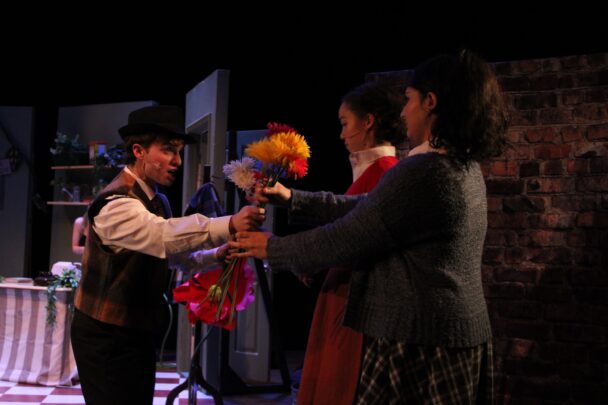
What takes two people and four arms to puppeteer? A murderous plant, of course.
On Friday, Nov. 21 and Saturday, Nov. 22, the Patricelli ’92 Theater came alive with song and dance as Spike Tape staged a production of “Little Shop of Horrors.” The fan-favorite musical portrays a carnivorous plant that feeds on human flesh and the flower shop employees who are instrumental to its survival.
The show follows Seymour (Zesun Hossain ’28), a “twerp of a klutz,” who works at his father figure Mushnik’s (Sasha Cohen ’29) struggling flower shop on Skid Row. After Seymour realizes one of the botanical experiments in his basement could be a good lure for customers, it quickly becomes a lucrative item…and a way for him to get the girl. The girl in question is his coworker Audrey (Gracie Halverson ’28), whom the plant, Audrey 2, is fittingly named after. As Audrey 2’s bloodlust grows, the demand for (human) sacrifices to appease it becomes greater and greater.
At this point, the show probably sounds incredibly grim. This is by design, as director Emma Somol ’27 wrote in her director’s note.
“While there is no doubt that ‘Little Shop of Horrors’ is a fun, campy musical, I have seen far too many productions that treat its darker themes too lightly,” Somol wrote. “I want to remind the audience that at its core, this musical is a tragic, grisly tale of greed, obsession, and malevolence.”
This focus reverberates throughout the show. Hossain portrays Seymour’s charmingly bumbling exterior with a compelling nervous energy, but also nails the character’s deeply unlikeable moments with a malice that reveals Seymour’s true self. Halverson’s Audrey wears her pain for the world to see; though her black eye and bandaged arm are far from subtle, Halverson’s performance adds new layers of hurt and hope to the tragic character. Even the set design, by Jordan Schwarz ’26, makes it clear that while the characters work in a cute, colorful flower shop, they are still on Skid Row, with dilapidated brick walls and an Oscar the Grouch–esque trash can right outside.
It is not all doom and gloom, however. The actors’ performances give the show an infusion of energy and, at times, levity. The show is a comedy after all, and the entire cast rises to the challenge. Harry Resnik ’28 was a consistent scene stealer not just as Orin, Audrey’s sadistic dentist boyfriend, but in his myriad other roles, which included an overly enthusiastic customer, a magazine editor, and more. Cohen’s Mushnik moved with an inherent musicality, dancing with ease and enthusiasm through his high-energy songs. Ronnette (Ayomide Alao ’29), Crystal (Flora White ’28), and Chiffon (Aryia Banihashem-Ahmad ’28) shone as the downtrodden chorus, a group of opportunistic beggars whose synchronized song and dance bring moments of humor and tragedy. In the showstopping number “Somewhere That’s Green,” Halverson’s Audrey envisions a hopeful suburban future, a dream of toasters and plastic-wrapped furniture that feels far from her reality as the abused girlfriend of an evil biker dentist. Hope is not out of reach, despite the characters’ grim realities.
The biggest, and perhaps most important, performance was the dual portrayal of Audrey 2. It took two people and four puppets to embody one murderous plant. Audrey 2 was voiced by Ola Oladitan ’28 and puppeteered by Kitty Edwards ’28. As Seymour gathers more flesh to feed Audrey 2, it grows and grows until its vines overtake the humble flower shop.
For Edwards, this growth meant she had to work with increasingly large puppets, including the final two iterations of Audrey 2, which she described as requiring “full-body engagement.” As her vine-covered legs kicked out from their potted-plant perch, it was clear that Audrey 2 had truly become a force of nature. Oladitan’s vocal performance was equally lively, as his voice rang out deep, otherworldly, and primal.
While the show’s subject matter invokes humanity’s worst, this iteration’s origin is one of connection and community. Somol was inspired to pitch the show after Xzabian Ramiz, a Public Safety officer who was called to unlock a performance space during a tech week her freshman year, told her that “Little Shop” was his favorite show. She wrote in the director’s note that: “If not for him, I may not have pitched the show or even directed at Wesleyan.” In a fitting full-circle moment at the end of the invited dress rehearsal, stage manager Micah St. George ’29 revealed that Ramiz was in the audience.
Unlike the musical’s group of downtown misfits, the audience got a happy ending.
Abby Slap can be reached at aslap@wesleyan.edu.



Leave a Reply