
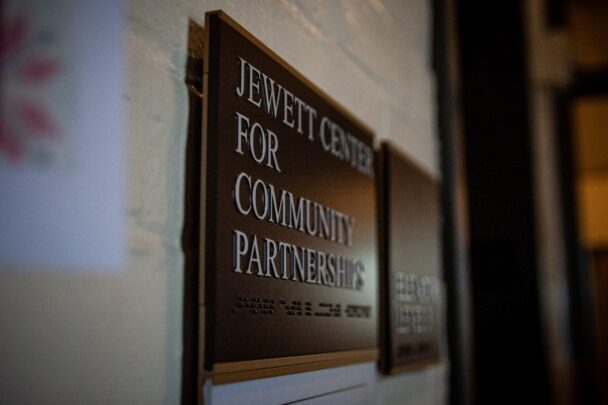
Inside the JCCP’s Budget Reckoning: How Miscommunication and New Systems Led to Years of Overspending
After years of unaddressed overspending, the Jewett Center for Community Partnerships (JCCP) has become embroiled in a conflict between student organizers and University administrators over the future of its budget. The JCCP administers the work of over a dozen student-run, community-facing organizations, many of whom rely on the center to pay for student coordinator and worker positions. However, according to University sources, the JCCP overspent its discretionary budget by roughly $60,000 in the 2023–24 academic year and $180,000 in the 2024–25 academic year.
This semester, in an attempt to balance its budget, the JCCP cut student employment hours across its affiliated programs. The University has insisted that the JCCP must operate within its means; student organizers have argued that the cuts endanger Wesleyan’s relationship with Middletown.
The Argus spoke to several current and former University administrators who have ran or overseen the JCCP, including University Provost and Senior Vice President for Academic Affairs Nicole Stanton, Executive Director of the Allbritton Center for the Study of Public Life Khalilah Brown-Dean, former JCCP Director Cathy Lechowicz, and former JCCP Associate Director Diana Martinez ’07 MA ’19, to understand how the JCCP’s funding conflict developed.
Current and former administrators and student organizers said that the budget crisis emerged due to several factors, including the implementation of new financial software, a staffing shortage within the JCCP, and a major change to the University’s budget policy for departments, all of which led to decreased oversight of student employment funding.
Today, with no indication of a University-level reevaluation, the conflict is at an impasse; President Michael Roth ’78 has said that the University will not consider an increase to the JCCP’s discretionary budget. While the Allbritton Center, housed under the JCCP, has insisted it is willing to engage in substantive conversations with student groups to develop a path forward, many student organizations have said that the approach is not sufficient.
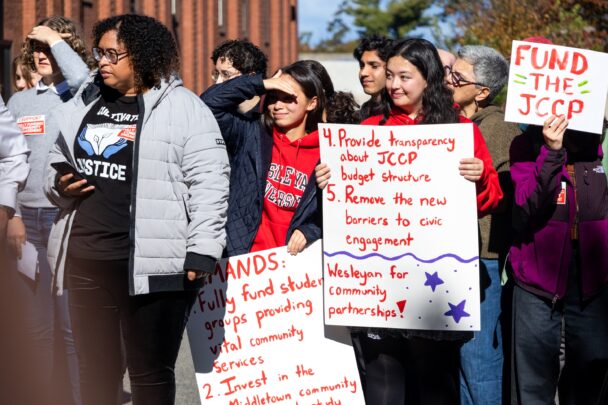
As frustration has grown, the leaders of several affected organizations formed a coalition called Stop the JCCP Cuts and circulated a petition calling for an increased JCCP budget. On Saturday, Oct. 25, over 100 students, alumni, and Middletown residents attended a protest outside of North College to decry what they saw as a blow to the relationship between Middletown and the University. Multiple elected Middletown officials attended the demonstration, including Mayor Gene Nocera and Common Council member Vinnie Loffredo.
Director of the Jewett Center for Community Partnerships Clifton Watson repeatedly declined to comment on the organization’s budgetary difficulties, instead referring The Argus to University Communications.
A Cornerstone for Civic Engagement
Founded in 2003, the JCCP—then known simply as the Center for Community Partnerships—transitioned from an amalgamation of community-facing University offices to serving as the University’s primary conduit between Middletown and Wesleyan-run community initiatives.
Lechowicz says that the JCCP’s prominence today stems from the work of Professor of Sociology Emeritus Rob Rosenthal, who served as University provost from 2010 to 2013, and later as the director of the Allbritton Center.
Lechowicz, who directed the Office of Community Service and Volunteerism—one of the offices that would eventually fold into the JCCP—from 2003 to 2011, succeeded Rosenthal, becoming the Center for Community Partnerships’ director in December 2011.
In 2016, the Center for Community Partnerships was renamed in honor of Ellen Jewett ’81 P’17, a former University trustee and co-chair of the Patricelli Center for Entrepreneurship.
Both Lechowicz and Martinez, who worked for the JCCP from 2013 to 2024, said that student employment had long been a cornerstone of the JCCP and its predecessors’ work.
“From the time that I started in 2003, the vast majority of the budget was work-study,” Lechowicz said.
Martinez said that student employment was such an important aspect of the office’s budget that the JCCP would often transfer other discretionary funds into the student employment pool.
“We would collapse other budgets into student payroll,” Martinez said. “We’ve collapsed professional development into it. At the end of the year, we would be spending the vast majority of our budget on student payroll and transportation costs.”
While a portion of student payroll came from the JCCP’s budget, a significant amount was subsidized through the federal work-study program—which covers half the cost of employment for eligible students—and other grants. Until 2024, Martinez said, student payroll began with the JCCP, which would first pay students out-of-pocket. The University would then reimburse the JCCP for the allotted work-study hours.
Accounts of the JCCP’s total student employment budget vary. While the University declined to share the details of the JCCP’s operating budget for the current or past academic years, Martinez and Lechowicz provided The Argus with estimates.
Lechowicz said that before she left the JCCP in 2017, the Center’s budget for student employment remained consistent around $20,000 per year. According to Lechowicz, 75% of the JCCP’s student employment cost was subsidized by a mix of federal grants, including federal work-study. Therefore, the JCCP under Lechowicz functionally provided student organizations with $80,000 in hourly wages per year.
“The way that it was structured when I was there, only 25% of the students’ wages actually hit our budget line,” Lechowicz said.
Martinez estimated that in the 2023–24 academic year, the JCCP’s student employment budget was around $120,000.
In the years between Lechowicz’s departure and the JCCP’s 2022–23 budget overage, Martinez says that it was a regular practice for the JCCP to go over budget due to hiccups in the work-study reimbursement process. These issues included students exceeding their work-study allotments, students holding employment in multiple JCCP-funded groups, and simple accounting errors. Martinez said that when the JCCP exceeded its budget, the University’s Finance office would require a detailed explanation of the overage, but they consistently approved funding to balance the Center’s budget.
Brown-Dean denied that the JCCP had any significant budget overages before the 2022–23 academic year.
“I don’t think it’s true,” Brown-Dean said. “I can’t imagine a scenario where a significant overage like that would have just been [allowed to] continue.”
Investigating the Budget Conflict
Whether or not the JCCP historically went over budget remains a point of contention; The Argus could not obtain data to prove or disprove this claim. However, University sources did acknowledge that the JCCP went over budget by $5,000 in the 2022–23 academic year.
Stanton said that following the first budget overage, the University didn’t seek stringent corrective measures.
“It was to a much smaller degree,” she said. “That was easy…. We bailed them out. We absorbed it, and we said, ‘You can’t do this again.’ And lo and behold, not only did it happen again, [but] it happened to a much larger degree.”
In the 2023–24 academic year, University sources said that the JCCP exceeded its student employment budget by $60,000. This would equate to almost 3,700 extra student employment hours, which Martinez estimated would have meant the JCCP had hired roughly 75 additional student workers. Despite the budget overage, Martinez said that the JCCP had not seen a significant influx in student employment that year.
To explain the errors, both Martinez and the University have pointed to the lack of accounting on the implementation of the software Workday, a program meant to streamline onboarding, human resources, and payroll processes at the University.
“The tracking didn’t go the way that it was supposed to go,” Stanton said. “No one was monitoring closely what students were documenting and how they were documenting their hours of work. By the time the end of the year came, we weren’t going to ask people for money back.”
But budgeting for the JCCP only became more extreme as years passed. According to University sources, in the 2024–25 academic year, the JCCP overspent by $180,000.
The University declined to give additional details of this overage, but according to a student employment database obtained by The Argus, the JCCP employed roughly 250 students in the 2024–25 academic year. Multiple student groups said that they were able to hire significantly more student workers than in the past, particularly in the Spring 2025 semester.
“I feel like we had our peak employment last academic year,” Traverse Square Coordinator Remy Fu ’26 said. Traverse Square, which provides tutoring and after-school services to children residing in the Traverse Square housing project, is one of the largest recipients of JCCP funding; in the 2025–26 academic year, it receives almost one-third of the JCCP’s student employment budget.
But on top of the expansion of JCCP-funded organizations, both students and administrators corroborated that the overspending was the result of several systems not functioning as intended.
Firstly, administrators said that there still were significant problems with the implementation of Workday, leading to incorrect reports, poor tracking of student hours, and lapses in communication between staff.
Secondly, according to Martinez, in between the 2023–24 and 2024–25 academic years, the University changed its budgetary policy for departments. Instead of the back-and-forth “reimbursement system” that JCCP staff had grown accustomed to, where the JCCP would be reimbursed after they paid out of pocket for funds covered by work-study and other grants, the University told the JCCP that for the 2024–25 academic year, it would receive a firm slate budget inclusive of the work-study reimbursement. Martinez said that when the University came back to the JCCP with its set budget for the year, something had clearly gone wrong.
“I don’t know what measurement they used to calculate it,” she said. “But when they spit the number back, it was woefully low.”
Martinez told The Argus that she raised her concerns at the time with JCCP Director Clifton Watson, telling him that the JCCP would very likely go over budget again in the 2024–25 academic year.
The third issue was a personnel problem. The University controversially fired Martinez in November 2024, leaving the role of associate director vacant in the midst of the JCCP’s biggest funding lapse yet.
“I think the reason for overspending is a lack of any oversight,” Traverse Square Coordinator Maya Nelson ’27 said. “Student payroll was hardly monitored at all, especially last spring, so a ton of errors went through.”
Stanton explained that even though problems with the JCCP’s spending were apparent in the midst of the academic year, it was difficult for the University to take action until summer 2025, when student employment would slow.
“Once you notice that there’s an issue, what do you do about that?” Stanton asked. “Would it be appropriate mid-semester to say, ‘You know what, no one else can work for the rest of the semester?’”
On Tuesday, Aug. 12, recognizing that it needed to significantly roll back student employment hours, the JCCP formally reached out to student organizations. The JCCP told the groups that each would be limited to a set number of coordinators (two) and student employees (eight).
“The timing of these changes…has left little time to plan or adapt, and created financial uncertainty for many coordinators who rely on these positions as a primary source of income,” the leaders of Traverse Square, Adolescent Sexual Health Awareness (ASHA), and the Wesleyan Doula Project wrote to the JCCP’s leadership.
After weeks of back and forth, the JCCP agreed that instead of limiting positions, it would create an organization-wide cap of 7,500 paid student hours for the 2025–26 academic year. While there was no strict hour cap in the 2024–25 academic year, student coordinators have said that the new limit was effectively a cut of over 50%.
Since the new hour cap was implemented, student organizations have struggled to manage a workload similar to last year with less than half the paid staff.
Traverse Square said that it had to cut its paid staff by almost 70%. In Spring 2025, the organization had 59 students on its staff, with 45 work-study employees; this semester, that number is down to 28, with only 13 on work-study.
Cardinal Kids, which teaches after-school classes at multiple Middletown elementary schools, said that the organization could not remain viable under the current hour cap.
“We went from having a really robust coordinator team,” Cardinal Kids Coordinator Isaac Platt Zolov ’26 said. “We had one person dedicated to coordinating the schools, one person dedicated to gathering all the forms, one person dedicated to doing outreach, and one person dedicated to coordinating with the JCCP.”
Platt Zolov said that Cardinal Kids went from having five coordinators to two, a number that was unsustainable for the organization, leading to the group postponing their programming until next semester.
Next Steps for Affected Student Groups
Roth, Stanton, and Brown-Dean have maintained that while the University is willing to work with student groups to develop a path forward, there will be no University-level reconsideration of the JCCP’s budget, a move that would be necessary to implement a higher hour cap.
“I think that the JCCP is just going to live within its budget,” Roth said. “Some clubs pay people for being part of the club, and some clubs don’t, and I think a lot of clubs are robust without paying people.”
“There’s both student employment and support for student engagement beyond employment, so that there are multiple pathways for students to pursue those interests,” Brown-Dean said.
Stanton emphasized the importance of continued conversation with students.
“I’m very interested in a dialogue with the students, [but] a dialogue with the students doesn’t mean that I have spare money,” Stanton said. “We have constraints, just like everybody, but we’re committed to working with students and providing them with these kinds of opportunities.”
According to multiple student organizers, a cohort of JCCP-affiliated organizations met with Stanton on Wednesday, Nov. 19, during the Provost’s office hours.
“[Stanton] did apologize for the lack of communication last summer about the changes with the JCCP and she did express that going forward, she wants there to be more communication,” Traverse Square Coordinator Liana Lansigan ’26 said.
Fu, who was also in attendance, said that he saw increased communication as a net positive, even if it wouldn’t affect the University’s stance on the JCCP’s budget.
“I at least want to be in the room where conversations are happening,” Fu said. “I think being there is better than not being there when decisions are being made about our programs. That doesn’t mean I’m going to like the decisions, but I’d rather know about them.”
Miles Pinsof-Berlowitz can be reached at mpinsofberlo@wesleyan.edu.
Akari Ikeda can be reached at aikeda@wesleyan.edu.


Leave a Reply