
Michael Steinberg ’83: Wesleyan Activist Turned ACLU Lawyer and UMich Law Professor

Michael Steinberg ’83 is the director of the Civil Rights Litigation Initiative at The University of Michigan Law School. Prior to joining the faculty at Michigan Law, he was the legal director of the Michigan chapter of the American Civil Liberties Union (ACLU) for 22 years.
But years earlier, he came to Wesleyan from a small town in Maine. Steinberg said the school gave him a greater understanding of what it meant to pursue justice.
“I had a political awakening when I came to Wesleyan,” Steinberg said. “I felt strongly about justice, but I was not very aware of social justice movements. Wesleyan was transformative for me. I never would have been an ACLU lawyer had I not gone to Wesleyan.”
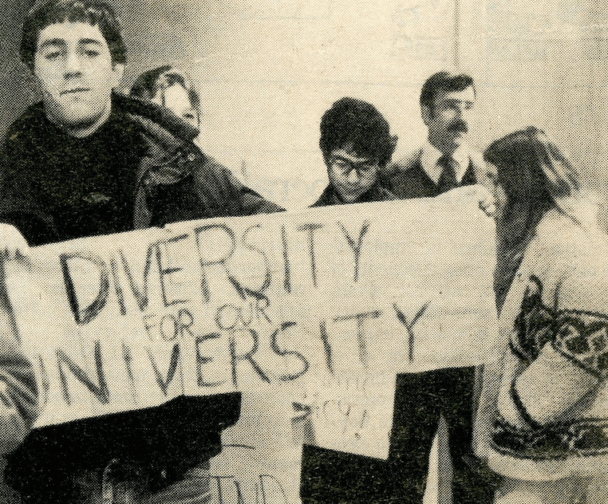
In his sophomore year, Steinberg got involved in the anti-nuclear and peace movements gaining steam amidst the backdrop of the Cold War. Along with a friend, Danny McCormick, Steinberg transformed Wesleyan’s Nuclear Resistance Group, a student-run club focusing primarily on nuclear energy, into an organization dedicated to stopping the nuclear arms race between the United States and the Soviet Union.
“This group grew,” Steinberg said. “We had 40 people at our weekly meetings, worked on having conferences and ballot initiatives at the University, and even brought three buses of people to Washington D.C. to lobby for an end to the nuclear arms race.”
Following his graduation from Wesleyan, Steinberg spent time at Oakwood Friends School, a Quaker boarding school in New York, where he taught history and coached and advised the school’s nuclear disarmament committee. He moved to Michigan when his wife, also a Wesleyan alum, was accepted to graduate school in Ann Arbor.
After earning a law degree from Wayne State University Law School in 1986, Steinberg worked as a solo practitioner focusing primarily on civil rights cases. His biggest private practice suit involved a police misconduct case in Ann Arbor. Police officers, who suspected that a Black man was behind a serial rape spree, established what Steinberg described as a “dragnet” to attempt to coerce as many Black men as possible to give blood for DNA testing.
“They eventually caught the rapist, not through this DNA dragnet, and then they refused to return the blood samples to 162 people who, either through coercion or voluntarily, gave blood,” Steinberg said. “So we sued to get the blood samples back, not just for our client, but for everybody, and to get a ruling that this, this racial profiling, was unconstitutional. There was just a documentary that came out about the case.”
In 1997, Steinberg joined the Michigan ACLU as their legal director, where he litigated numerous cases, many of which reached the United States Supreme Court.
“I was probably at the Supreme Court eight times,” Steinberg said. “I wasn’t arguing, but I kind of put the case together, and I was often at the counsel table. The first one that I was involved in was Grutter v. Bollinger in 2003, when the ACLU, the national and state chapters, and the NAACP intervened in an affirmative action lawsuit against the University of Michigan that was brought by two white applicants. We intervened on behalf of 17 Black and Latino high school seniors who had the most to lose if affirmative action was abolished. When that went up to the Supreme Court, we had a pretty good result. Affirmative action was saved.”
In June 2023, the Supreme Court in the cases Students for Fair Admissions v. University of North Carolina and Students for Fair Admissions v. Harvard, struck down race-based affirmative action in college admissions as unconstitutional.
Steinberg also won a case under the Americans with Disabilities Act, in which a child with cerebral palsy was prohibited by her school from bringing a service dog with her, despite having a doctor’s recommendation.
“The school was not allowing the service dog,” Steinberg said. “We thought, ‘This is silly, we’ll take care of it with a letter.’ It ended up going all the way to the U.S. Supreme Court, and we won that one, eight to nothing.”
Following a long career at the ACLU, Steinberg joined the faculty at the University of Michigan Law School seven years ago. Seeing a lack of a civil rights clinic at the law school, he proposed the idea, and the school agreed to establish one. The school chose Steinberg to lead it.
“It’s a dream job. I work with students who have come to law school to make a difference, and they want to do civil rights or some sort of public interest work, and we are able to work on some important cases while they are in law school,” Steinberg said.
At the Michigan Law Civil Rights Litigation Initiative, Steinberg said the most important case that he worked on dealt with a Black man who was arrested by the Detroit Police Department using facial recognition technology, which is notoriously bad at recognizing people of color.
“We sued on behalf of the wrongfully arrested man and got a great result, a really amazing settlement as well as a protective policy that will ensure this technology is not misused and will not lead to additional wrongful arrests,” he said.
After Roe v. Wade was overturned, Steinberg sued to strike down a so-called zombie law that sprung back into effect, which re-criminalized abortion in Michigan. “We challenged the 1931 law, working with Planned Parenthood and the ACLU. We argued that law violated the Michigan Constitution, and we won,” he said.
When asked what advice he would have for Wesleyan students interested in a career in social justice, Steinberg had a simple answer: Call him.
“I have spoken to a bunch of Wesleyan undergrads who are thinking about going to law school, who want to do social justice work. Now, even with a Supreme Court that is hostile to civil rights, we need lawyers committed to making the world a better place. You can make a huge difference in people’s lives by doing public interest law,” Steinberg said.
Steinberg noted that there are many pathways for students who want to pursue a career in public interest law. “When you go into law school, you can very easily be sucked into a big corporate firm because the high salaries are tempting. But if you go with the goal of using the skills that you’re acquiring to advance social justice, it’s very rewarding,” Steinberg said.
For students who want to learn more about the Civil Rights Litigation Initiative, they can visit this page or watch this video.
Blake Fox can be reached at bfox@wesleyan.edu.





Leave a Reply