
Shasha Seminar Brings Roth’s “Dialogue for Change” to Campus With Speakers Across Ideological Spectrum
This weekend, the University hosted the first installment in a four-year initiative spearheaded by President Michael Roth ’78 to foster dialogue across political divides.
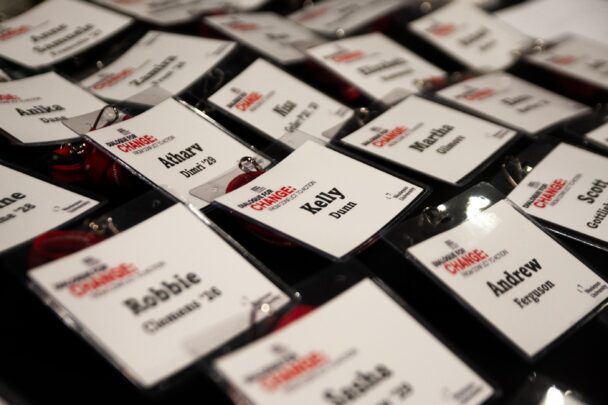
On Friday, Nov. 14 and Saturday, Nov. 15, alumni, faculty, and students gathered to attend the Shasha Seminar for Human Concerns, an annual forum for the Wesleyan community that includes a variety of panel discussions and workshops linked by a shared subject. “Dialogue for Change: From Conflict to Action” was this year’s guiding theme, and a string of noteworthy speakers came to campus to share their perspectives on where Americans have faltered in their ability to communicate with those with whom they disagree and what steps can be taken to alleviate the escalating challenge. The event drew more than a hundred participants.
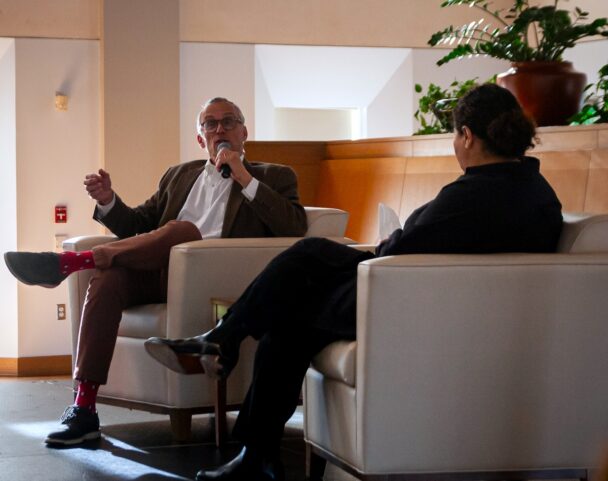
Eboo Patel, the founder of Interfaith America, a Chicago-based nonprofit organization that advocates for cross-faith conversations, kicked off the seminar with a Friday keynote speech.
“I did not want to just come here and give a talk,” Patel said, introducing his talk entitled “From Wokeness to Pluralism.” “I wanted to do something different, something a little risky, a little dangerous.”
Patel outlined the merits of pluralism, a concept that prioritizes the division of power between different factions, positioning it opposite to the “woke” status quo of higher education, which he suggested was driving Americans historically aligned with the Democratic Party away from it.
“The demographic group that drives [wokeism] is white, educated, wealthy, and speaks on behalf of other people’s identities,” Patel said. “I’m one of the people out there who doesn’t like it.”
Patel described wokeness as a battlefield that encourages viewing America as uniquely evil in its history of discrimination and dissuades national pride, punishing and pushing away Americans who do not agree with its representation of their lived experience. Instead, Patel argued, Americans should embrace the inherent plurality and diversity of America and encourage the equal distribution of power to facilitate cooperation, especially in university settings.
“You cannot do good intellectual work in homogenous environments,” Patel said, a thread which reappeared frequently in the following talks.
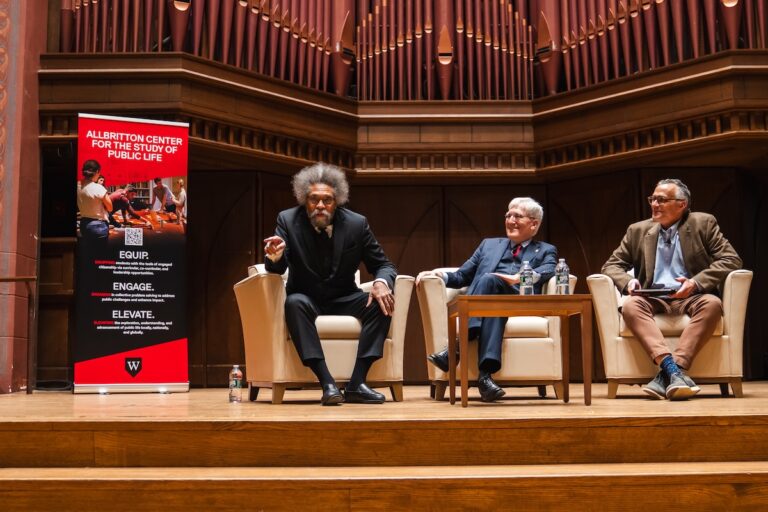
The sessions on Saturday morning opened with an address over breakfast by Anna Deavere Smith Hon. ’97, an acclaimed playwright and professor at New York University. During the open conversation, Roth and Smith reflected on the importance of critical art in institutional settings like Wesleyan, from their respective perspectives as a university president and as a playwright.
“I want to know how people are dealing with the discord or the conflict or the impossibility [of finding an answer],” said Smith. “I’m not interested in jargon. I’m not interested in academic fashion. I don’t want to know the answer.”
Smith also shared her observations on the continual fight for change in America and encouraged students to be more assertive in engaging in conversations with those who hold different views.
“Not everybody has the talent to [jump into conversations],” said Smith. “I think of us as living in safe houses of identity affiliations. Certainly our colleges are like that now. But among you and I, there are those who have a talent to come out of their safe house. It takes a risk because once you come out of that house of identity, you can’t necessarily go back, and you may not be welcomed somewhere else.”
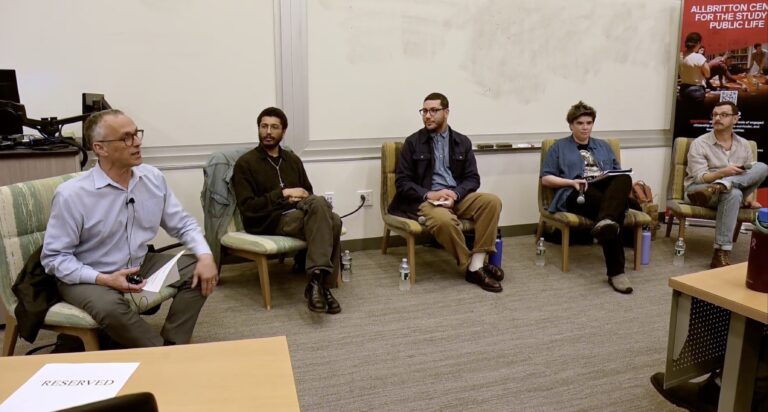
The alumni and faculty panel discussion that followed the keynote speech was centered around the theme of “Communicating Across Differences,” and it featured four speakers with backgrounds in political science, business, and policymaking: Joseph Bubman, the founder of Urban Rural Action, an organization building cross-partisan collaboration in communities; Bob Feldman, founder of Feldman and Partners, an investment firm; Scott Gottlieb ’94, Hon. ’21, a former United States Food and Drug Commissioner; and Professor of Government Erika Franklin Fowler. The speakers drew on their experiences in their respective fields to give advice on communicating more effectively when there are stark disagreements between parties.
“We [tend to] think that there are basically two choices,” Bubman said. “Either we can tell our neighbors all the reasons that we disagree with them, and we can prepare for the relationship to suffer and potentially end. Or, we can hold our views and resentment to ourselves. That is a false choice. None of us are born a good communicator across differences. None of us are born a good conflict resolver. It’s a skill that needs to be developed, practiced, and cultivated.”
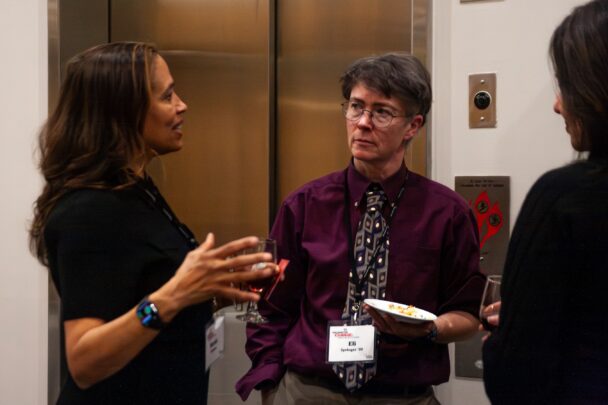
Attendees were then given the opportunity to choose from three seminars hosted by members of the Wesleyan faculty: “Considering Authority” by Assistant Professor of Government Hari Ramesh; “Storytelling for Change” by Executive Director of the Allbritton Center for the Study of Public Life Khalilah Brown-Dean; and “Sharing a Problem: Norms for Interpretation and Translation in Charged Encounters” by Associate Professor of Philosophy Elise Springer ’90.
Springer, who spoke on approaching situations of conflict through the lens of aikido, appreciated that she was able to give participants the opportunity to reflect on conflict resolution.
“The participants found it empowering and hopeful to have a chance to focus less on deciding between opinions in conflict and more on the process of recognizing one another as sharing the same challenge,” Springer said.
A second panel, “Building Community in Divided Times,” featured panelists Pearce Godwin, founder of Listen First Project; Richard Hollant, founder of design firm CO:LAB; Director of Religious and Spiritual Life and University Jewish Chaplain David Teva; and Eunice Lin Nichols, co-CEO of CoGenerate, who each offered personal anecdotes and perspectives on their work to bridge communication gaps between ideologically or demographically differing groups.
The day closed with a session in which participants were encouraged to reflect with each other on the seminar.
The “Dialogue for Change” initiative was started by Roth and Provost and Senior Vice President for Academic Affairs Nicole Stanton in an effort to encourage intellectual diversity among Wesleyan students.
“A friend said we should create a ‘seed bank’ for democracy, where you could have the opportunity to help practice democratic cultural forms during a period when democracy was under duress from the federal government,” Roth said in an interview with The Argus. “I thought that was a great way of thinking about it, even if, in other words, we are beleaguered or the world is inhospitable to these democratic practices. We can cultivate them here [at Wesleyan] because in the future, it might be a more propitious time for them.”
The emphasis on democratic practices stems from Roth’s reaction to the Trump administration’s recent attack on free speech on college campuses across the country.
“I spoke to Provost Stanton and Khalilah Brown-Dean about it, and they both were very excited,” Roth said. “Provost Stanton and a couple of faculty members were responsible for the content [of the seminar]. My input was to take the emphasis on civic engagement and public purpose that I’ve had for the last five or six years, at least, and find a way to exercise our democratic muscles, while the regime is so inhospitable to those efforts.”
Akari Ikeda can be reached at aikeda@wesleyan.edu.
Aarushi Bahadur can be reached at abahadur@wesleyan.edu.
Leave a Reply