
Office Hours: Artist-in-Residence Shinohara on Techniques, Teaching, and Freedom in Art
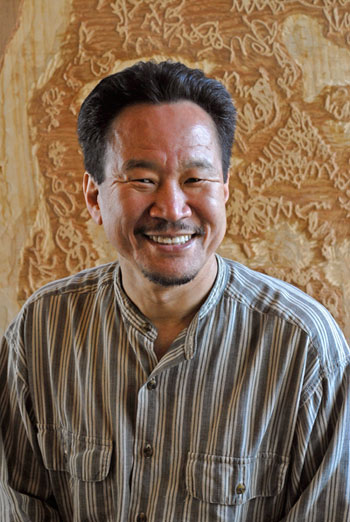
Keiji Shinohara is an Artist-in-Residence affiliated with the art studio major and the College of East Asian Studies. The Argus sat down with Professor Shinohara to talk about his decade-long apprenticeship in Kyoto, his philosophy regarding teaching in a liberal arts context, and how his practice continues to evolve over time and space.
The Argus: Would you say your main focus is woodcuts and printmaking rather than sumi-e [Japanese ink painting]?
Keiji Shinohara: My main focus is woodcuts. Sumi-e came into my life to support my [transition from using my] left hand to my right hand. I was left-handed, and then my teacher [for woodcuts] said, “No, you can’t be left-handed if you want to be a printer and learn woodcut techniques, because the tradition is [using your] right hand, not left hand.”
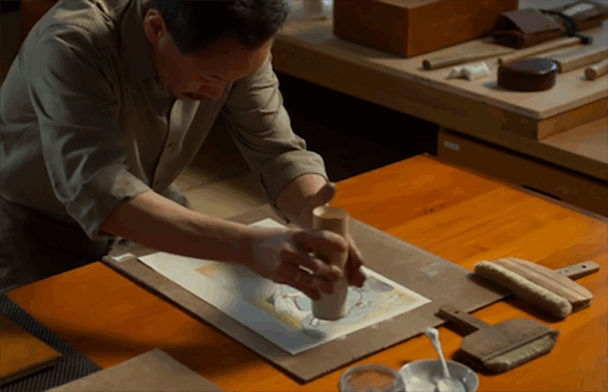
When you apprentice, you learn [from your teacher] for about five or six years. After [those] years, your teacher tells you that you are now a master. But even after becoming a master, you stay in the same workshop, sort of as a subcontractor, [and] you continue learning from your teacher, but it’s no longer like before when the teacher was paying you a salary. [For example,] my teacher would tell me, “Okay, why don’t you print this?” and for that job, whatever I made, he would give me 80% and take 20%. So for the first five years, he paid me without gaining anything; finally, when I became good enough to take on jobs, he started earning.
[My teacher] thought being left-handed would slow down my productivity, and that [we] might get a pay cut. A right-handed craftsman could finish a job in one week; because I was left-handed, it might take me ten days. That’s why he thought it would be better to start with my right hand. But he also thought just switching hands [in daily life], like using chopsticks with [my] right hand or throwing a ball with [my] right hand, wasn’t enough. He said I needed a much more sophisticated movement, so he thought it would be better to learn through sumi-e. He had a person he knew in the lineage of Maruyama Ōkyo, and that’s how sumi-e came in to support the transition from [predominately] using my left hand to my right hand.
A: What was your daily life like during your apprenticeship years?
KS: Those ten years of early training were very intense. I probably ate with my woodcuts and slept with my woodcuts. Every moment, everything was about woodcuts. On weekends, I would go see exhibitions—so many different shows, visiting galleries—and then come home and keep working. I think from around age 20 to 32, I was completely absorbed in it. I didn’t see anything else. I was reading a lot of books. I think all those things—the books, the exhibitions, the studio work with my teacher, and my own practice—came together to make me who I am now. I’ve never worked that hard since then.
A: What first drew you to woodcuts?
KS: I [didn’t] think that deeply when I first found [this practice]. It was more just curiosity [about] how they print, and also just, “Oh, wow, this is beautiful. I’d love to be able to do that.” So it was really shallow at first. I didn’t know much about Hiroshige or Hokusai [Japanese artists], and I don’t think I had ever seen traditional prints before. I mean, maybe I saw [pictures of] them in an art class or something like that in high school, but I had no clue what they really were. But when I started learning and practicing with my teacher, it became much, much deeper. It just amazed me . . . And then maybe two or three months later, I thought, “Oh my god, this is too difficult. I might quit.” I was always thinking about how to quit! But somehow I just kept working on it. And then, you know, ten years later, I [became] a master.
A: What is your favorite subject when you’re doing woodcuts?
KS: I think [when] I was around your age, I was really into American abstraction: It [was] everything. Now, I’m doing more landscape work, but back then, if you were doing landscapes, people would think you’d sold your soul. They’d say, “Oh, you’re just doing that for money, it’s not pure art.” But what is pure art? At that time, in the late ’70s, avant-garde abstraction was everything. It was very hyped. Everybody was doing it, so I was, too. I had compositions with [traditional] images, but I had to destroy them because that was what was cool, [and] I did that abstract work. But when I came to the United States, things slowly opened up for me. I started thinking, “Why do I have to destroy? Why can’t I celebrate?”
I also struggled with technique. I had too many techniques. I used my technical skills when I worked with other people, but in my own work, I didn’t want to rely too much on technique. I wanted it to be more about the image, about what the audience feels. So I started doing bigger works, and those were very challenging because my techniques weren’t really made for large-scale prints. But I kept trying.
Little by little, I began to [question], “Why I am denying my techniques?” So I slowly returned to smaller [and more technical] works, and that’s when I started doing a lot more landscapes. Also, my background was different. A lot of people went to college or got master’s degrees studying art, drawing, and different media. But when I was [in my twenties], I only knew woodcuts. That’s it.
But over time, I opened up more. I started drawing, doing more sumi-e work, and I began to feel like I could explore what I’m capable of. I used to think, “As long as I’m doing woodcuts, I’m the master.” I liked that authority. But when I tried something else, I couldn’t do it well. So now I’m more open. I struggle, just like you guys struggle too.
A: What made you decide to move to the U.S.?
KS: If I had [continued to] stay in Japan, I [would probably have] become a printer, not an artist. You probably understand the Asian mentality of “don’t do two things”: If you chase two things, you might fail at both. You probably hear your parents say, “Do well in one thing.” It’s the same idea. I was working as a printer, and at the same time, I was trying to make my own work. But people told me, “Why are you doing your own stuff? You never went to college to study this. You’re a printer, you’re a good printer, just focus on your printing.” But I just couldn’t do that. I can’t function if I’m only doing one thing. I needed to do both. That’s why I came to the United States.
A: I remember you bringing that same idea into the sumi-e class. When I first joined, I thought we’d be focusing strictly on traditional techniques, but by the time we got to the final, you encouraged us to do anything we wanted. Where do you see that openness in your teaching philosophy?
KS: My feeling is, art here at [Wesleyan] has a lot to do with the [open] curriculum, and this is not an art school. I will teach traditional movement, like traditional brushstroke or subject matter, but so what? You learn those, and then how are you using those techniques for your own idea? That was always my key.
It would be great if you draw pretty bamboo or [traditional] subjects; that’s great, but that’s not my goal. For you guys, the goal is to take those techniques, those brushstrokes, and use them for your own idea to make [your final] project: one with still life, [one] landscape, and whatever you want to do. If I teach the whole semester [with] just traditional [techniques], I don’t think it fits that kind of teaching here at Wesleyan. Go research [and] find your own interest in [the] subject matter. I think that’s what a real professor should push. You learn the traditional way, you get really good at it, but then you stop doing just bamboo. If you like manga, draw manga with sumi-e. If you like science, draw scientific stuff with sumi-e.
A: I know you’re going on sabbatical next semester. What are your plans for that time?
KS: [Mostly] work. Landscape has been my main focus. [But] until around 2012, almost everything I made was in my office or studio in the United States. Then in 2012, I had the opportunity to go to Florence, and I made [woodcuts] there. After that, in 2016, I was invited to Denmark, and I made prints there too.
Of course, my work changes depending on the environment or landscape. When you’re in a different place, you react to it differently. When I went to Italy again in 2022, I really enjoyed it, and my work changed again, how I used color, how I saw things.
So now, for my sabbatical, I’m going to travel to Scotland, Iceland, and Japan. I’ll have studios [I can work in] in different places and make prints there. I’m very excited to do that. I’m not young anymore; I don’t know how long I’ll be able to keep doing this kind of work. I hope for longer, but it depends on my health. I also want to keep doing my own work. This is my thirtieth year; I came to the University in 1995. It’s amazing. I thought I’d only teach for one or two years, but here I am, 30 years later. I’m just so glad [that] I’ve worked with so many wonderful, smart students. I never [formally] learned how to teach; I struggled a lot to figure it out, but it’s been a wonderful experience. I think students have helped me learn how to teach.
This interview has been edited for length and clarity.
Nancy Li can be reached at nli02@wesleyan.edu.
Leave a Reply