
Leslie Gielow Jacobs ’82 Reflects on Her Supreme Court Clerkship and Today’s Court
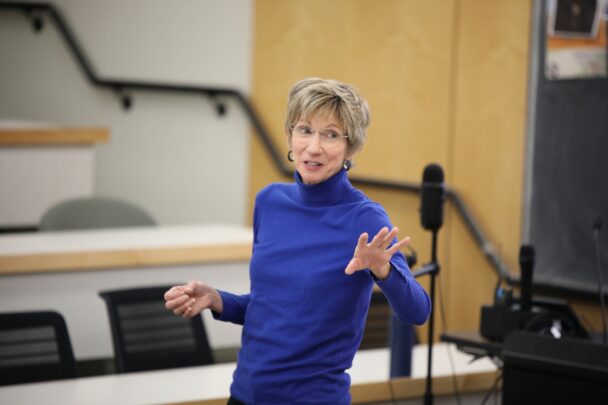
Leslie Gielow Jacobs ’82 is the Justice Kennedy Professor of Law at the University of the Pacific McGeorge School of Law. Prior to joining the law school in 1993, Jacobs clerked for Associate Justice Lewis F. Powell Jr. of the Supreme Court of the United States.
Jacobs attended Wesleyan University and double-majored in the College of Letters and government.
“The College of Letters had me spending a semester in Heidelberg, Germany,” Jacobs said. “I went to lots of plays there.”
As a student at the University, Jacobs did not intend to enter the field of law. Rather, she dreamed of becoming an international journalist.
“I wanted to be like Barbara Walters,” she said. “She was inspirational as a woman out there traveling the world and interviewing lots of people.”
However, Jacobs ultimately decided to pursue a legal career because of her strong skills in reading, writing, and reasoning. She attended the University of Michigan Law School, where she earned her Juris Doctor in 1985.
Following law school, Jacobs clerked for two federal judges: Louis F. Oberdorfer of the U.S. District Court for the District of Columbia and Lewis F. Powell Jr. of the United States Supreme Court.
“Clerking was fantastic,” she said. “In some ways, those are the best jobs I’ve had in my whole life. They were a wonderful combination.”
Jacobs noted that she particularly enjoyed clerking for Judge Oberdorfer because of the large number of his cases related to the federal government.
“We got a lot of interesting cases arising because of the government agencies. One had to do with [activist] Mitch Snyder, and he wanted to put up a display illustrating homelessness. We had a Soviet sailor jumping in New Orleans off a ship in an asylum attempt. [Oberdorfer was a] great judge to clerk for. He taught me all sorts of things.”
Jacobs then clerked for Associate Justice Lewis F. Powell Jr. of the United States Supreme Court, an experience that she said continues to influence her to this day.
“I teach constitutional law, and I bring insights from what I learned while I was at the Supreme Court,” Jacobs said.
She clerked for the Supreme Court in the October 1986 term, which was a pivotal point in the Court’s history for its jurisprudential shift to the right.
“It was interesting at that point in time. Justice [William] Rehnquist had been elevated to the Chief Justice, and then it was Justice [Antonin] Scalia’s first year on the Court. And I know this seems very long in the past, but these were the beginnings of the transformation that has now occurred on the Court.”
Speaking about the current Supreme Court, Jacobs questioned some of the Court’s recent decisions.
“I respect the judiciary,” she said. “The six justices in the majority have fairly uniform preferences and ways of interpreting. Justice Kennedy was a very stabilizing force. He was certainly conservative in various ways—ruling in favor of business interests and the First Amendment and election law—but then would be more socially liberal and [achieve] results that were more what Democrats would think would be their policy preferences. So there was a stability there, and people felt like there was at least a Supreme Court up there that was representing what we think. Now, that is just not true.”
Jacobs expressed skepticism that the Supreme Court will revisit its landmark precedent of Obergefell v. Hodges, which legalized same-sex marriage. Kim Davis, a former county clerk in Kentucky, is appealing a damages judgment to the Supreme Court on multiple grounds, including that Obergefell was wrongly decided.
“I do think that the momentum is not there to overturn Obergefell that was certainly there with Roe v. Wade. I mean the extraordinary fight that just went on and on and on and went on through state legislatures. That was one where they just did not stop fighting until they twice took it to the Supreme Court, asking for the right to be interpreted out of the Constitution. But again, I hesitate to predict.”
Jacobs offered this advice to University students considering a career in the law: “Think hard about it and make sure that is what you want to do. There are a lot of other careers out there, and just think about what you’re going to be doing, not just in law school, but day-to-day as a lawyer or as something else in academia. If that’s something that you really want to do, don’t give up the dream.”
Blake Fox can be reached at bfox@wesleyan.edu.


Leave a Reply