
Students Hold Memorial Service Honoring Israeli Lives Lost in Oct. 7 Attacks
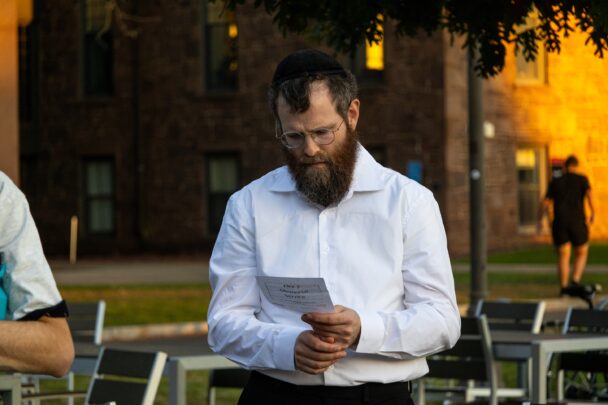
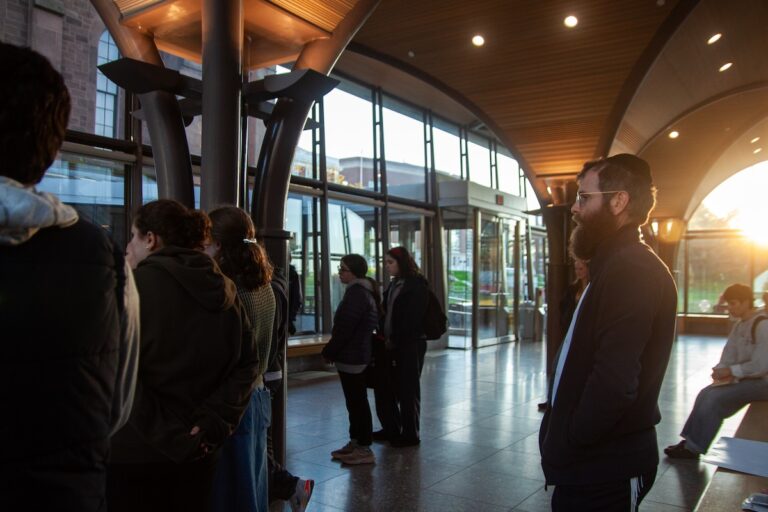
On Monday, Oct. 6, Students Supporting Israel (SSI) and Chabad at Wesleyan held a memorial service outside of Usdan University Center. Organizers told The Argus the service aimed to honor the victims of the Oct. 7, 2023 attack on Israel in which Hamas-led forces killed almost 1,200 Israelis, most of whom were civilians.
Since the attack, Israel has engaged in a protracted war against Hamas. The Israel Defense Force’s (IDF) military effort has killed over 67,000 Palestinians and destroyed the Gaza Strip’s infrastructure, leaving a vast majority of the Palestinians located in the territory vulnerable to famine. While protests against Israel’s conduct have swept the nation and the University campus, the memorial’s organizers were clear about its scope: to honor the Israeli lives lost in the Oct. 7 attacks, which they view as unprovoked and intentionally brutal.
The memorial, a relatively short affair attended by a dozen members of the University community, featured reflections and prayers from the students in attendance.
The event was attended by both Rabbi Levi Schectman, who leads Chabad, and University Jewish Chaplain Rabbi David Leipziger Teva. While both rabbis participated in the memorial service and prayer, the reflection portion was led by Gaby Sorin ’27, Aviva Schnitzer ’28, and Zachary Rosen ’27. Sorin and Schnitzer are co-founders of the University’s SSI chapter, and all three are members of the organization’s board.
SSI is a global nonprofit organization that aims to serve as a “clear and confident pro-Israel voice on college campuses and to support students in grassroots pro-Israel advocacy.” According to its website, it has over 200 chapters worldwide, and financially supports students’ outreach and advocacy initiatives.
Sorin said she and Schnitzer decided to establish an SSI chapter at the University after observing what she described as a lack of non-religious pro-Israel voices on campus.
“We didn’t want to be affiliated with a religion, even though we both are very proud Jews, because being pro-Israel isn’t necessarily about being Jewish,” Sorin said. “So that’s why we started SSI. We felt like there needed to be some sort of presence, because [Students for Justice in Palestine] has such a huge presence on this campus, and we felt that it was only fair to have something on the other end.”
While Chabad helped to advertise the memorial, it was primarily organized by SSI, Rosen said.
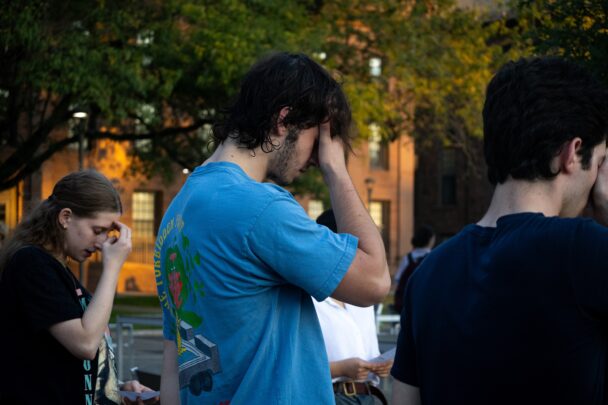
As attendees arrived, the organizers passed out pamphlets featuring four prayers, two of which were in Hebrew. The attendees recited Psalm 121, a common prayer in both Judaism and Christianity, and the Shema, a prayer recited daily by practicing Jews.
They also recited a “Prayer for Those in Captivity,” referencing the hostages taken by Hamas in the Oct. 7 attack. Over 251 Israeli civilians and soldiers were taken captive in the invasion, and while many have been released in sporadic ceasefires between Israel and Hamas, dozens have died in captivity. Today, there are 48 hostages still remaining in Gaza, of whom 20 are alive.
The memorial concluded with a reading of Oseh Shalom, a common prayer calling for peace.
Rosen told The Argus that he hopes SSI can expand its community on campus.
“We had challenges in making students feel comfortable attending a public October 7th memorial,” Rosen wrote. “We continue to build our community and [assure] students that we have a large community of pro-Israel students who believe in the right of a Jewish State and the existence of Israel.”
Sorin concurred with Rosen, saying that she created the University’s SSI to foster dialogue.
“We felt like we needed to start SSI to create a healthy discourse and a fair playing field,” Sorin said. “We wanted to show people that there are other perspectives.”
On Oct. 9, two days following the second anniversary of the attacks, Israel agreed to a ceasefire deal brokered by the Trump administration, which, in addition to dozens of military and political agreements, would require Hamas to release all of the remaining hostages. While the framework of a future peace treaty and governing agreement remains far from clear, both Hamas and Israel have agreed to take the first steps enumerated by the agreement.
Spencer Landers can be reached at sklanders@wesleyan.edu.


Leave a Reply