
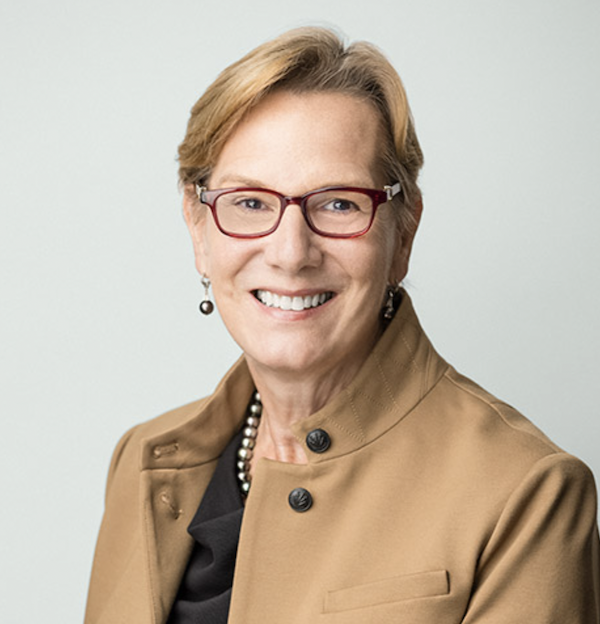
Katherine Forrest ’86 on Her Time as a Federal Judge, the Future of AI, and Wesleyan Memories
Katherine Forrest ’86 is a retired United States District Court Judge for the Southern District of New York and currently serves as a partner at Paul, Weiss, Rifkind, Wharton & Garrison, where she chairs the law firm’s Artificial Intelligence Group.
Forrest described her time at Wesleyan University as a “life-changing, very positive experience.”
“I was exposed to a world that was so politically aware and also not so large that I got lost,” she said. “There was a lot of activism at the time. It was the era of the anti-apartheid demonstrations. There were people who were living on the front lawn at Wesleyan on the street. One of my best friends was there, and so it was sort of an eye-opening, really important, informative experience for me.”
A women’s studies major, Forrest was also an athlete. She ran for the cross country and track and field teams.
During her time at Wesleyan, Forrest did not plan on becoming a lawyer. She decided to attend the New York University School of Law after being admitted to a program where she could pursue both a Ph.D. in history and a Juris Doctor.
“I really thought I’d be a professor, and law school was really a hedge against the financial vicissitudes that might otherwise come my way,” she said. “But I really thought I would become a professor of women’s history.”
Forrest spent 20 years at the law firm Cravath, Swaine & Moore, where she specialized in technology law and litigated some of the first and biggest cases involving internet copyright, including UMG Recordings, Inc. v. MP3.com, Inc., which addressed unauthorized duplication of copyrighted material on the internet.
After establishing herself as one of the nation’s premier technology litigators, Forrest was ready to become a federal judge. She submitted an application through her senator’s office, and with her record working for a top firm and amassing numerous achievements, she was eventually shortlisted.
“When President Barack Obama was first elected, he could not get any judges through Congress for the first nine months of his presidency, and so I went to the Department of Justice, where I worked in the Antitrust Division,” she said. “While I was there, I got a phone call. I had had my short list interview with Senator Chuck Schumer the year before, and he called and said, ‘Do you still want to be a judge?’ I said, ‘Yes.’ He said, ‘I’m announcing you tomorrow.’”
Forrest was nominated by Obama to be a district court judge for the Southern District of New York in May 2011 and was confirmed by the Senate in October.
While on the bench, Forrest decided many pivotal cases and presided over 104 trials, including the government’s prosecution of Abu Hamza, an accused supporter of Al-Qaeda.
In 2018, Forrest issued an opinion in Ragbir v. Sessions III, et al. The case concerned Ravidath Ragbir, an immigration activist who, upon being ordered to leave the country by United States Immigration and Customs Enforcement, was detained immediately by the federal immigration agency. The activist, a longtime resident of the United States, argued that the government was required to allow him to make personal arrangements before his deportation. In her ruling, Judge Forrest recognized the activist’s right “to say goodbye,” and made the unprecedented decision to read her opinion aloud to the courtroom.
“It ought not to be—and it has never before been—that those who have lived without incident in this country for years are subjected to treatment we associate with regimes we revile as unjust, regimes where those who have long lived in a country may be taken without notice from streets, home, and work,” Forrest said at the time.
“It was the only opinion I ever read from the bench,” Forrest said. “And I would say that’s a big moment.”
In 2018, Forrest left the federal bench and re-entered private practice at Cravath, Swaine & Moore.
“It was with great sadness that I left the bench,” she said. “I got divorced, and it was not something I had planned for, and I ended up having two children [to support] financially, where I needed to put them through college.”
Back at Cravath, Swaine & Moore, Forrest quickly re-established herself as a powerhouse attorney. She represented Epic Games, the maker of Fortnite, in an antitrust case against Apple, and started an artificial intelligence practice for the firm.
In 2023, she joined Paul, Weiss, Rifkind, Wharton & Garrison and started an artificial intelligence practice there.
“They offered me this unique opportunity to hire the people that I wanted to and to build a practice,” she said. “We have a very, very robust AI practice now. But meanwhile, I still do other trials and other cases as well, and I’m [currently] working on my third book for AI.”
Forrest predicts changes in the legal world driven by artificial intelligence.
“I think that there will be far fewer lawyers,” she said. “But I think there’s going to be lawyers, because humans like to talk to humans [about] some of their legal issues. I also think that there are many tasks that will be made much easier and more efficiently done with artificial intelligence. For instance, there are a large number of early research tasks that young lawyers do that artificial intelligence can do far better today. Hallucination rates are less than a percent; it’s far [more likely] to misread a case than it is to have AI hallucinate. Right now, it is sort of like a pyramid at a law firm with partners at the top and then a whole bunch of younger lawyers at the bottom. That’s going to become more of a rectangular box. It does not mean that we’re going to eliminate lawyers. It just means we’re going to have fewer of them.”
Forrest is passionate about the topic of artificial intelligence and legal personhood.
“Artificial intelligence will be achieving a kind of self-awareness that would suggest some form of moral obligation that typically has led to rights through our legal system,” she said. “But as we reach a point of superintelligence with artificial intelligence, the question should really be, not, ‘Are we going to paternalistically bestow upon artificial intelligence rights?’ but ‘What rights are we going to have?’ We are going to have to navigate a new social contract with artificial intelligence where we are co-existing with an entity of superior intelligence. What rights we are able to retain, what our values are, and how they’re going to intersect with the values of a super intelligent entity is going to be very, very interesting.”
Blake Fox can be reached at bfox@wesleyan.edu.





Leave a Reply