

Cross Talk: A Contentious Summer at the Movies With Louis and Gryphon, Part 1
Now that we’ve returned to school, it’s a good time to take stock of how our summers went. What brought us joy, what brought us disappointment, and what simply confused us?
Most importantly, for me: How were the movies?
As soon as I returned to campus, I sat down with my friend and fellow connoisseur Gryphon Magnus ’28 to discuss the state of the union. We had a conversation about the state of movies and compared notes on films we found notable. Since we ended up talking for well over an hour, this overview will be split into two parts—check in with Arts & Culture on Friday to read thoughts on “Materialists,” “Highest 2 Lowest,” and “Cloud.” All these films run the gamut from contentious to exciting to maddening to esoteric. Our conversation itself may run a similar track.
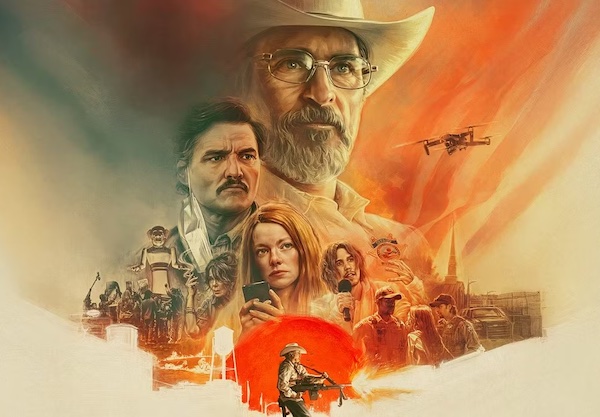
“Eddington”
Louis Chiasson: “Eddington.” This is a movie that I think it’s safe to say you adore: a movie that I would like to see again. I’ve only seen it one time, and you’ve seen it maybe four times?
Gryphon Magnus: Four times in like a week and a half. Let’s talk “Eddington.” I think Louis can attest that, like, this is totally the one movie that has been on my mind for the entire summer. I think every time we’ve had a conversation about movies it comes back to “Eddington.” Before touching on the politics, which are very interesting in and of themselves, I would just like to say that I found that every moment—every scene—sucked me in to a degree that hasn’t happened to me in a long time. I think I remember being upset when you said it wasn’t fun. That blew me away. Because I thought that was, like, the most thoroughly entertaining thing to me.
LC: I think if I watched it again, I would have more fun. Maybe I was in a bad mood, but something about the movie always held me at a distance, and that was sort of a feeling of so what? I thought that the jokes made about Black Lives Matter and specifically about the female activist rubbed me the wrong way. For the record, I think the jokes made about the male activist, who (to spoil it) essentially becomes Kyle Rittenhouse, were so funny.
GM: @black_lives_eddington_brian. You’ve been saying that you didn’t like the protest part, and I kind of thought that that was involved…. What do you think about the big joke in the movie, when he’s at the dinner table with his parents?
LC: That joke got a gigantic laugh in the theater, the biggest laugh of the movie. And I laughed, yeah, but it made me uncomfortable in a certain way, because the discourse that he is parroting is very close, nearly identical, to the discourses we were having at that time [2020].
You can say the movie is arguing that everyone in that time was operating from a place of bad faith, and I’m willing to go there to an extent. But the discourses we had in that time, for me, are still valuable. It sort of reminded me of when Trump won a second time and conservatives were saying, well, of course, we never believed in woke ever, we were just pretending for you all. And now that we’ve regained power, we can say this was all BS. I’m not saying that “Eddington” is saying that, but I was left with a feeling that it was correctly pointing out all these issues in this country and very correctly pointing out where they’ve gotten us; but I still wonder, so what? I don’t need the movie to offer answers, and the movie is not offering answers.
GM: But I think it kind of does for me…. I just very much thought that the way he treated Emma Stone’s character, something I did not catch in the movie at all the first time I watched, revealed how insane [Joaquin Phoenix’s character] Joe Cross is from the start. He is already buying into the conspiracy theories through his mother, and then he’s upset at his wife for doing the same thing. Realizing that, for me, makes you go and think about every time you sympathize with him in the beginning. And that’s a very hard thing to, like, grapple with, especially on the first watch. I feel like I was kind of on guard the first time.
LC: That’s what I felt, which is why I need to see it again.
“Weapons”
LC: Let’s get into a movie I think we’re gonna be sour on. What were your “Weapons” feelings?
GM: “Weapons” is a hard one for me. I think we shared the same general thing, which is that it’s structured like this epic, and it should have been more epic. It should have just been way more. I just do not think it warranted the structure. Not to make that comparison, but if you’re gonna make the “Magnolia” comparison, which the movie is begging you to—
LC: Look at Alden Ehrenreich’s moustache.
GM: It’s insane. And even without all this witch stuff, “Magnolia” felt way huger than any of this. I think it comes down to just how Paul Thomas Anderson makes places beautiful.
LC: “Weapons,” for the few things that are good about it, is a profoundly ugly movie, in all senses. I think we share an intense frustration with the movie, where every time you want the film’s structure to open the world up for you, and every time it closes it down. Every time I felt myself getting invested in something or something was finally getting scary, it sucked me away. And the first time you’re like, oh, that’s interesting. And then it does it five more times.
GM: And if it came together in a meaningful way at least it’d be kind of worth it, but the movie is not scary at all.
LC: I wanted to see these actors who I love make a meal of these characters, and every time it was like the director was intentionally limiting these characters because, at the base of it, they’re very underwritten.
GM: It doesn’t clash them together in any interesting ways; all the interactions between the characters and the interwoven-ness are not that compelling. The fates of all these characters are just so meaningless. Josh Brolin especially feels like he did absolutely nothing. Thank god Pedro Pascal took “Eddington” over this.
LC: We can agree there. Josh Brolin, an actor who is one of my favorites, was completely wasted. And it had me thinking—because as much as I love [Josh Brolin], he’s an actor-brained guy—that “Hereditary,” a movie I like, broke the brains of certain actors. Now they will only take a horror movie if they get really actorly monologues.
GM: That’s the whole epidemic of elevated horror, which is a very annoying term—
LC: But it’s a more annoying style of movie. I think what we’re coming down to is that “Weapons” just offered none of what we want in a horror movie. And I think if there’s anything we have a shared mind about, it is what we want in a horror movie. If anyone wants to see that in practice, head on over to Gryphon’s YouTube channel to watch “The Bagwoman,” a great horror short that is quite indicative of what I want in a horror movie.
“Caught By the Tides”
LC: I just wanted to briefly put in a shout-out for a movie that I saw at [IFC Center] when I was in New York this summer. It is the new film by the Chinese filmmaker Jia Zhangke, who is a master in his own right. I would like to see it again, because I walked into it not knowing what it was. Essentially the first two thirds are compiled from B-roll and footage he shot behind the scenes of two of his other movies, “Unknown Pleasures” and “Still Life,” neither of which I’ve seen. So I was completely lost, but I adored it. “Caught By the Tides” is one of the great film titles of the year, and it’s a title that kind of situates how you should watch it. It’s about being awash in history and looking back on your life and thinking, oh my god, so much has changed around me and I’m this small person—literally caught by the tides of history. I think Jia Zhangke is incredible at that. I haven’t seen nearly enough of his movies but I’d definitely put in a recommendation for “Still Life” and “Ash is Purest White,” which is kind of the more cohesive narrative version of what I feel like “Caught By the Tides” does experientially as you’re watching it.
GM: You said the first two thirds were B-roll; what was the last third like?
LC: The last third is new footage shot, I believe, during COVID-19. Certainly it’s set during the COVID-19 era, and that is when the movie is almost retconned into having had a plot the whole time, which is very interesting to me. It was jarring that it reached that place after so much time just being awash in these frankly beautiful images and sequences of music. And also watching the progression of his muse, Zhao Tao, over 20 years is so incredible, and it reveals that his project the whole time has been his filmography. I love filmmakers like that, where you get a certain feeling watching individual films, but the feeling you get watching all of them and watching a sensibility develop over a period of time is even more powerful. It’s just invaluable to me. So yeah, major shoutout to “Caught By the Tides.”
This conversation has been edited for length and clarity.
Louis Chiasson can be reached at lchiasson@wesleyan.edu.
Gryphon Magnus can be reached at gmagnus@wesleyan.edu.

Leave a Reply