
Unused Squash Courts to be Transformed into Academic Building
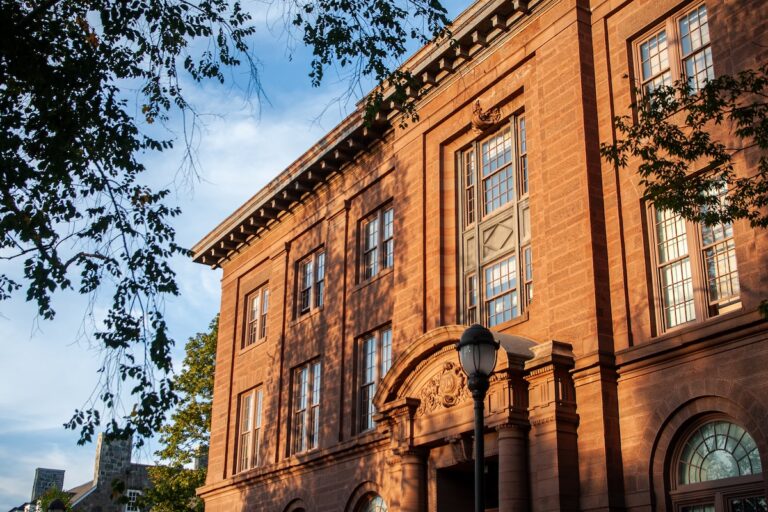
While student, faculty, and alumni attention has lately been focused on the fate of former dining center McConaughy Hall, another large, highly visible, and architecturally relevant University building has stood by unused and unmentioned. The red brick building located between the Usdan Center and North College, which once housed squash courts, has been idle since 2005 when the squash courts were moved to the Freeman Athletic Center. Currently, the building is used as little more than a loading-dock for in-coming Bon Appétit supplies; however, plans for converting the indoor athletic courts into office space for the Career Resource Center (CRC), the College of Letters (COL), and the Art History department are underway.
“This building is a prominent feature of college row, a significant building in Middletown, and an important example of work completed by McKim, Mead and White Architects,” Assistant Vice President for Facilities Joyce Topshe wrote in an e-mail to The Argus.
The University selected Newman Architects, a New Haven firm, for the adaptive reuse renovation; planning for the project is currently in the early stages, according to Topshe.
The Office of University Relations hopes to find a donor to fund the project, which has an estimated cost of $8.7 million, in time to start construction by January 2011 and finish construction by January 2012. No donors have come forward yet. The University wants 50 percent of the project’s budget to be committed before any renovation begins.
“This is the same funding process that we used for Allbritton and Usdan,” said Barbara-Jan Wilson, Vice President for University Relations and the current head of the donor search. “Ideally, we can find two or three donors to fund the whole project at the 10 million dollar level. Otherwise, we will look at 20 to 30 smaller donors. By smaller, of course, I mean in the half million dollar range.”
Currently, the Art History department is located in the Center for the Arts (CFA), and COL and the CRC are located in the Butterfield Colleges. Although there are no concrete plans for what will fill the departments’ former locations, Topshe predicted that the empty space in the Butterfields might be converted into student housing.
Following the squash court building’s closing, the University considered converting it into a museum to display the University’s extensive collection of prints and drawings, including pieces by Albrecht Dürer, Rembrandt van Rijn, Francisco Goya, and Pierre-Auguste Renoir, which are currently housed in the basement of the Davison Arts Center. A committee to coordinate the museum was formed in 1997 but the University determined in the fall 2007 that the project was not cost effective.

Leave a Reply