
MonsterPiece Preview: “The Vagina Monologues”
Hey there! Enjoying this weather? After such an inconspicuous winter, the heavens’ decision to suddenly shoot its frozen load all over me seems a little unfair. You can’t even make snow angels in this shit! Here’s my suggestion: after dragging yourself through this gruesome tundra all day, with the wind biting your ass, you deserve a reward. Why don’t you fill up that bathtub with boiling water, put on your favorite early-90’s R&B LP (All-4-One’s 1994 self-titled “All-4-One”), and pour yourself a tall glass of some nice, hot, steamy…
Vagina!
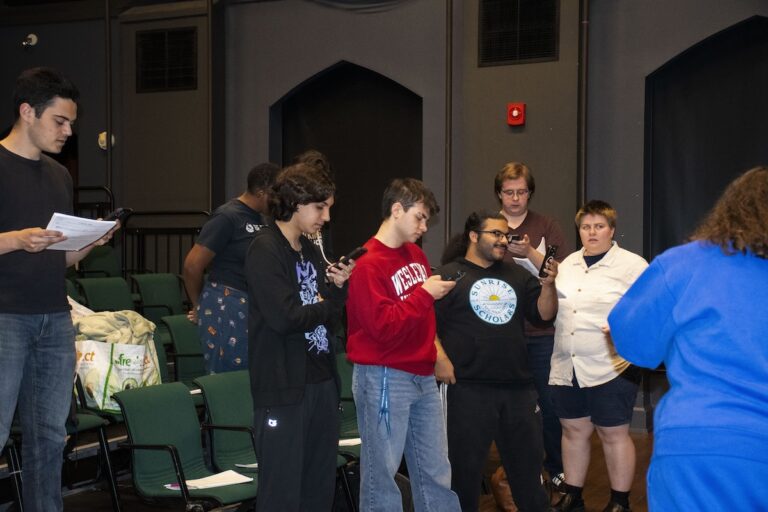
This week: “The Vagina Monologues,” by Eve Ensler. Directed by Emily House ’09 and Kate Heller ’09.
In 1996, Eve Ensler wrote “The Vagina Monologues” based on interviews she conducted with hundreds of women regarding their views on sex, relationships, and violence against women. The off-Broadway premiere that year (starring Ensler) was followed by several celebrity performances of the monologues, as well as a televised version on HBO. In the wake of the show’s massive following, Ensler founded the V-Day movement. With “The Vagina Monologues” as the focal point of the movement, V-Day consists of a series of performances and events that teach love and respect for women in an effort to end violence agaianst women. Proceeds from V-Day are donated to various charities that work to end violence against women or support victims of domestic abuse. Celebrated worldwide, the movement has raised over $31 million. At Wesleyan, your dollars will help support New Horizons, a shelter for survivors of domestic violence.
To co-director Emily House ’09, Ensler’s play is “more than just theater- it’s about building connection and creating a space for honest conversation.” House and co-director Kate Heller ’09 intend to open up the discourse of violence against women, to give a voice to women’s experiences, and get the word “vagina” out in the public.
More personally, in presenting this year’s production, the directors aim to foster a liberated sense of the relationship women have with their bodies—a connection House doubted until her first encounter with the monologues. Says House of this experience: “That night changed the way I looked at myself, at the shame and disconnect that I felt in relation to my body and the words used for it.” This release of tension is what House and Heller hope to offer.
House, who was in last year’s performance of the monologues (“The Moaning Monologue”), marks her directorial debut this semester. So, understandably, the task of sorting through over 60 auditions was overwhelming. Given the subjective personality of the piece, House and Heller were looking for individual, resonating voices. One of those voices will be in a new monologue, one yet to be heard in any recent Wesleyan production of “The Vagina Monologues.” The directors are interested in calling “into question the notion of where the line between ally and affected person is drawn,” in relation to the discourse of violence against women. To address this, a supplemental piece was written, which will be performed at the end of the intermission by self-identified male cast member Jesse Bordwin ’10. The illustration of violence against women affecting all those in contact with it resonates with the larger goals of the piece, and of the V-Day movement.
“Anti-woman violence comes in many forms,” House says, “From the physical violation of her body to the act of making her feel ashamed about herself and her physicality. ‘The Vagina Monologues’ is only a show that lasts for 1 hour and 45 minutes, so it can’t effectively combat all of these issues. But it is a start. And that’s what we nee—a start.”


Leave a Reply