
Sanchez remembers M.L.K. Jr.
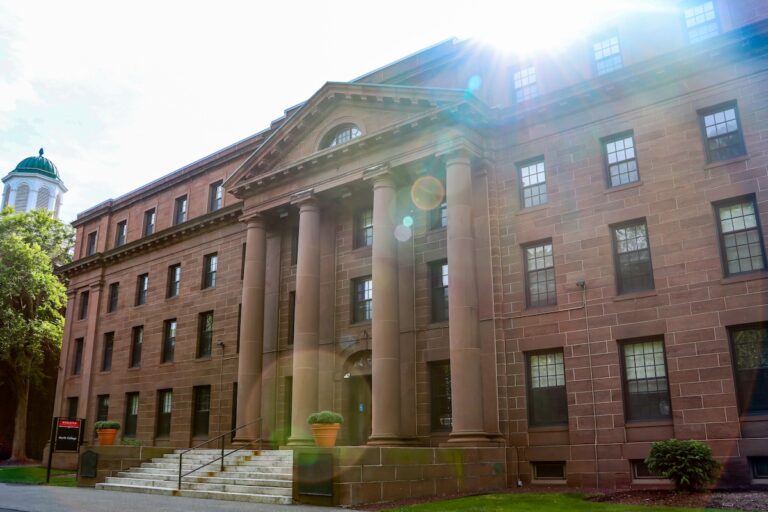
A presentation by author, civil rights activist, and poet Sonia Sanchez marked the beginning of Black History Month. Students, faculty, and staff crowded into the Memorial Chapel on Tuesday night to join the keynote speaker in commemorating the life of Dr. Martin Luther King, Jr.
Like Dr. King, Sanchez studied the institutionalization of oppression in the United States and believes that the work to reverse it is far from finished.
“Integration must be seen not in aesthetic or romantic terms,” she said. “Integration in its true dimension is shared power.”
Sanchez emphasized the necessity of creativity and the importance of education as an instrument of change. As the author of over a dozen books of poetry, short stories, and plays, she spoke about the process of creation as a method of self-discovery and inquiry.
“Cruelty is caused by a failure of the imagination, the inability to assign the same feelings and values to another person that you harbor in yourself,” she said, quoting Mexican novelist Carlos Fuentes.
Sanchez began her work as a civil rights activist in the early 1950s in Harlem, where she received a BA in Political Science at Hunter College. In the 1960s, she became a professor, heading up the world’s first African American Studies program at San Francisco State College in California. Since then, she has taught at Amherst, Rutgers, the University of Pennsylvania, and most recently at Temple University, as well as lectured at more than 500 universities and colleges throughout the United States.
“I made an amazing discovery” Sanchez said. “When you go searching through your identity and liberation, when you write about yourself and your struggle…you find yourself in others who have been weighed down and hidden their eyes from themselves.”
Sanchez also argued it was a cruel irony to claim to fight for freedom and equality abroad when these rights are still not guaranteed to U.S. citizens. Reading from King’s speech “Beyond Vietnam: A Time to Break Silence,” which she had heard at Riverside Church in Manhattan on April 4, 1967, she drew parallels between the war in Vietnam and the current occupation of Iraq by U.S. forces.
“A nation that continues year after year to spend more money on military defense than on programs of social uplift is approaching spiritual death,” she said. “This is your century, you must begin to populate it with peace.”
Overall, Sanchez presented an approach to activism that was grounded in hope and optimism. In a book signing following the speech, she wrote the words “EBE YIYE!” in a student’s book. In Twi, the language of the Akan peoples of Ghana and the Ivory Coast, the words mean, “It will get better.” It is with this message that Sanchez honored the life and legacy of Dr. King and encouraged the Wesleyan community to continue his efforts.
In his brief remarks, President Doug Bennet reminded the audience that Dr. King was no stranger at the University during his lifetime. John McGuire, professor of Government and Latin American Studies, became friends with him while studying in the graduate program at Crozer Theological Seminary in Chester, PA. After McGuire joined Wesleyan’s Religion Department in 1960, he invited King to speak at Wesleyan for the first time on June 14, 1962. He spoke to a packed Memorial Chapel, and returned again in 1963. In 1964, Dr. King was the keynote speaker at Wesleyan’s Commencement exercises. His final sermon at Wesleyan was in 1966, two years before his death.
Speaking in a short interview after the lecture, Assistant Professor of Government Melanye Price said that when people fail to discuss issues of race and identity, not just in the context of power relations, but in the course of their everyday lives, they betray King’s legacy.
Students found Sanchez’s presentation moving and inspiring.
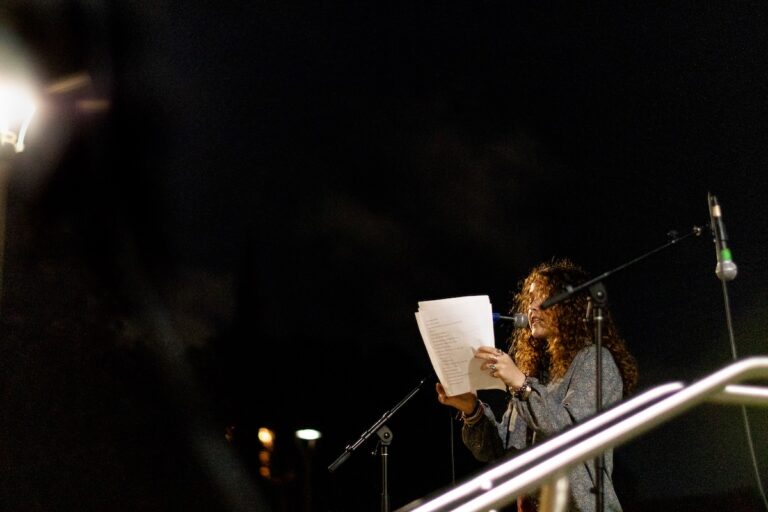
“I think just the format in which she spoke, the way that she combined performance art, singing and oratory so beautifully and flawlessly, just the rhythm of her voice was so beautiful to listen to, I think it really touched a lot of people,” said Ruby-Beth Buitekant ’09, who had read some poetry of her own as part of the commemoration. Other contributions included performances by faculty singing group The Roadside Girls and Ebony Singers.
“What is really the most important thing to me about sister Sanchez is that she bridges the gap between artistry and activism,” said Mike Berger ’08. “Her entire speech was really a piece of performance art; having seen this, now I really understand what that looks like.”
Leave a Reply