
Experimental sounds: The Hub combines music and technology
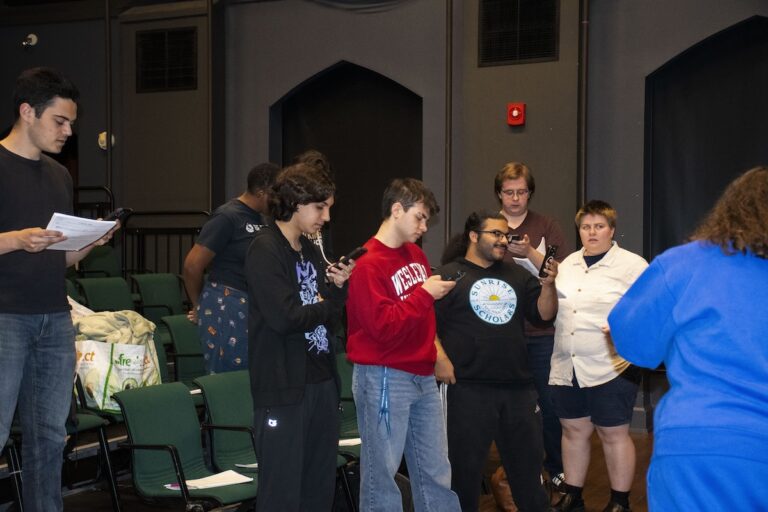
“hub is in da house,” wrote Scott Gresham-Lancaster, typing to his band-mates onto a giant screen that hung over a dense forest of wires, cables, and silver Macintosh laptops. His computer network music ensemble, The Hub, had just begun its performance, turning Crowell Concert Hall into an alien soundscape.
The performance, consisting entirely of improvised pieces constructed on the spot, moved through a series of “sonic experiments,” using modern computer technology to pinpoint aural patterns emerging from a soup of static and noise. Songs were then created from these patterns, each band member tweaking the computer output as they pleased.
The first piece, “noosphere,” represented “the sonification of global consciousness,” wrote John Bischoff, typing to the audience from his laptop. Bischoff then explained that “noosphere” took its data from radio receivers stationed around the world, recording ambient noise from their surroundings. Their computers searched these recordings for timbre changes, then built songs around them, filling the hall with beeps, blips, and piercing clinks that resembled the sounds of metal hitting metal.
“I was surprised by how human it all turned out to be,” said Mary Farnsworth, a Middletown resident who came to see the performance. “I didn’t know anything about this kind of music before I came here. Now that I’ve seen it, electronic music as a whole feels a lot less artificial to me.”
The music’s human aspect was most apparent in the band’s screen communication system. Before and during the performance, not a single member of the band physically spoke to the audience, relying instead on instant messages visible throughout the room. Bandmates used it mostly to communicate with each other, speaking directly to the audience only to introduce pieces and explain their inspirations.
“we compose phrases, and share the composing duties,” wrote Chris Brown, one of the band’s founders, when introducing a piece called “Cut to Ribbons.”
The piece consisted of pings, high-pitched echoes, and a deep bass gurgle that prompted another band member, Phil Stone, to call it a “body sound quintet.”
Since the band played what could easily be called the opposite of traditional songs, it was impossible to judge them by familiar qualities, such as catchiness. Dominick Grant, a Middletown resident who accompanied Farnsworth, chose his favorite piece based on structural elements.
“’Lou Drift’ had the best textures and harmonics,” he said. “Out of all the pieces it sounded the most like a well-composed song.”
Music Professor Ron Kuivila, who is also a designer of electronic instruments, approached the performance similarly. He spoke afterwards about the compositional questions that bands like The Hub raise.
“This music tries to understand how related compositional approaches interact,” Kuivila said. “It’s music of discovery, not self-expression. They learn more about the nature of music by making it and seeing what patterns emerge. The data packets moving from machine can form an entire world of sound, all out of hard measurements and musical statistics.”
Kuivila praised the band for its efforts, emphasizing that while the band is not traditional, it is still a band like any other, overcoming the same hurdles and working with the same creative processes.
“Like any good ensemble, the music emerges over time,” Kuivila said.


Leave a Reply