
Catholic students continue efforts for full-time chaplain
Catholic students on campus continue to press their case for a full-time chaplain in the face of budget cuts that have left the Dean’s Office pinching for pennies.
Beset by a $70,000 budget reduction this year motivated the Dean’s Office was motivate to change the chaplaincy from a full-time to a half-time job after Father Louis Manzo retired last spring. Since then, limited interest in the half-time position has left the position vacant. Currently, rotating priests lead the weekly mass.
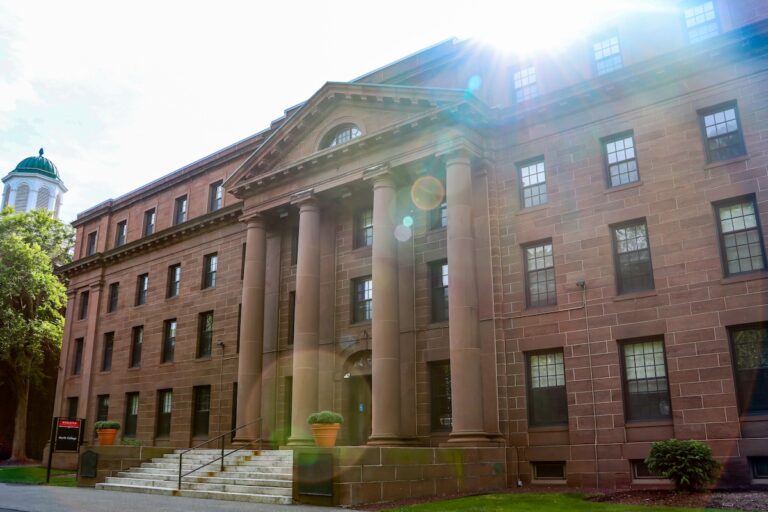
Dean of Student Services Mike Whaley will prepare a document by Thanksgiving break that will incorporate comparative data on chaplaincies at other universities and student input on the needs of the Catholic community. This week, he will hold two opinion-gathering meetings open to the community on Tuesday, Nov. 7 at noon and Wednesday, Nov. 8 at 5:00 p.m. at North College.
Whaley’s document will be sent to Dean Maria Cruz-Saco, who will then decide whether to advertise for a full- or half-time chaplain in the spring.
“If we think that we need a full-time person, then that is what our recommendation will be,” Whaley said. “Then we in the Dean’s Office, and Dean Cruz-Saco in particular, will have to sort out…what funding we would have to reduce [elsewhere] to make up for the extra $20,000 or so it would cost to hire a full-time chaplain.”
The trustees’s goal of reducing the annual draw on the endowment from 7.2 percent to 5.5 percent will force the University to cut approximately $5 million from the current operating budget over the next five years.
The Dean’s Office alone is expected to cut $70,000 from its budget this year. Next year, it will have to cut $40,000, and two years from now, another $70,000, according to Whaley.
“Students are just beginning to sort out what this [budget constraints] thing means in practice now,” Whaley said. “From last year to this year the Catholic community was impacted. The new question is, ‘What gets impacted next as we keep making these reductions?’”
Tom Crosby ’07, a leader of the Catholic Student Organization (CSO), also questioned the reductions.
“The Dean’s Office is very well aware of numbers,” Crosby said. “It seems to me the whole thing has been a question of numbers, both financial numbers and percentage numbers.”
The switch to a half-time Catholic chaplain was partly justified in the Dean’s Office by the reduced number of Catholic students in recent years. Crosby’s view of how to deal with lackluster numbers differs from that of the administration.
“If it’s true that the number of self-identified Catholics is diminishing, we still say that that’s reason to take action to stop it by hiring a full-time chaplain,” Crosby said.
The University has full-time Jewish and Protestant religious leaders and a part-time Muslim imam. To investigate chaplaincies at other universities, the Dean of Student Services’ Office has already compiled data from 12 peer institutions of similar size.
Among them, only Pomona College has a full-time Catholic chaplain, while Oberlin College has two half-time Catholic chaplains with funding from the Cleveland Catholic Diocese. Swarthmore College has a part-time Catholic advisor with all funding coming from outside groups. Trinity College has a part-time Catholic chaplain with funding from the Archdiocese budget.
“[The question] I’m really after is, ‘What does this community need and how do we see a Catholic chaplain, part-time or full-time, working with us to solidify but then also enrich our lives in this community,’” Whaley said.
Still, some CSO members question the need to reevaluate the position and to compare it with other universities’s Catholic chaplaincies.
“I don’t understand why we had to cut [the chaplain position] to half-time when it was already working,” co-leader Jenna Gopilan ’07 said. “Why do we need to review the chaplaincy when it was perfectly working in the Catholic community? The students were happy with it.”
Manuel Sanchez ’07, another CSO member, fears that Dean Cruz-Saco’s pending decision on the issue might fail to consider Catholic students’s interests.
“It doesn’t seem that the needs of the Catholic community are going to be taken into account,” Sanchez said. “I think it’s a tough statement, but I think it’s also true.”
Cruz-Saco emphasized that administrators are working to better address the needs of the students.
“Some Catholic students felt that we had not adequately consulted with them and for this reason we are meeting with them to obtain their feedback,” Cruz-Saco said.

Leave a Reply