
Western Civilization offers laughter along with stereotypes
“Western Civilization: The Complete Musical (Abridged),” was supposed to offer refreshingly lighthearted fare, an exercise of campy silliness rather than of abstraction.
“I wanted the play to be fun; we had lots of fun doing it,” said Steve Sunu ’08. “The audience had fun too, I hope.”
Performed in the ’92 Theater from Oct. 26 to 28, hopes of fun were not enough to carry the awkward and at times troubling script for 90 minutes; it was lighthearted because it lacked depth.
The play began with a dark empty stage. It came to life as dramatic lights illuminated the three actors one by one, who then turned and began to sing about history. The music was expectedly cheesy, the lyrics were silly, the dancing was ridiculous, and the actors were singing as if their message was of the gravest importance.
The premise of the play, the three actors explained, was to go through the entirety of Western Civilization’s history in song and dance. A computerized voice served as the narrator and dictated the major eras to be covered. The trio of actors sang a barbershop quartet song of Viking woe, a cowboy ballad about the Magna Carta, a Scottish anthem for a capitalist innovator, and a rock song for the inventor of the toilet.
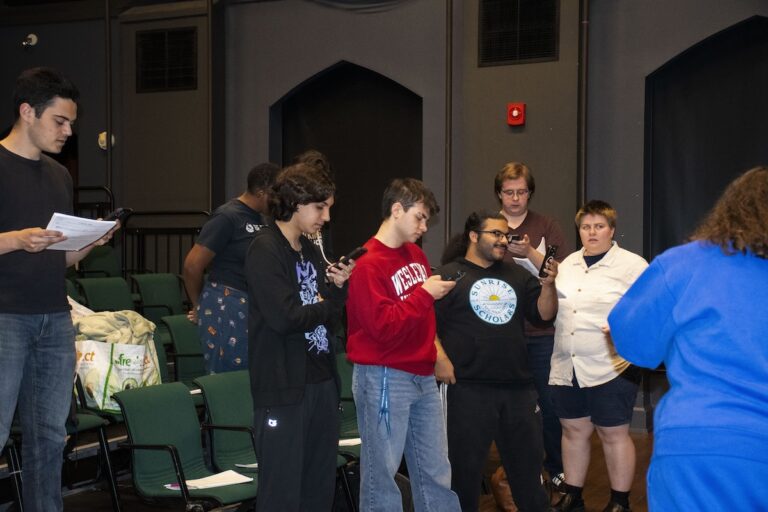
The actors, Leah Lucid ’10, Gabe Fries ’09 and Rob Boyd ’08, did an admirable job. The enthusiasm they brought to each song was comedic, managing to bring humor to the majority of the obvious jokes on which the lyrics depended. The actors moved deftly from genre to genre, exaggerating their movements and expressions as a sort of mockery of the musical form itself. Costumes were minimal and relied on symbolic hats or accessories such as a Viking helmet or kilt to suggest a character. The rest was up to the actors.
The singing was excellent. Lucid did a particularly rousing gospel number as Joan of Arc, with a convincing and hilarious French accent; she had an impressive command of the audience’s attention. Boyd’s portrayal of a lecherous Galileo was so disturbing it produced laughter from the audience, as did Fries’s leer as Galileo’s backup singer. Though the arrangements—the background music apparently came from the group that wrote the play (The Reduced Shakespeare Company)—were less than stellar, they fit within the already ridiculous tone of the play. The excellent lighting, designed by Anna Martin ’09, was overstated in a manner that perfectly matched the musical’s necessary lack of subtlety.
As a silly romp through time, the play was equally cheerful in its offensiveness. “We make fun of race, class and gender so you don’t have to,” stated an advertisement for the show. The script relied heavily on stereotypes of gender and race for laughs—an inevitable situation in a play attempting to review all of Western Civilization’s troubled history. At the beginning of each era, the narrator cynically noted that the “church was intolerant and the world was run by a few wealthy white men.”
Other generalizations, however, made me uncomfortable. While the phrase “towel-heads” was used in jest within the song “Let’s Be Frank About the Muslims,” the lyrics were heavily based on an overgeneralized image of Muslim culture. Perhaps it was meant as a satire on those who have such stereotypes, but such intent was not conveyed by this particular production. It seemed inappropriate to mock a religious group that is constantly minimized by the dominant American narrative.
The play seemed to hide behind a common argument that it’s okay to offend if every group is equally ridiculed. Such an argument relies, though, on the fact that every group is equal to begin with. Boyd, as Galileo, was funny because he was portraying a specific person, an important one with power. Fries’s songs about Muslims, and the trio’s song entitled “Gay” which featured a gay ballet to Tchaikovsky and a chorus of “Let’s hear it for homos today” refer to broad groups that are, to this day, marginalized by dominant society.
Boyd’s character was a feminist; his constant concern for the inclusion of women in the history played out on stage was the object of much ridicule and laughter. The way laughter silenced and delegitimized his arguments for the recognition of women in history was reminiscent of current arguments claiming that sexism isn’t as pervasive as sometimes it is believed to be.
Humor does have an important role in breaking down barriers, but I don’t think the work of the Reduced Shakespeare Company accomplished anything quite so revolutionary. They played with stereotype because it is easy to do; they gave power to existing jokes based on generalized ideas of gender and race which go unquestioned in life outside the theater. There was laughter, last weekend, in the ’92, but at whose expense?

Leave a Reply