
B’nai Mitzvah Program offers adulthood
The Wesleyan B’nai Mitzvah program is entering its second year of providing Jewish students who have not yet become a Bar or Bat Mitzvah with a chance to take part in this coming of age ceremony. Students who take part in the program will begin after Thanksgiving break and the experience will culminate in their Bar or Bat Mitzvah (B’nai Mitzvah is the Hebrew plural) late next spring.
Traditional B’nai Mitzvahs celebrate the transition of a Jewish young person at the age of thirteen into adulthood. The Bar or Bat Mitzvah (the term applies to the participant as well as the ceremony) is called to the Torah chants a section of it and leads other parts of the Shabbat morning service.
“I always wanted to be Bat Mitzvahed since I was about fourteen,” said Gabrielle Fondiller ’07, one of the four students who became B’nai Mitzvahs last year. “So once I got here and they offered it, it seemed like a good opportunity.”
Daniel Heller ’06 started the program last Fall in response to an appeal by Rabbi David Leipziger, Wesleyan’s Jewish chaplain, for the active Jewish community to create more campus-wide events. Heller, who is now abroad, ran the project; this year, Ari Fagen ’07 is Project Coordinator. Right now one of her main tasks is to design a curriculum for this year’s B’nai Mitzvah students, determined in part by the students’ own interests and level of prior knowledge of Judaism.
“We basically start after Thanksgiving, and the students learn the Hebrew alphabet, how to pronounce basic words, how to read Torah trope [notations for chanting],” Fagen said. “They meet once a week with a tutor—we have students tutor them—and then they practice about 20 minutes each day, and then on Fridays during lunch we have a class to teach them some basics about Judasim. The class is just casual, over lunch, it’s a combination of [instruction about] the holidays, the different parts of the service[…] to anything as intense as Kabbalah and Jewish mysticism.”
In the spring, the new B’nai Mitzvahs will lead a Saturday morning service to which all Wesleyan students and faculty members are invited. They will read from the Torah and give a sermon about their Torah portion. Services will be followed by a Kiddish luncheon and then a party.
“[The party] is thrown by the whole Jewish community—the entire Wesleyan community is invited,” Fagen said. “It is in the style of all the B’nai Mitzvahs you regularly have when you’re thirteen. So, [last year] we had all the fun games, the limbo, Coke and Pepsi, we had a moonbounce, and it was really, really, really fun, a big celebration. [The guests of honor] got lifted up in chairs like it’s tradition to do—a very culminating point—and we did the horah.”
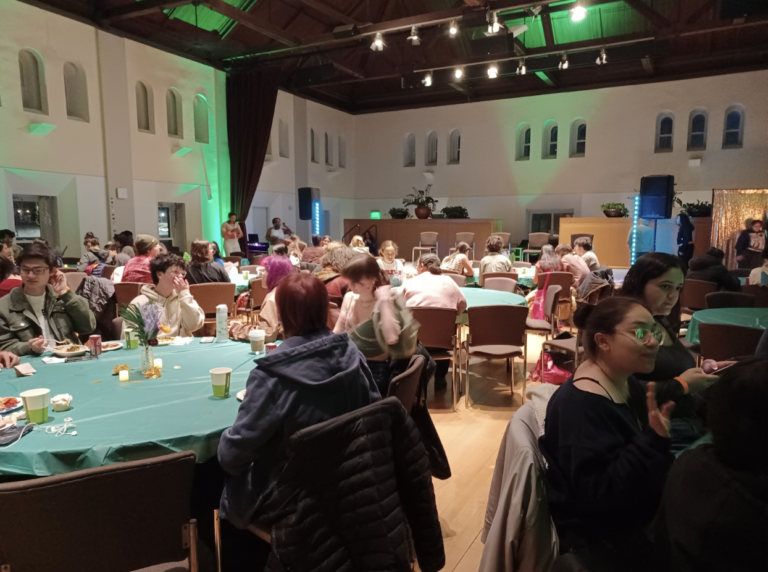
Over one hundred people attended the B’nai Mitzvah service last year, and 550 came to the reception, according to Fagen.
“It was the largest party offered at the largest party venue on campus—and it was the only big blowout party that didn’t revolve around sex or alcohol,” she said.
Leipziger said he supported the B’nai Mitzvah program because his role on campus is to help students grow spiritually.
“This program is great because I know that many students feel like, ‘whoa, I’m Jewish, but I don’t know if I belong [in the Jewish community], I’m not like them, I don’t know as much as they do’—so the brilliance of this project is that it allows them to catch up to where they think their peers are,” Leipziger said.
Annie Fox ’07, one of the two future Bat Mitzvahs currently participating in this year’s program, said she hopes to have such an experience. Fox, whose father is Jewish and mother is Christian, said she grew up with both religions. She had always been interested in becoming a Bat Mitzvah, but had reservations until she attended last year’s B’nai Mitzvah service.
“I realized I really wanted to do this process,” Fox said. “And then it was like, it would be stupid to do this process and then not be called to the Torah. For me it’s not so much the ceremony, and I’m not so excited about the day of my Bat Mitzvah as I am about learning Hebrew and learning how to practice Judaism. As a Jew I think you have the responsibility to learn.”
Interested students should e-mail Ari Fagen at afagen@wesleyan.edu.

Leave a Reply