
Picasso plus Einstein equals zany comedy for Gould
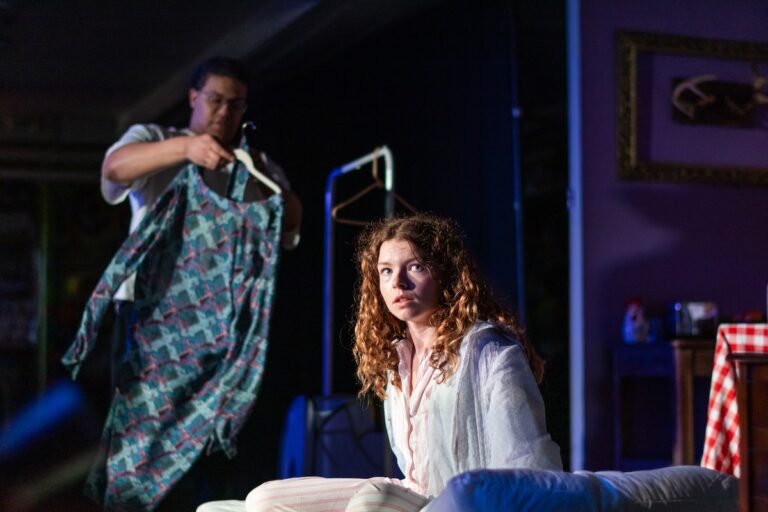
The most memorable production I’ve ever seen was a performance of “Picasso at the Lapin Agile” by faculty at Michigan’s Interlochen Center for the Arts. So I was excited to learn that a cast of Wesleyan’s own was taking up the challenge of Steve Martin’s brilliant play. Willie Gould ’06 directed the Second Stage production of “Picasso” that went up on Thursday, April 8 at Psi U. The play was stage managed by Jeni Morrison ’07, with set design by Teddy O’Connor ’06.
“Picasso” tells the story of a chance meeting between Pablo Picasso and Albert Einstein in 1904. Although by that year Picasso’s drawings had earned him some local celebrity status, both Picasso and Einstein were still relatively unknown. But all that would soon change. Just one year later Einstein would publish his “Special Theory of Relativity”, and three years later, Picasso would paint his groundbreaking “Demoiselles D’Avignon.”
As Martin imagines it, Picasso (Tristan Chirico ’06) is inspired to create “Demoiselles D’Avignon” at the Lapin Agile. In the charged atmosphere of the bar, he crosses paths with Einstein (Rene Wachner-Solomon ’07), with whom he exchanges ideas on life, the future, and the Universe. After much double-entendre filled sparring, the two come to appreciate their mutual desire to “create a new way of looking at the world.” By the play’s end the two have found in each other’s kindred spirits. Says Picasso, “My only regret is that we’ll be in different volumes in the encyclopedia.”
As Picasso, Chirico did a great job of conveying the artist’s energy and desire to create beauty (and the accent was right on as well). He avoided presenting Picasso as merely a womanizing, arrogant artiste—an impressive feat given the jabs Martin takes at Picasso’s image. Wachner-Solomon’s Einstein was more of a ham in comparison; a little crazy, but great with a punch line.
Although dialogue between Picasso and Einstein forms the play’s center, the constant stream of ideas thrown around by the Lapin’s less erudite patrons propels their exchanges. This colorful bunch includes Gaston, an “older French man” played by the wonderfully funny Andrew Flint ’06, whose concerns seem to extend only to women, wine, and the state of his bladder (although occasionally he manages to think about more than one at the same time). Suzanne (Anna Moench ’06), a 19-year-old Parisian, speaks in monologues and makes no secret of her sexual involvement with Picasso. (“Do you know Picasso?” “Twice.”)
The art dealer Sagot (John Wesley ’06) also kicked the wackiness up a notch, though his dandy act got a bit verbose at times.
“[N]o one really wants a painting of Jesus in the living room” he says. “You could put him in the kitchen, maybe, but then that’s sort of insulting to Jesus. Jesus, ham sandwich, Jesus, ham sandwich….”
Hallie Cooper-Novack ’07 was strong as Germaine, the Lapin Agile waitress and girlfriend of bartender Freddy, played by Paul McElfresh ’06. Freddy manages to hold it down at the bar, but cannot quite prevent Germaine from sneaking around behind his back. When he leaves the bar for a minute (“I might be gone a longer time than you’d think it would take a person…but traditionally it’s okay” says Freddy), Germaine flirts with Picasso and holds forth on love and infidelity.
Director Gould threw in a few great gags that upped the comic effect. When Suzanne is describing her sexual experiences with Picasso, Freddy keeps score on a blackboard. And when Freddy tells a joke that falls flat, a tumbleweed rolls across the floor. These touches helped personalize and enliven the performance.
Part of what makes Martin’s text so fabulous, however, is that it is uproariously funny one minute and harshly sobering the next. For example, take this exchange from the end of the play:
Picasso remarks to a blue suede shoed “visitor” from the twentieth century that “we are both exalted, because we are originals.”
“Well, that’s a pretty bold statement Mr. Picasso,” the visitor replies, “considering we both took ideas from the art of the Negro.”
Sometimes I felt that in an effort to give us comedy, this depth and abrasiveness was glossed over in the production. I would have liked to see what developed if instead of going bigger, the cast did more with those shifts between the moment of laughing out loud, and the sudden realization that there’s a lot more than humor going on.
Despite this, the production was an extremely solid performance of a wonderful play. “Picasso” is an ensemble piece, and these actors were able to let each other shine.


Leave a Reply