Author: Henry Spiro

  • Ken Jeong Brings His Manic Energy to the Dull “You Complete Me, Ho”

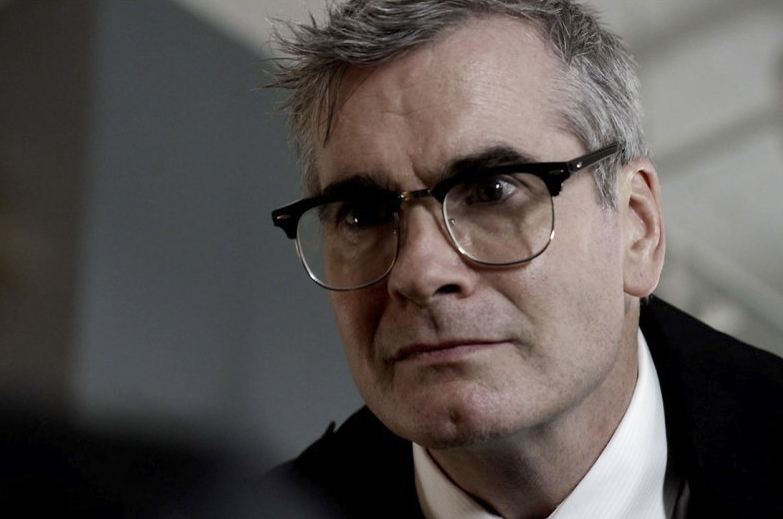
    Ken Jeong Brings His Manic Energy to the Dull “You Complete Me, Ho”

    c/o Entertainment Tonight
    c/o Entertainment Tonight

    I’ve long been a fan of Ken Jeong. His energetic and eccentric performances in “The Hangover” and “Community” were always delightful, a source of non-stop humor as he consistently found ways to top his last, utterly bonkers joke.

    Still, I couldn’t help but be apprehensive when I discovered that he’d be doing a stand-up special for Netflix. His comedic stylings worked best when he was acting alongside comparatively grounded characters. Take his arc in the third season of “Community,” in which his character gradually seizes control over the community college at which the show is set. His character dresses and acts like an amalgamation of various historical dictators. He dresses like Napoleon; he spreads posters that stylistically mimic the propaganda of Mao Zedong throughout the school. It’s an utterly bonkers, heightened scenario, one which Jeong embraces with glee. But it only works if the actors around him acknowledge how truly insane Jeong’s character is. In a stand-up set, however, Jeong is on his own; without any other actors to ground his antics, he could come off as a rambling madman, instead of a comedic genius.

    With the release of his special, I’ve realized that my fear that his zaniness would derail his comedy was ungrounded, but my fear that his comedy would falter, was not. “You Complete Me, Ho,” (a reference to his wife’s last name) fails not because Jeong is too outlandish; on the contrary, his immense energy is perhaps the only praiseworthy quality of the special. The problem does not lie with Jeong’s move to go solo, but with his uninspired and downright lazy writing. His jokes switch between crude humor, riffs on Asian stereotypes, repeatedly name-dropping celebrities he’s worked with, and smirking about how wealthy he is.

    It’s a shame. Jeong is not only a great perfomer, but he also has a fascinating personal life, one that’s a potential goldmine for comedy. His career didn’t begin in show business, but rather as a general practitioner for Kaiser Permanente. It was when Judd Apatow offered him a role in “Knocked Up,” playing a doctor (of course), that Jeong got his first taste of show business. Shortly afterwards, he took an enormous risk, leaving his safe job as a doctor behind to become a performer. The rest is history.

    But his presentation of the story is shockingly impersonal. He repeatedly praises Apatow and complains about how boring being a physician is in comparison to working on a movie. It’s a fine, mildly funny bit, but Jeong never delves beneath the surface. Then, he discusses his parents’ reaction to his decision to leave his medical practice. Again, rather than approaching the subject with a unique, personal touch, he relies on stereotypes about how Asian parents expect their kids to be A+ students and become doctors or lawyers. It’s exemplary of the type of comedy on display in “You Complete Me,” in which a subject potentially ripe with personal humor is wasted on jokes that a middle schooler could have written.

    His storied career, working alongside great actors and comedians over the years, is another potential goldmine that’s also left untapped. At one point, he discusses the runaway success of “Crazy Rich Asians,” in which he had a small supporting role. Rather than grant any insight into what it was like to make such a film, he brags about how great it was to improvise alongside co-star Awkwafina. He’ll repeatedly mention the importance of “The Hangover” to his career, but he only gives one anecdote about the making of it. Actually, he doesn’t tell anecdotes from “The Hangover”—only the lame sequel. Specifically, he jokes about Bradley Cooper’s experience shooting a scene involving prostitutes in Thailand. The contents of said joke are too crude to describe here, but suffice to say, it’s an uninspired, un-insightful joke, reliant on shock value instead of wit.

    Even at its best, “You Complete Me, Ho,” feels like a joke at the audience’s expense. Jeong promises the viewer insight into his life but again and again delivers school-yard crassness instead. Towards the end of the special, he begins to discuss subjects so immensely personal and serious that it seems, for a moment, like some comedic genius might be on the verge of shining through. He tells the story of his wife, whose full name is Tran Ho, whose seemingly benign lump in her breast grew to stage three breast cancer. When they found out that she had roughly a 30 percent chance of survival, Jeong grew deeply depressed.

    The best comedians can wring humor from darkness, as Tig Notaro so famously proved in her set about her own battle with cancer. So Jeong had set himself up to truly test his comedic chops. But it’s a test that he immediately fails. Again, there’s the familiar and stale crass humor, yet another riff on his wife’s last name, some name-dropping of Hollywood celebrities (this time, its director Todd Phillips), and a complete lack of inspiration. Put succinctly: “You Complete Me, Ho,” is just as creative and funny as its title.


    Henry Spiro can be reached at hspiro@wesleyan.edu and on Twitter @JudgeyMcJudge.

  • The Decline and Fall of “The Flash”

    The Decline and Fall of “The Flash”

    c/o The Daily Express
    c/o The Daily Express

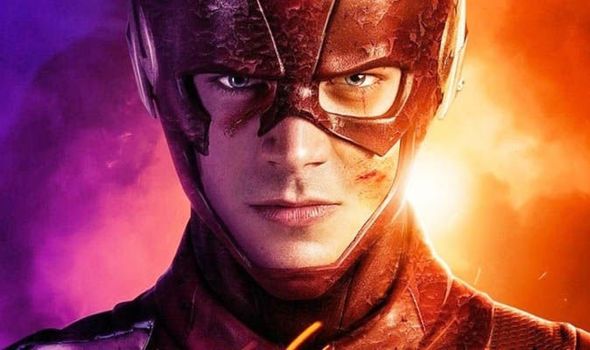
    In its first season, “The Flash” was an outstanding show. The tale of a man who, in a freak accident, becomes the fastest man alive, embraced its campy, comic book source material. There was a breezy, light-hearted tone to the show, which kept things entertaining, even during the weaker episodes. Its ensemble cast was extremely charismatic, elevating their somewhat flat characters; their chemistry, too, kept even the duller scenes engaging. Most impressive of all was its narrative structure, mixing villains of the week with a compelling, overarching storyline involving a mysterious, time-traveling big bad.

    To unpack the success of this overarching narrative requires a lot of heavy-lifting, so apologies for having to devote so much space to merely describing the plot. The pilot episode begins with Barry Allen (Grant Gustin), recalling the death of his mother, Nora. According to police, she was stabbed by Allen’s father, who was promptly imprisoned; in Barry’s memory, Nora was not killed by his father, but a supernatural, yellow blur, which ensnared her before her death. Flash forward to years later, the now adult Barry is granted superhuman speed when he’s struck by lightning, which originated from a particle accelerator exploding. He then takes up the mantle of being The Flash, fighting against the other people who gained powers from the particle accelerator, but used them for nefarious purposes. Harrison Wells (the excellent Tom Cavanagh), the scientist behind the failed accelerator, decides to take Barry under his wing and mentor him, helping him with his new-found powers.

    Unfortunately for Barry, Wells is not who he claims to be: He is actually Eobard Thawne, a speedster from the future. Thawne, under the alter-ego Reverse-Flash, is Barry’s nemesis in the 22nd century. It was Thawne who killed Nora, when he and Barry had traveled back in time. Seeing an opportunity, Thawne travels back in time to kill Barry but is stranded in the 21st century. Knowing that, in the time that he is trapped in, Barry has yet to acquire his powers, Thawne kills the real Harrison Wells and steals his identity. By mentoring Barry while remaining disguised as Wells, Thawne can train Barry to run fast enough to time travel and return Thawne to the future.

    If this all sounds extraordinarily elaborate and hard to follow, that’s because, on paper, it is. It’s a testament to the show’s writing that this dense narrative unfolds with clarity across 23 episodes.

    The Reverse-Flash’s plan comes into fruition in the season one finale, a deft mix of moral dilemmas and emotional devastation. Thawne makes Barry an offer he can’t refuse: if he creates a wormhole, allowing Thawne to travel back to his time, Barry can travel back in time to save his mother from death. It’s not a particularly easy decision for Barry to make: he had previously experienced the unpredictable, potentially deadly consequences of altering the events of the past. Still, the death of his mother remains the most traumatic moment of his life; how could he possibly refuse a chance to save her?

    Upon arriving at his childhood home, on that faithful day, he spots his future self, battling the Reverse-Flash, who solemnly warns him not to intervene in their mother’s death. Barry reluctantly agrees; Nora Allen is stabbed by Eobard Thawne; Barry’s father is sent to jail; the timeline remains unchanged. It’s a devastating moment, watching Barry do what he knows is right, despite the fact that it means choosing to watch his mother die once again.

    But that doesn’t mean that he can’t do anything. In a profoundly moving scene, Barry consoles his dying mother. Barry, speaking through tears, tells his mother that her husband and son are safe. He tells her about his future; that one day, he’ll receive a second chance to return to the past, to tell her that he’ll be safe; and she says goodbye to her son for the last time. Everything in the scene, from the touching score to Gustin’s poignant performance, add up to a deeply affecting scene. It is nigh impossible not to tear up watching it all unfold.

    Since then, the show has been in absolute free fall. It has never come anywhere close to reaching the monumental peaks of that scene, and it will certainly never come close again. “The Flash,” as it exists now, in its fifth season, has not only lost sight of the qualities that made it great; it has erased them from existence.

    When its second season stumbled a bit from episode to episode, it was forgivable. Countless great shows have undergone a “sophomore slump,” in which a terrific first season is followed up by a temporary decline in quality, followed by a return to form in the third season. Even if it was sloppier than what came before it, there was still fun to be had. The show introduced a multiverse, with doppelgängers across various versions of Earth; an undeniably fun idea that the show ran with. Yet, the tone had become increasingly grim, not a good fit for a show that thrived on silliness. The main villain, Zoom, suffered from similarities to Reverse-Flash. He too was a speedster with a grudge against the Flash, who is also faster than Barry, and also tries to help Barry become faster. That the actor behind Zoom’s mask, Teddy Sears, was wildly miscast, didn’t help matters either.

    But all of these missteps could have been forgiven right up until the disastrous season two finale. After (unsurprisingly) defeating Zoom, Barry inexplicably decides to travel back in time and prevent the Reverse-Flash from murdering his mother. Given that Zoom had just murdered his father, there is some shred of logic to Barry’s actions. The real reason behind his decision, though, is very clearly the writers’ desire to tease the plot of the next season. Regardless of intent, the scene is unforgivable.

    Barry was a hero throughout season one, and his heroics reached their peak with his decision not to save his mother. Undoing that literally undoes his heroism. No matter the emotional burden of having two parents killed, it is not heroic to save them if the consequence of doing so is potential disaster for those around him. Barry acted selfishly in a situation with profound consequences, and consequently, it became difficult to root for him. The third season botched its opportunity to grapple with Barry’s actions. He changed the timeline, largely to the disservice of those around him, meaning that he suffered negative consequences for his actions. Still, he was presented as a hero, not as a man in need of redemption. The show’s writers did not understand the gravity of what they did. They destroyed Barry’s best quality and didn’t properly work to restore him.

    “The Flash” has continued to tell elaborate stories about super-villains with plans spanning the past, present, and future; it has continued to show off the heroics of Barry Allen; but it has stopped producing anything worth watching. The big bads are increasingly rote and unimaginative, either lazy variations on Reverse-Flash or comically underwritten antagonists. The tone of the show became increasingly dark, moving away from the optimism and fun of the early episodes. But its worst crime continues to be Barry Allen’s decision to put himself before the rest of the world. There is no reason to be invested in his story. Its current season, and its upcoming sixth season, will continue to spin its wheels. But unlike its titular protagonist, “The Flash” cannot travel through time and undo what it has done.


    Henry Spiro can be reached at hspiro@wesleyan.edu and on Twitter @JudgeyMcJudge.

  • “Velvet Buzzsaw” is Far Duller Than Its Title Suggests

    “Velvet Buzzsaw” is Far Duller Than Its Title Suggests

    c/o wikimedia.org
    c/o wikimedia.org

    “Velvet Buzzsaw” is a horror comedy that is neither horrifying nor funny. It’s a particularly disappointing film on a number of levels, not the least of which is its delightfully bonkers premise. The assistant to a high-profile art agent discovers a bevy of beautiful, transfixing paintings in her recently deceased neighbor’s home. Realizing their potential selling point, she and her boss decided to sell them for a profit. But there’s something off about the paintings. Indeed, the spirit of the artwork’s dead creator seems to be haunting, and eventually killing off, those who try to sell his works. Over the course of the film, a variety of shallow, cynical, money-driven members of the art world are killed by the creative works around them.

    Unfortunately, premise aside, very little about “Velvet Buzzsaw” is all that creative. Writer-director Dan Gilroy shies away from the gleeful absurdity of his premise, instead presenting the film as a straight-faced drama which, almost incidentally, features paintings coming to life to commit murder. He strives to craft an argument against viewing art in terms of commercial value, but his satire lacks sharpness. His inability to build suspense means the film isn’t scary, further weakening his message; and most baffling of all, he forgets to actually defend the value of art.

    In Gilroy’s defense, he at least gets his message across clearly. His characters populating the art world, including critic Morf Vandewalt (Jake Gyllenhaal, deserving better), gallery owner Rhodora Haze (Rene Russo), and her rival gallery owner, Jon Dondon (Tom Sturridge), are all terribly unlikable, obnoxious people. When they begin to bite the dust, the point is rather obvious: selling art for profit is immoral.

    Yet most of Gilroy’s satire is dull, lacking the silliness or absurdity to properly sell his message. His characters may have wacky names (Morf is a personal favorite of mine), but they remain too grounded. The art gallery owners are obnoxious, self-centered sellouts, but not humorously so. You can practically imagine them as real people, albeit the worst of the worst within the art world. They’re caricatures, but not cartoons; they’re only one or two degrees removed from being real people. None of them are very funny as a result, dulling Gilroy’s attempts to mock his targets. The same failure to exaggerate effectively extends to Gilroy’s direction. He seems afraid to embrace the screwy nature of his story, presenting everything in the most realistic way possible. His camera shows the narrative events unfold in a matter of fact manner; he does not try to amp-up the tension or ridiculousness when a character is murdered by an art work.

    In more ways than one, “Velvet Buzzsaw” should’ve taken inspiration from Paul Verhoeven’s “Robocop,” a movie with a similarly silly premise and satirical undertones. But Verhoeven didn’t try to present “Robocop” as a serious drama; on the contrary, he embraced the fundamental ridiculousness of the title, using B-movie aesthetics to deliver a harsh critique of corporatism and violence. It’s funny and effective, something that “Velvet Buzzsaw” aspires to be but never is.

    Let’s compare examples from the two films. Early in “Robocop,” a board meeting goes horribly awry and ends in the death of an employee. The company was trying to demonstrate their new law-enforcement robot, but a glitch causes it to repeatedly and violently shoot a man. People look on and scream in horror as his body is riddled with bullets. The CEO of the company (a crotchety, old white man, as one would expect), laments the failed demonstration, as the company is set to lose a lot of money over their failed experiment. The scene is exemplary, a perfect example of both dark humor and sharp satire. The message is clear: Corporations care about profits over human lives. The narrative of “Velvet Buzzsaw,” unfolds in a similar manner. Characters sell the cursed art and they are violently murdered. Their sin was that of commercializing art, and their punishment was the loss of their life. At least on a basic story level, the two films operate similarly.

    c/o GeekTyrant.com
    c/o GeekTyrant.com

    Where they divulge is in the presentation. The aforementioned scene in “Robocop” is extremely over the top. The victim is shot over and over again, with obscene amounts of blood flying out of his body, which is knocked onto a 3-D plastic model of a city; people around him scream in utter horror as the scientists present struggle to stop their monstrous creation. All of this is contrasted with the grumpy demeanor of a CEO who’s worried about losing some money. “Velvet Buzzsaw,” is comparatively tame. Yes, people die creative deaths at the hands of the art, but these supernatural demises unfold as though they were merely natural. The deliberate, campiness of “Robocop” is nowhere to be found, and neither is the satirical bite.

    The problem with the film’s presentation extends to its horror elements, which are similarly muted, and unfortunately uncreative. Gilroy directs as though he’s never seen a horror film but has had one described to him. Every kill has all the basic elements you would expect: A character is wandering by themselves and begins to hear unusual noises, or they hallucinate strange images, or a movie projector turns on all by itself, and refuses to turn off even when its unplugged. It’s clichéd, to be clear. Little of the possibility of murderous art is explored. Gilroy instead expects us to settle for death by strangulation, or neck-snapping. Needless to say, death-by-drowning-in-a-Monet-water-lily would’ve been more entertaining. His inexperience in the horror genre is blatantly clear, he goes for the easiest deaths, and barely even tries to build suspense before them.

    Still, the most utterly baffling aspect of the film is Gilroy’s failure to actually defend, or even properly define, the value of art. So much time is spent on the obnoxious protagonist’s love lives, greed, and eventual demises that Gilroy never makes the case for art for art’s sake. The closest he comes is his decision to leave some characters alive, specifically those who reject the world of art commercialization. (The other thing he surviving characters have in common? They’re all played by talented actors, including Daveed Diggs, Natalia Dyer, and John Malkovich, who all look understandably bored). But an argument against commercializing art does not a defense of art make. Perhaps confusing the two, Gilroy decided to present his high-concept film as a straight-faced drama, thinking he was making a serious case in favor of valuing art on its own right. It’s not necessarily true, but it’s the best way to make sense of Gilroy’s dull writing and direction.

    “Velvet Buzzsaw” is never a truly terrible movie. To his credit, Gilroy is a competent writer-director who understands the basics of filmmaking and cobbles them together. His star-studded cast may have to struggle with mediocre material, but they’re still the charismatic stars we all know and love. There’s even the occasional laugh to be had. On the other hand, Gilroy falls astonishingly short of every single one of his ambitions: His message is sloppily told, he can’t build suspense to save his life, and his satire isn’t sharp. I can’t say that “Velvet Buzzsaw” is a bad movie, but it is certainly a failure.


    Henry Spiro can be reached at hspiro@wesleyan.edu and on Twitter @JudgeyMcJudge1.

  • The “Aquaman” Problem

    The “Aquaman” Problem

    c/o dcplanet.fr
    c/o dcplanet.fr

    It shouldn’t come as much of a surprise that “Aquaman,” despite the inherent silliness of its title character, has become a smash hit at the box office. One need only glance at the marketing campaign; with stunning visuals set within an imaginative fantasy world, an appealing cast, and the promise of a fun adventure flick, “Aquaman” seemed like a guaranteed good time at the movies.

    The overwhelming scale of the film’s success is a bit more surprising. It has, as of writing, grossed $1.09 billion across the globe, outpacing “Wonder Woman” and “The Dark Knight” to become the highest-grossing DC comics movie ever. That’s to say nothing of the money it’ll continue to make in theaters, and when it releases on streaming services.

    But the success of “Aquaman” is truly shocking for one simple reason: It’s an awful movie. Not the kind of blockbuster that’s messy or uneven but still entertaining; nor the kind that’s merely serviceable. “Aquaman” is insufferable, a chore to sit through as it slogs from opening frame to underwhelming finale.

    The problems of “Aquaman” begin with its screenplay, which seemed to view George Lucas’ scripts for the “Star Wars” prequels as the Platonic ideals of screenwriting. That’s the only explanation I can come up with for why “Aquaman” consistently repeats the missteps of Lucas’ trilogy of dumpster fires. Both franchises are obsessed with needlessly elaborate and fundamentally uninteresting politics. The prequels spent hours outlining trade disagreements, military strategizing, and the rise of authoritarianism, never giving us a reason to care or a solid grasp on how anything worked. Similarly, “Aquaman” devotes much of its runtime to the political strife between the seven kingdoms of Atlantis, the underwater kingdom where much of the movie is set. We are meant to gawk, in horror, as the film’s villain, Orm (yes, Orm– I felt tremendous pity for Patrick Wilson, trying in vain to make a character named Orm intimidating) violently forces several of the kingdoms to join his plan to wage war against the surface world. In the “grand” finale, we’re supposed to be deeply concerned when Orm attacks a kingdom comprised of crab people, who literally never appeared on screen before then. Fantasy politics do not a good blockbuster make.

    There are other parallels between this film’s script and Lucas’, namely the forced romance between two leads without chemistry; too many villains; an unfocused narrative; and the general sense that all of this is going on for far too long (astonishingly, “Aquaman” was allowed to be nearly two-and-a-half hours of insufferable nonsense).

    Then there’s the uniformly bad acting, which falls under two camps of terrible performances. The first camp, comprising the likes of Nicole Kidman, Willem Dafoe, Dolph Lundgren, and the aforementioned Patrick Wilson, comprises incredibly talented actors given in thankless roles. Dafoe, who plays Aquaman’s mentor and the film’s exposition deliverer, can barely hide how depressed he is to have taken his role for the paycheck; no amount of money can make up for the suffering he must’ve endured standing in front of green screens and speaking gibberish, with his hair done up in a man-bun. Other members of the cast, such as Amber Heard as the love interest and Jason Momoa as the titular character, give plainly bad performances. Momoa isn’t entirely to blame; he was fun in “Justice League” when he was essentially playing Aquabro, but here he’s disappointingly forced to play a generic, personality-free hero.

    Small positives to “Aquaman” exist, namely James Wan’s direction (particularly his hyper-active and exciting action scenes) and the previously mentioned visuals. But that alone cannot explain the astonishing success of the film; it couldn’t have gotten this far on marketing alone. There must have been remarkably positive word of mouth, countless people recommending the film to friends and on social media. The movie itself, not its marketing, somehow must have been appealing on a massive scale.

    A similar phenomenon took place with “Venom,” the Tom Hardy movie about an alien symbiote which latches onto a host and begins wreaking havoc. As I wrote in my review, that film was also a disaster, lacking any semblance of coherence (though, mercifully, that movie is less than two hours long). Despite the film’s clumsiness, “Venom,” like “Aquaman,” was also a hit, grossing around $850 million worldwide, roughly eight times its budget.

    The two massively successful and massively incompetent films point to a worrying trend in Hollywood: If a superhero flick simply copies the tone, but not the charm or fun, of a Marvel Studios movie, it’ll make bank at the box office. Indeed, both “Venom” and “Aquaman” prided themselves on being very silly and over the top, forcing wisecracking heroes to fight to save the world. These are the qualities seen in every movie within the Marvel cinematic universe (MCU), which no doubt helped make the franchise an unstoppable juggernaut.

    But Marvel has consistently picked talented artists to create their films. Working within the franchise’s formula, the writers and directors of the MCU add unique touches to movies that could otherwise be mediocre cash-grabs. Ryan Coogler crafted a film grappling with colonial and post-colonial issues with “Black Panther,”; Joe and Anthony Russo mixed 70s-era conspiracy films with Jason Bourne-style action in “Captain America: The Winter Soldier”; James Gunn brought his unique comedic sensibilities and delightful character work to the “Guardians of the Galaxy” films. They’re undeniably formulaic films, but at least they have personality.

    “Venom” and “Aquaman” not only lack that, they lack the basic mechanics of good storytelling. They’re terribly lazy films, in other words, and their success should worry us. They borrowed the goofy, slightly ironic tone of Marvel movies, but they’re also disastrous; their success begins and ends with the box office. But box office receipts are what producers care about. “Venom,” and “Aquaman,” have offered Hollywood proof that it’s not quality that audiences crave but copying a few of the basic tenets of Marvel movies. In other words, we should all brace ourselves for a few more years of bad superhero movies.


    Henry Spiro can be reached at hspiro@wesleyan.edu and on Twitter @JudgeyMcJudge1.

  • “Red Dead Redemption 2” Perfects the Art of the Prequel

    “Red Dead Redemption 2” Perfects the Art of the Prequel

    c/o news.xbox.com
    c/o news.xbox.com

    Warning: This post contains majors spoilers for “Red Dead Redemption 2,” including extensive discussion of the game’s ending.

    Despite being one of the biggest games of all time in terms of its massive budget, the overwhelming anticipation surrounding its release, and the staggering scale of its world, “Red Dead Redemption 2” gets off to a bizarrely slow start. Given that the game is a Western about a gang of outlaws, you would expect the story to begin with the vast and expansive American Frontier, or a thrilling bank robbery. Instead, you’re trapped in the snowy mountains; members of your gang have either died or are worried that an upcoming blizzard will leave them frozen; and the bank robbery you expected already happened. It went badly, and so you’ve been forced to flee from law enforcement into the mountains. As Arthur Morgan, an outlaw who’s been with the Van Der Linde gang for much of his life, you spend the first few hours attempting to survive the oppressive, suffocating weather conditions. Why Rockstar Games chose to focus on this, as opposed to letting us experience what must’ve been a tense, exciting robbery, was baffling.

    It wasn’t until hours later that the purpose of these dreary early missions became clear. “Red Dead Redemption 2” is not a game about the thrills of being an outlaw in the Wild West; at least, not narratively. It’s not about the exhilaration of robbing a bank, but the devastating aftermath. The events of the early missions (bank robbery gone wrong, gang flees to a new location, plots a new get-rich scheme which inevitably backfires) repeat themselves throughout the game. But it’s the repetitive nature of the story that allows “RDR2” to be an improvement upon the original, greatly deepening the main themes set out by its predecessor.

    Despite the “2” in the title, “RDR2” is actually a prequel, set roughly a decade before the original game. In that game, you play as John Marston, who left the gang some time ago, choosing to instead make an honest living as a rancher while taking care of his wife and son. His perfect life is destroyed, however, when federal agents kidnap his family and force John to kill down all the remaining members of his former gang. By the game’s end, John has succeeded, but the feds betray him, gunning John down in cold blood. Some years later, his son Jack, now a young adult, finds and kills the agent who led the assault against John. The main motif of the first game was fatalism. Despite his best efforts, John could never escape his past and live the peaceful life he wanted. The law would inevitably hunt him down; once an outlaw, always an outlaw.

    Yet, the narrative structure of “RDR2” allows for a deeper exploration of fatalism. Players watch, over and over again, as Arthur and the rest of his gang suffer the same consequences. They try, again and again, to gather enough funds to flee the country, only for lawmen to find them once again. People die; the gang flees to set up camp somewhere else; they craft new plans. This kind of repetition may sound like it would be dull, but the opposite is true. It’s a character driven story. Every failed plan takes its toll on the various gang members: some grow disillusioned with the cause, others slowly lose their minds. It’s a story about devastation, both physical and personal, caused by the gang’s inescapable fates. It’s a smart theme for a prequel, given the dramatic irony at play. We all know what will eventually happen to these characters; it doesn’t matter what anyone does, John’s fate will remain the same.

    The game takes advantage of this dramatic irony over the course of the story, but no more so than during its finale. Arthur, slowly and painfully dying from tuberculosis, loses faith in the gang he spent nearly all of his life working for. With mortality staring him in the face, he decides to make the most of his final days and do something good: help John Marston leave the gang and start a new life with his family. In the final mission, Arthur and John are surrounded by federal agents out to kill them, and Arthur is presented with a final choice: either help John flee to safety or return back to camp to steal the stash of cash hidden by the gang’s leader, Dutch. Either way, Arthur is confronted by Dutch and Micah (a member of the gang who had been working as an informant for the federal agents). How things end depends on how you played the game, either as a morally upright and “honorable” character, or a “dishonorable” violent outlaw. Arthur is either killed by Micah, lying face down in the mud (the “dishonorable” ending), or gasps his last breath while staring out at his final sunrise. He doesn’t even get the satisfaction of getting the bad guys; Dutch and Micah flee the scene, and he’s too weak to stop them anyways.

    It’s heart-wrenching to watch. Arthur’s sacrifice, the titular “redemption,” is entirely in vain. John never truly escapes the life of an outlaw. One day, in the not-so-distant future, his family will be kidnapped; he’ll gun down Dutch and the others; he’ll be killed. Arthur died to save a man who couldn’t be saved; his end was set in stone before the game even began. Arthur’s death might’ve been hopeful, if “RDR2” weren’t a prequel. It would’ve seemed like he died to let his friend live. Instead, we know that he only delayed the inevitable.

    But as agonizing as it is to watch Arthur’s end, it pales in comparison to the game’s epilogue, which follows John as he comes to create his ideal life on a ranch. In one sense, it’s the most tedious section of the game, forcing you to perform dull tasks such as milking cows, shoveling manure, and building houses. Its tedium is in service of a larger point, however. Rockstar wants us to experience all the struggle and hard work that John pours into creating a life that we know won’t last. The narrative highlight of the entire game, one that shows the immense power a prequel can wield, follows John as he proposes to his girlfriend, Abigail. It’s a mission that delicately balances sentimentality with the often tense, realistic relationship built up between the pair. John takes Abigail into town to get a portrait of the two of them, they see a show at the local theater, and watch a sunset from a lake, where John proposes with a ring given to him by Arthur. As sweet as the scene is, the proposal is painful to watch. Abigail is doomed to be kidnapped, John will be gunned down in the farm he worked tirelessly to build, and their son Jack will turn towards a life of violence not so dissimilar to the one his father tried to escape.

    It’s risky, to say the least, for a multimillion-dollar game to take the kind of narrative risks that “Red Dead Redemption 2” takes: telling a sobering, pessimistic story in slow, occasionally deliberately boring fashion; denying the player the satisfaction of watching their character triumph, or at least accomplish something meaningful; and forcing characters in the same kinds of scenarios over and over again. It is equally risky to tell such a story over the course of roughly fifty hours, especially when the original game seemed long at fifteen. But the risks that pay off tremendously. By the time the credits roll, you’ll feel like you’ve spent a lifetime with Arthur, John, and the rest of the gang, and it’s this connection that allows the story to work so beautifully. You’ll be able to truly understand the misery and suffering they undergo every time they repeat the violent cycle of failed robberies. Knowing how that lifetime will end only adds to the anguish.


    Henry Spiro can be reached at hspiro@wesleyan.edu and on Twitter @JudgeyMcJudge1.

  • “Ralph” Doesn’t Quite Break the Internet

    “Ralph” Doesn’t Quite Break the Internet

    c/o independent.co.uk
    c/o independent.co.uk

    Spoiler Alert: This post may contain minor spoilers for “Wreck-It Ralph: Ralph Breaks the Internet.”

    There are a myriad of reasons why the new follow-up to “Wreck-It Ralph,” Disney’s animated movie about video game characters facing existential crises, shouldn’t have worked, besides the fact that most sequels fall flat. It’s mainly because it chose, as its primary setting, the internet, a vast hellscape of narcissism, toxic comment sections, and corporate pandering. Beyond any initial wonder at what modern technology can do, the internet appears, to any reasonable person, to be a beacon for the worst of humanity. It is, in other words, a terrible, terrible setting for a movie aimed at children.

    “Ralph Breaks the Internet,” however, is both the kind of silly, lighthearted entertainment you’d expect from Disney, and a genuinely sharp satire of the Internet. Directing duo Phil Johnston and Rich Moore depict the internet using elaborate, colorful visuals, while managing to find clever visual representations of the worst aspects of the web. A script co-written by Johnston and Pamela Ribbon similarly finds ways to parody the internet and its users, and nestle that within a well-told, age-appropriate story about friendship.

    And yet, despite all that there is to like about the film, I don’t feel particularly impressed by it, nor do I think it’s all that memorable. It has all the beats of a classic animated kids movie, such as “Toy Story.” It manages to sneak in serious themes and discussions into shots engulfed in bright, neon colors; there’s excellent voice acting; and there was a climactic scene that was both genuinely moving and worked as a smart moral lesson. But this is a movie produced by Disney, not Pixar, and it shows. All of the machinations of a great animated movie are there, but the soul is missing.

    But I’m getting ahead of myself: “Ralph Breaks the Internet,” takes place six years after the original, and follows Ralph and Princess Vanellope (John C. Reilly and Sarah Silverman, a delightfully charming duo) as they venture out from their arcade and into the internet. A piece of Vanellope’s game, “Sugar Rush,” was broken, and there’s only one, overpriced replacement piece on the web. The pair set their sights on purchasing that replacement piece on Ebay to prevent “Sugar Rush,” from being replaced. (Side note: there’s a mildly discomforting subplot in which, as a result of the broken arcade game, Vanellope and the other characters in her game essentially become homeless refugees, which is a fairly dark means of establishing the stakes, though most kid’s movies tend to be darker than anyone ever remembers). The pair embark on an elaborate journey through the internet, from random pop-up ads to parodies of “Grand Theft Auto.”

    It’s in the visuals, and their accompanying satirical bent, that the film really shines. The internet is represented as a kind of vast, utopian metropolis. Countless avatars, representing real-life people on their computers, commute from website to website. Massive corporations, such as Amazon and Google, are presented as towering skyscrapers. Pop-up adds are sidewalk salesmen, shoving bright signs in the faces of passersby and chatting obnoxiously about their obviously over-hyped products. This representation of the web allows the film to have the vivid and vibrant colors that kids expect, while also poking fun at the best and worst aspects of having Wi-Fi access.

    Beyond satire, there’s a genuinely heartwarming and emotionally mature story within “Ralph Breaks the Internet.” Vanellope has grown tired of the daily repetition of her job, but quickly finds herself at home in an online game called, “Slaughter Race.” She enjoys the thrills of driving through the explosion filled streets of crime-ridden city and finds new companions when she meets a fellow racer Shank (Gal Gadot) and her pals. But Ralph wants his best friend to stay with him and grows increasingly frustrated with Vanellope’s desire to leave. It culminates in a poignant climax, in which Ralph learns to let his friend lead her own life, even if it means they can’t see each other as much. I’d be lying if I said I didn’t tear up a little bit.

    Still, I left the theater a little unsatisfied, a feeling which has only grown since I saw the film over Thanksgiving break. Maybe it’s the imbalanced narrative structure, which spends far too much time on Ralph trying to pay for the replacement part and not enough time developing the growing split between him and Vanellope; maybe the supporting characters aren’t memorable enough; maybe I was turned off by the obnoxiously lengthy list of references to other Disney-owned properties. Whatever the case, the film is entertaining and moving, but only to a limited extent. It’s a very good film, but the kind of very good film which is easily forgotten, if only because it was just a few steps away from being a great film.


    Henry Spiro can be reached at hspiro@wesleyan.edu and on Twitter @JudgeyMcJudge1.

  • “Supergirl” Crafts a Shockingly Real Political Allegory in Fourth Season
    “Supergirl” Crafts a Shockingly Real Political Allegory in Fourth Season

    c/o comicbook.com
    c/o comicbook.com

    When it comes to its politics, “Supergirl” has been a reliably simplistic show. The story of Superman’s cousin, Kara Zor-El (Melissa Benoist), presented its progressive lessons to the audience in a manner similar to how old Saturday morning cartoons would. Generally speaking, the antagonists would express the views of real-life right wing cultural figures in the guise of superhero and science fiction related antics. The villains would be cartoonish and over-the-top, their arguments pathetically weak, motivated by nothing other than irrational evil, and would easily lose to the heroes, both in the physical sense, and in terms of the moral debate. Other times, the political message would be randomly shoved into an episode that was otherwise more straightforward. The show was better at regurgitating progressive talking points than it was at telling compelling, political allegories.

    That trend began to slowly change towards the end of the third season, which was otherwise plagued by sloppy storytelling decisions and dull conflicts. Still, some of the show’s finest moments came when it decided to seriously wrestle with real-world political issues. In the episode entitled, “Not Kansas,” James and J’onn (Jeremy Jordan and David Harewood), discover that a gun manufactured specifically for their government agency was also sold to the public, leading to the deaths of several civilians. By the episode’s finish, J’onn decides his agency, the DEO (the Department of Extra-Normal Operations), must use non-lethal weaponry against their enemies, due to the risks associated with traditional, lethal armaments. It’s not exactly a subtle criticism of America’s gun culture, but it doesn’t need to be. It works well because it’s a message that’s integrated organically into the story, doesn’t present the debate as overly one-sided, and takes its message seriously, not as a forced and cheesy addendum to the story.

    Yet, the political power of that episode pales in comparison to nearly everything the series has done in Season 4. The big bad of the season is not yet another maniacal alien, but an all-too human threat, literally and figuratively speaking. Besides his unintentionally silly metal mask, Agent Liberty (Sam Witwer) is an all-too-real villain, a seductively charismatic charlatan out to prove that all aliens are evil. He’s the show’s answer to its failed political storylines, and to the politics of today. This new villain is an amalgamation of many far-right wing figures present today, from charismatic yet deeply immoral media figures, to Trump voters dealing with real economic issues through racism.

    His origin story is impeccably crafted through flashbacks in the third episode, “Man of Steel.” There, we learn that the now-demagogic figure is actually named Ben Lockwood and was once a history professor who was sympathetic toward aliens. Yet, the show reveals that he has suffered in the face of Supergirl and her crew’s actions. During the events of the last three season finales, his house was destroyed, his father killed, he was fired from his job for speaking out against aliens, and more. He finds logical reasons to blame these tragedies not on bad luck, but on aliens. It was those aliens after all, who destroyed his life; he uses his knowledge of American history to craft warped narratives about the threat posed by outsiders, who are now comprised of aliens. All of which leads him to begin spreading his propaganda and leading violent attacks against aliens.

    It’s a storyline that works on an impressive number of levels. For starters, the show expertly walks the fine line between presenting Lockwood as sympathetic and as a force of evil. He has suffered unjustly over the last few years, but the show makes clear that his jump to blaming all aliens for his woes is illogical and based in hatred. Yet, this same illogic of his is also what prevents him from being another cartoonish villain for Supergirl to face off against, and instead makes him a genuinely compelling, and scary protagonist.

    If anything, what makes him and his villainous plans so unnerving is how the show expertly relates them back to reality. This is a man who has inspired others to dress up in masks and hoods and go door to door beating up and potentially killing innocent aliens. The similarities between the violent events of the show, and the racist violence embroiling America, are unnerving to say the least. They’re made somewhat more palatable by the show’s cartoony, slightly silly tone: this is a superhero show after all. As a result, the writers are smart to break the tension of watching a violent home invasion with a house pet morphing into a kind of dragon. Rather than work against its political messages, the show’s generally silly tone works in its favor, making it easier to watch otherwise horrifyingly real events unfold. Simply put, the fourth season of “Supergirl” is some of the best political allegory for our current moment being produced; and I am just as surprised about that as you are.

    Still, there’s plenty of reason to be skeptical as to whether or not the show can maintain its current momentum. As already mentioned, it has previously struggled with political storylines and big bads, and it’s not impossible for the show to fall back on bad habits. It also remains to be seen how well this narrative could be resolved: “Supergirl” has always prided itself on being anti-violence, instead in favor of appealing to the goodness in everyone. It’s not hard to see how this could backfire, with some kind of forced, overly sentimental scene in which Lockwood and his goons renounce their former beliefs (not that such a scene couldn’t work, only that it needs to be handled gracefully to avoid schmaltz and sloppy motives for a change of heart). The show has also been teasing a more comical, ridiculous villain in the form of a clone of Supergirl, who seems to be working for the Russian government. It’s not unlikely that the show will abandon its current storyline and fall back on yet another uninteresting, one-dimensional villain.

    Still, the current season of “Supergirl” has been remarkable to watch. It’s a smart examination of contemporary politics, balancing empathy for its villain without forgetting the maliciousness he preaches. Its cartoonish tone has made its worryingly real story easier to swallow. Most of all, it shows growth and maturity from a show that seemed to have been spinning its wheels for the past two seasons.


    Henry Spiro can be reached at hspiro@wesleyan.edu and on Twitter @JudgeyMcJudge1.

  • “Widows” Mixes Concise Storytelling, Heist Movie Thrills, and Scathing Social Criticism

    “Widows” Mixes Concise Storytelling, Heist Movie Thrills, and Scathing Social Criticism

    c/o hollywoodreporter.com
    c/o hollywoodreporter.com

    “Widows” does not begin as we might expect a heist movie to. It does not begin with our protagonists planning their robbery, but instead, an uncomfortably intimate, close-up shot of Veronica and Harry Rawlings (Viola Davis and Liam Neeson, respectively) passionately, aggressively kissing. It’s a disconcerting scene in its own right, but however unsettling the sight of two legendary actors in bed is, it’s nothing compared to what comes next. The next few minutes of the film cut between a robbery going horrifically wrong, and intimate scenes of the domestic lives of our protagonists. It’s an absolutely gripping opening, jolting from the sight of a getaway vehicle falling apart while police cars are on its tail, to the sight of a husband and wife arguing over money issues. Eventually, Rawlings and his crew switch vehicles, only to be caught in an ambush by the authorities, riddled with bullets, and burned to a crisp when their car explodes.

    The opening is great storytelling for a number of reasons. It quickly and seamlessly introduces the principle cast; gets to the inciting incident; and offers a tense, brilliantly shot car chase. But director Steve McQueen (of “12 Years a Slave” fame) and his co-screenwriter Gillian Flynn (author of “Gone Girl,”) have more than a few tricks up their sleeves. Their introduction perfectly establishes the film’s identity as a tightly plotted, tense thriller, which includes familiar elements such as domestic drama and car chases, but combines and manipulates them to create something entirely new.

    After its brisk opening, the film wastes no time delving into its elaborate, multi-faceted narrative. Veronica is threatened by a crime boss running for a government position in Chicago’s south side, Jamal Manning (Brian Tyree Henry), who has lost two million dollars, stolen by her late husband and destroyed when his car exploded. At a loss for options, she decides to contact the widows of the rest of her late husband’s crew and pull off the next heist Harry had planned. Veronica is joined by Alice (Elizabeth Debicki), a survivor of domestic abuse at the hands of her late husband who turns to prostitution to make money, and Linda (Michelle Rodriguez), whose late husband failed to pay off debts keeping her small business alive and allowing her to take care of her two children. The trio hesitantly agree to pull off the heist, despite their lack of experience and the immense risks they’d be taking.

    But that’s not all. Manning has sent his violent, psychopathic brother Jatemme (Daniel Kaluuya) to find out Veronica’s plans and violently hunt down anyone in his way. There’s also the story of Jack Mulligan (Colin Farrell), Manning’s political opponent and the next in line in a lengthy political dynasty. His father, Tom (the legendary Robert Duvall) is manipulating his campaign and forcing him to continue to promote the same policies and corrupt business dealings their family has had for years.

    To be clear, this is established within the first 30-odd minutes of the film.  It’s a lot of territory to cover for any movie, let alone a two-hour popcorn flick. But McQueen and Flynn expertly balance the varying, interconnected narratives. Nearly every scene mimics the first in being as intense and succinct as possible, while loaded to the brim with plot twists. The level of storytelling skill on display here is simply remarkable.

    It helps, too, that the elaborate story is brought to life by such a remarkable cast. Davis is in top form here, selling her character’s complex grief, anger, and immense fear. Debicki is terrific, displaying both her character’s fragility (from years of physical abuse at the hands of her late husband as well as the implied emotional abuse she suffered from her mother), and eventual growing toughness. Farrell and Duvall make an outstanding pair; the former oozes insecurity and uncertainty (his character is deeply unsure if he even wants to be a politician), and the latter portrays a formidable figure whose power and influence are slipping through his fingers. But perhaps the most memorable performance comes from Kaluuya; the calm demeanor that made him a likable protagonist and audience stand-in in “Get Out” is used for entirely different ends in “Widows.” His tranquil appearance heightens the horror of his violent actions, making him one of the more memorable cinematic antagonists of the past year.

    Perhaps more memorable than Kaluuya’s acting, however, is McQueen’s direction, who brings his art-house sensibilities to the crowd-pleasing heist genre with fantastic results. He presents the heist itself, and all the other moments of violence, with a restrained realism, allowing the actions to speak for themselves. It’s the opposite of the stylistic choices Steven Soderbergh deployed well over a decade ago in “Ocean’s Eleven,” but it works wonders. When the climactic robbery actually occurs, it is taut but brief, seemingly playing out in real time.

    There are plenty of other noteworthy directorial choices, too. In one of the film’s best scenes, Jack leaves a rally and enters his limousine to drive home, anxiously conversing with his campaign assistant about how to beat his political competitor. Rather than film the interior of the limo, McQueen places the camera on the front of the car viewing the exterior. As the scene progresses, we watch as the vehicle moves from an impoverished neighborhood in the South Side of Chicago to an enormous, decadent mansion. It’s a powerful moment of social commentary about wealth and poverty in America, all demonstrated by the placement of a single camera.

    For all the narrative and stylistic heft of “Widows,” the film succeeds most in delivering a scathing, powerful critique of modern America. The two politicians running for office are both corrupt, either in the pockets of violent criminals, or criminals themselves. The titular widows acquire guns for their heist easily, in a scene that played for some dark laughs. At one point in the film, a young black man is shot and killed by police officers in his own car, as he chose to put something away in his glove box which the cops misconstrued as a possible weapon.

    More broadly, this is a film in which everyone has a gun to their head, sometimes metaphorically but often literally. The widows are forced to pull off a heist or face the violent wrath of the Manning brothers and their goons, as well as the looming threat of poverty. Jamal Manning is running for office to avoid attacks from the authorities or other crime bosses. Jack Mulligan is campaigning not because he necessarily wants to, but because his father is practically forcing him to.

    It’s no coincidence that the character with the smallest burden to carry is the wealthy white male, but that’s part of the point. It would have been impressive if McQueen and Flynn had crafted an excellent thriller, or a great polemic. But the pair have managed to achieve something even more remarkable; they have created a taught, thrilling heist flick that doubles as one of the most incisive and scathing critiques of American politics and culture in recent memory. “Widows” isn’t just a great piece of popcorn entertainment, it’s an amazing movie, period.


    Henry Spiro can be reached at hspiro@wesleyan.edu and on Twitter @JudgeyMcJudge1.

  • Cinefiles 11/14-11/17

    Cinefiles 11/14-11/17

    COME TO THE FILM SERIES, COME TO THE FILM SERIES, COME TO THE SERIES! You’d think we’d have something more subtle or persuasive to say to you by now, but we think these films speak for themselves. Check out Iran’s first Palme d’Or winner “Taste Of Cherry!” Celebrate the kooky craftsmanship of Terry Gilliam’s “Baron Munchausen!” Recapture your youth and relive those middle school musical fantasies with early 2000s comedy “School of Rock!” Soak up the moody sensuality of Louis Malle’s debut killer couple crime thriller “Elevator to the Gallows!” They’re all fantastic films. You can’t go wrong. Go see one, go see them all!

    c/o humanities.byu.edu
    c/o humanities.byu.edu

    “Taste Of Cherry”

    1997. Iran. Dir: Abbas Kiarostami. With Homayoun Ershadi. 95 min. 35 mm.

    Wednesday, Nov. 14. 8 p.m. Free.

    Winner of the Palme d’Or at the 1997 Cannes Film Festival, this film follows Mr. Badii, a middle aged man who has decided that he wants to die. He drives through the suburbs of Tehran in search of someone to bury him after his suicide, offering a large amount of money in return. Understandably, he soon discovers that it is difficult to find someone willing to take on the job. Kiarostami explores themes of life and death in this moving minimalist tale. From the first shots to the surprising, inventive ending, this film is not to be missed.

    “The Adventures of Baron Munchausen”

    c/o sitpaleo.info
    c/o sitpaleo.info

    1998. USA, Germany. Dir: Terry Gilliam. With John Neville. 126 min.

    Thursday, Nov. 15. 8 p.m. Free.

    If Gilliam is known for anything, it’s zaniness and imaginative visual splendor; this film is no exception. In fact, for our money, it may just be the epitome of all things bonkers and brilliant about this British filmmaker. “The Adventures of Baron Munchausen” is a delightfully absurd tale of German nobleman Baron Munchausen. The film is set during the Age of Reason and tracks the wartime shenanigans of our devilishly charming and charmingly devilish titular character across the Ottoman Empire. While by all accounts a complete box office flop, the film is beloved by many and ended up proving its mettle through several Academy Award wins, including Best Art Direction and Best Costume Design (no surprises there). Do yourself a favor and go see this fabulously ludicrous fantasy on the big screen where it belongs.

    c/o lawyersgunsmoneyblog.com
    c/o lawyersgunsmoneyblog.com

    “School of Rock”

    2003. USA. Dir: Richard Linklater. With Jack Black, Joan Cusack. 106 min.

    Friday, Nov. 16. 8 p.m. $5.

    After getting kicked out of his band, Dewey Finn poses as Mr. Schneebly, a substitute teacher at an elite private elementary school, to make some much needed cash. He soon throws away the regular curriculum and unites his reluctant students around rock and roll. Eventually his class secures a coveted spot at Battle of the Bands and prepares for the performance of their lives. This Wesleyan-alum written film is a crowd pleaser with a lot of laughs and a lot of heart.

    “Elevator To The Gallows”

    c/o criterion.com
    c/o criterion.com

    1958. France. Dir: Louis Malle. With Jeanne Moreau, Maurice Ronet. 91 min.

    Saturday, Nov. 17. 8 p.m. Free.

    Louis Malle’s debut film is a richly atmospheric crime thriller centered around a couple working against the odds and against the clock to be together. Jeanne Moreau and Maurice Ronet play secret lovers conspiring in a murderous plot until their plan goes awry when an elevator breaks down. With a jazzy score by Miles Davis and a wealth of close ups of the stunning French starlet Jeanne Moreau—in all her streetlamp-lit, black-and-white beauty—this atmospheric precursor to the French New Wave is sure to make you feel like scaling a building and stealing a car. If you’re French and in love, the world is yours!

    Beatrix Herriott O’Gorman and Julia Levine can be reached at bherriottogo@wesleyan.edu and jlevine@wesleyan.edu.

  • “Edith” Contrasts Childhood Innocence and Angst to Dramatic Effect

    “Edith” Contrasts Childhood Innocence and Angst to Dramatic Effect

    Thao Phan, Staff Photographer
    Anna Yeo, Staff Photographer

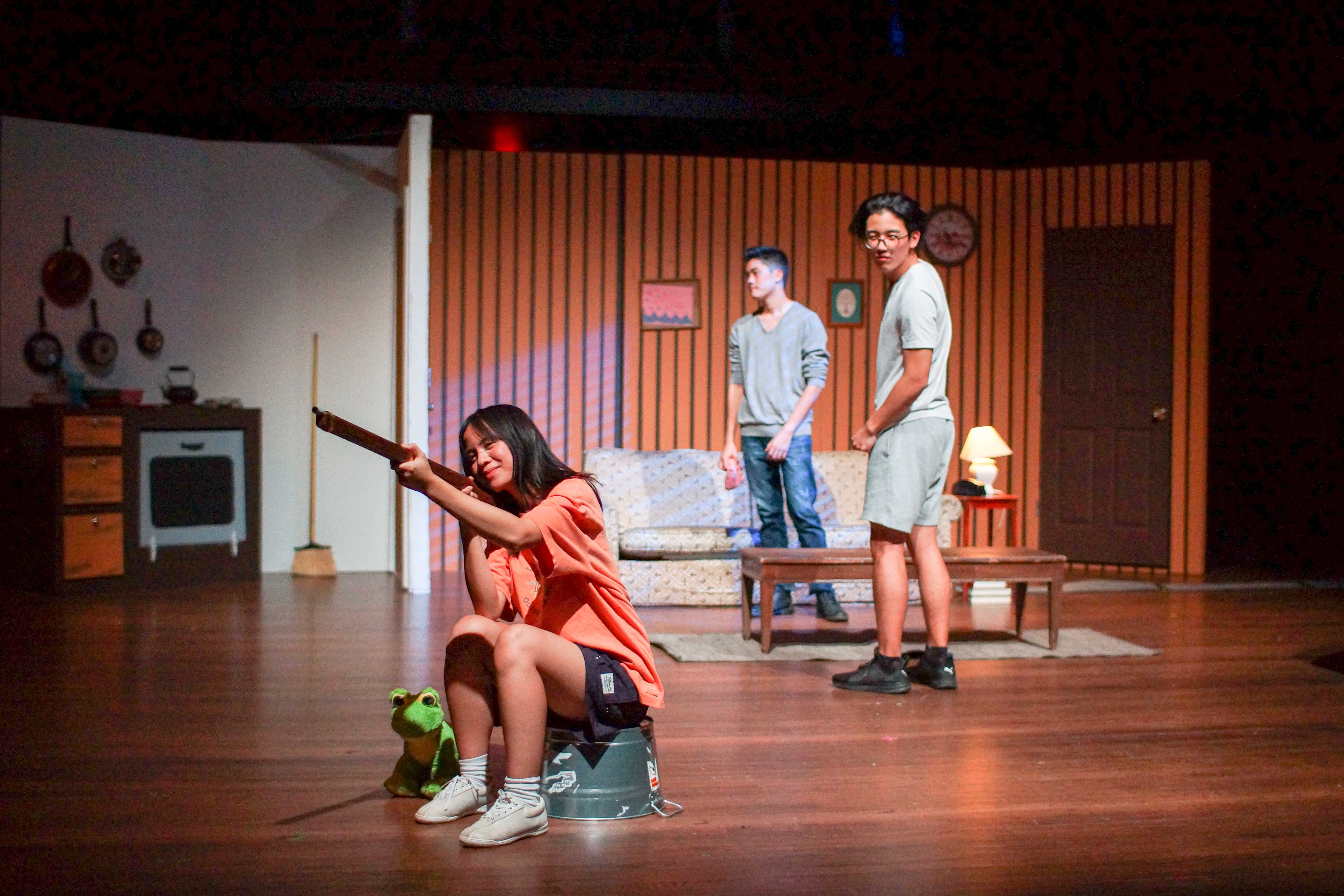
    It’s not long into the runtime of Second Stage’s most recent production that Chekhov’s gun is unveiled. This isn’t surprising; after all, the show is entitled, “Edith Can Shoot Things and Hit Them.” It would be more of a shock if Edith (Candice April Cirilo ’21) herself was never armed onstage. What was unexpected, however, was that the titular Edith is a young child, comfortably brandishing a BB. Watching Edith converse with her stuffed animal, and perform other adorable acts of early childhood, becomes a suspenseful sight; what, or who, is she going to successfully shoot and hit? (No, I won’t spoil that twist here).

    It’s a common feeling throughout “Edith” which contrasts warm, nostalgic feelings of childhood innocence with the difficult realities that the characters cannot avoid. Edith is both an innocent child and someone emotionally disturbed enough—by her diseased mother and emotionally alienated father—to feel the need to “defend” her home with a gun. “Edith” tells the story of a budding romance between two young men; in between scenes, chatter about how same-sex marriage is “unnatural” is blasted through an on-set television. It shows us an older brother comforting and teaching his younger sister, then reminds us that this is not merely a sign of the pair’s closeness, but something that must be done for them to survive. As brought to life by directing pair, Wenxuan Xue ’19 and Amira Leila S. ’20, “Edith” is both a harrowing drama and an optimistic reminder of the beauty of human relationships.

    Written by A. Rey Pamatat, the narrative follows Edith and her brother Kenny (Rama Co ’21), living in middle America and surviving off of what little money their father sends them. Edith grapples with her outrage over her mother’s premature death some years earlier and her disdain for her absent father, while Kenny is constantly forced to figure out how, exactly, he can properly take care of his younger sister. While doing so, he forms a budding romance with his classmate Benji (Dabin Shin ’22), who must grapple with his own family drama; namely an overbearing mother with homophobic disdain for her son’s new boyfriend. Wisely, none of the parental figures are ever actually seen onstage; their presence is instead felt, quite heavily, through the struggles of the three kids. The focus is squarely on the trio of young adults trying to navigate a world that consistently has nothing for disdain for them.

    Thao Phan, Staff Photographer
    Anna Yeo, Staff Photographer

    With such a limited group of characters, the show could easily backfire; thankfully, in the hands of a cast entirely made of newcomers to the Wesleyan theater scene, the play’s complex drama is handled with delicacy and charm. As Edith, Cirilo expertly depicts a young child without veering into broad caricature. She is grounded in both her character’s youthful whimsy and justifiable outrage at the cruel world she inhabits. As Benji, Shin inhabits his character’s quirky sensibility without losing sight of his character’s inner turmoil over his mother. Finally, in his portrayal of the over-burdened Kenny, Co never loses sight of his character’s struggles, nor his fleeting moments of joy. The actor is equally at home portraying a man on the verge of an emotional breakdown, and a man overjoyed at the sight of his younger sister.

    The production is further helped by its skilled directors, and their talented production team. Leila and Xue keep their staging simple, but effective, and guide their actors to turn in similarly excellent performances. Their production team, from the sets (designed by Daniel Gordon ’19) to the costumes (designed by Helen Wang ’21) is guided by a consistently homey aesthetic. Edith often strolls around their cozy home in an oversized t-shirt, the kind that suggests she stole it from her parent’s or brother’s wardrobe. The kind of comfortable living space contrasts wonderfully with the harsh realities of the drama; while their home may feel warm and welcoming, the reality is anything but.

    It’s that contrast between comforting sentiments and difficult realities that helps “Edith Can Shoot Things” excel. Its most heartwarming scenes make its most painful moments all the more devastating, and watching the pain its characters suffer through makes it all the more of a relief when something good happens. It’s a play of sharp contrasts that somehow all fit together.


    Henry Spiro can be reached at hspiro@wesleyan.edu and on Twitter @JudgeyMcJudge1.