
Author: Emmy Hughes

  • Earth Month Kicks Off With Sustainability-Focused Celebrations and Events

    Earth Month Kicks Off With Sustainability-Focused Celebrations and Events

    c/o facebook.com
    c/o facebook.com

    This April is Earth Month, and various sustainability-oriented organizations and departments on campus are hosting events and activities over the course of the month. Events range from lectures, to a garden tour, to the debut of a new Snapchat filter based on designs submitted by students. Organizations such as the Climate Action Group, the Wesleyan Eco Facilitators, the Sustainability Office, the College of the Environment, and the Earth and Environmental Sciences Department are all involved in campus events and promoting sustainability on campus.

    On Thursday, April 12, the launch of the Spin Bikeshare program will take place on the Usdan Lawn from 11:30 a.m. to 1:30 p.m.

    “Wesleyan is starting a bikeshare program!” the promotion for the event reads. “Come try out one of the NEW Spin bikes, learn about how you can earn rewards by riding a bike on campus, learn about transportation options around campus, and enter to win a FREE helmet if you download the Spin app!”

    Sustainability Coordinator Jen Kleindienst described some of the dynamics of Bikeshare in an email to the Long Lane Farming listserv. Kleindienst explained that the bikes will cost $1 for every 30 minutes of use, and a pass for unlimited rides will be available for $29 a month.

    “We hope that this program will allow for more people to take advantage of the bikes, be it to get from one end of campus to the other when you are in a rush, or to take them out for a leisurely ride during the weekends,” she wrote.

    On Thursday, April 12, there will also be a presentation on the recent efforts to reinstate the M-Link service, a modified bus route that would provide a faster ride from Middletown to the Meriden Railway Station. The presentation will take place at the same time and place as the Spin Bikeshare launch.

    Jonathan Chester, an award-winning author, professional photographer, and environmentalist, will give a lecture on Antarctica within the context of the global environment and climate change on Friday, April 13. The talk will take place in Shanklin 107 from 6:30 to 8:30 p.m.

    “Jonathan Chester has traveled to Antarctica on over forty expeditions as a professional photographer, author, and environmentalist,” wrote Chester’s son, Cormac Chester ’20, in the Facebook page for the event. “He will be showcasing his Antarctic photography and speaking about the continent and its relation to global climate change. He’s also my father, and I think it would [certainly] be worth your while to come to this very special event.”

    On Sunday, April 15, the Wesleyan Sustainability Office is hosting a tour of the Japanese Gardens around the College of East Asian Studies building, with a brunch following the tour.

    “The Freeman family garden Shôyôan Teien was designed and built in summer 1995 by Stephen Morrell, a landscape architect specializing in Japanese-style gardens,” reads the event description. “His earlier public projects have included meditation gardens for Zen Mountain Monastery in Mount Tremper, New York, and Omega Institute in Rhinebeck, New York, as well as a tea garden exhibition for the New York Japan Society.”

    Morrell will be on campus to give a tour of the garden at 10:30 a.m.

    April 23 to April 27 is Zero Waste Week, organized by the Compost Interns in the Sustainability Office. This is an annual week-long event, promoting the adoption of a zero-waste lifestyle on campus during this time period and beyond. Over the course of the week, educational events and activities will take place. This week will also be the week of the Clean Plate Challenge, which promotes student commitment to eating everything on their plates in order to reduce food waste on campus.

    On Sunday, April 29, the University’s Climate Action Group is hosting “EarthFest” on Foss Hill—this event will contain live music, tie-dye, and the debut of a Snapchat filter designed by students. There will also be multiple booths, including one at which students can write letters to legislators promoting sustainability on a governmental level.

    Luke Green ’20, one of the co-leaders of the Climate Action Group, described his excitement for the event, in addition to his excitement for the Bikeshare program.

    “I’m personally looking forward to [EarthFest] the most,” he explained. “But I’m also really looking forward to a new bike sharing program, which is going to allow students to swipe their phone on sensors to unlock bikes!”

    All of the events planned for this month are available for viewing on the Earth Month Calendar. Kleindienst, who has worked to organize many of the events, stated that any students hoping to host a sustainability-themed event this month can email her to have the event placed on the calendar.

    “There are more intersectional events on the calendar and more to come than in past years, which I’m very excited about,” she wrote in an email to The Argus. “Anyone (campus or community) can add to the calendar by emailing me or by requesting edit access—that way the calendar is open to anyone who has a great idea.”

    Kleindienst also noted that she hopes many University students will participate in the events this month.

    “I encourage anyone to stop by at least one event this month and step outside their comfort zone!” she wrote.


    Emmy Hughes can be reached at ebhughes@wesleyan.edu and on Twitter @spacelover20.

  • Van Dishoeck Delivers Sturm Lecture on “Ingredients for Life in Space”

    Van Dishoeck Delivers Sturm Lecture on “Ingredients for Life in Space”

    c/o cornell.edu
    c/o cornell.edu

    March 25 to 31 is Connecticut Space Week—like Shark Week, but in Connecticut, and even more otherworldly. Museums and universities all over the state host space-related events to celebrate, and one of the most prominent of these events is Wesleyan University’s own annual Sturm Memorial Lecture, hosted by the Astronomy, Chemistry, and Integrative Sciences Departments.

    On March 27, Leiden Observatory Professor of Molecular Astrophysics Ewine F. van Dishoeck came to campus to deliver her lecture, speaking to over 200 students, faculty, and community members. She is the 28th Sturm Memorial lecturer invited to Wesleyan, following a tradition of prominent speakers from the astronomy world, ranging from astronauts to cosmologists to astrobiologists. Van Dishoeck herself is an astrochemist, as well as the first international speaker to lecture on campus for this series. Her talk, entitled “Building Stars, Planets, and the Ingredients for Life in Space,” covered star and planet formation and chemical precedents for the formation of life in space. The enthralled audience was, perhaps unsurprisingly, more focused on the “Life in Space” aspect of the talk than any other.

    Kenneth Sturm, after whom the lecture is named, was an astronomy student at Wesleyan, and despite his love for astronomy, Sturm never pursued it as a career. As such, the lecture series honors serious commitment to and love of space and astronomy, but via the lens of education rather than the profession. For this reason, the event is free and open to all, and lecturers are not just scientists, but also members of the astronomy community known to be engaging speakers.

    Provost and self-identified space enthusiast Joyce Jacobsen introduced the talk to warm applause.

    “Provosts aren’t supposed to have favorite departments,” she said. “But actually, this is my favorite lecture event of the year and pretty much my favorite department.”

    After Jacobsen introduced the talk, Assistant Professor of Astronomy and of Integrative Sciences Meredith Hughes came to the podium to introduce van Dishoeck, noting the many awards and accolades she has received over the course of her long career. Hughes highlighted the various fields within astronomy that van Dishoeck has explored.

    “She is really one of the world’s experts on molecules in space, which is what she’s going to talk about with us tonight,” Hughes explained. “She has worked on many different scales and environments, from molecular clouds to planet-forming disks. She has worked very broadly across wavelengths, from infrared to radio.”

    Following Hughes’s introduction, van Dishoeck took the stage to lengthy, enthusiastic applause.

    Van Dishoeck received formal training in chemistry before studying molecular astrophysics, primarily studying the ways in which molecules in space form and interact with each other, simulated in a laboratory setting. Van Dishoeck also has experience with remote detection of molecules in space, using some of the most advanced telescopes in the world. And if that’s not impressive enough, van Dishoeck has also been involved in facilities development of instrumentation and telescopes, and is the co-principal investigator in building one of the main instruments on the James Webb Space Telescope, which will be the Hubble Space Telescope successor.

    By way of introduction to her talk, van Dishoeck commented on noticing an advertisement for her lecture, with the words “LIFE IN SPACE” in bold white font on the posters.

    “This morning I was actually walking along my hotel and I saw this telephone pole, and I saw this ‘LIFE IN SPACE’ poster, and I thought ‘What is this about?’” she said. “I started reading, and I realized that that was actually my own lecture! And then I realized that they had sort of very cleverly pulled out three words—‘Life in Space.’”

    “Just to remind you, [my] talk is actually [about] building the stars and planets, and the ingredients for life,” she added jokingly.

    At the beginning of her lecture, van Dishoeck described one of the more recent advancements in space exploration: the discovery of exoplanets, or planets that orbit different suns in the galaxy. These planets have been observed through two primary methods. The first is sensing dips in the amount of light a sun emits and correlating that dip in light to a planet’s size and distance from the sun. The second is called the “wobble,” which is a method that involves sensing the change in light that a sun emits when a planet passes in front of it, causing the sun to “wobble” and emit light of a slightly different wavelength.

    Van Dishoeck then went on to explain that one of the best ways to study solar system formation is to study our own solar system using physical meteorites as well as to engage in missions to comets to study them in detail.

    “These are early messengers from our own solar system and help us to put the formation of our solar system and also the formation of new planetary systems into perspective,” she said.

    The bulk of van Dishoeck’s work focused on astrochemistry, the molecular formation of planets and stars.

    “When you look up to the sky, you see the stars there, maybe you see a couple of planets, if you’re lucky you can see a galaxy, maybe, but many people have not realized what is in between the stars,” she said. “The space between the stars is not actually empty but is filled with very, very dilute gas. On average, just one atom per cubic centimeter. And it is really within this gas, the denser concentration of this gas that we call clouds, that is where the stars are born.”

    For van Dishoeck, one of the most interesting regions of star formation is the Orion Nebula, a gorgeous diffuse nebula south of Orion’s belt in which thousands of young stars are born.

    Using a video simulation of the inside of a nebula, van Dishoeck pointed out dark, dense clouds, which she explained are full of tiny dust particles. These particles consist of silicates and carbonaceous materials, which absorb and scatter light.

    “These clouds are actually some of the largest objects that we have in the galaxy—they can be several light years in diameter,” van Dishoeck said. “They can contain enough material to form maybe 100,000 new suns.”

    These video simulations were one of the most prominent aspects of her talk. Audience members were whipped through nebulas, hurtled past meteorites, and brought to the beginning of a planet’s formation.

    Although the romance of studying space through telescopes is appealing, much of van Dishoeck’s work is also in the laboratory, simulating a cubic centimeter of space. Simulating space conditions in order to observe molecular behavior is a tricky process but one to which Van Dishoeck has devoted considerable effort.

    “What actually makes it so interesting to me as originally a chemist, because outer space is really this wonderful laboratory, physical-chemical laboratory, that we can study basic processes between atoms and molecules,” she explained.

    Van Dishoeck explained that her method for studying dense clouds is to utilize infrared to see stars that are otherwise invisible. In this way, it is possible to study not just what is beyond the cloud, but what is within it. Zooming into one of the dark clouds and shifting light to a longer wavelength, it is possible to see, for example, the birth of young stars—what Van Dishoeck calls “young solar systems in the making.”

    But the only way to see these stars, clouds, and nebulas is to utilize high-tech telescopes. Many are on land, but many also need to be placed in space because Earth’s atmosphere contains molecules like water, oxygen, carbon dioxide, and so on, which block radiation from space.

    Van Dishoeck devoted the last portion of her talk to speaking about recent advancements in telescope technology, particularly the Atacama Large Millimeter Array (ALMA) Observatory, which was a combination project between North American, European, and East Asian nations. Groundbreaking discoveries have been made via the use of ALMA, which has some of the most powerful telescopes in the world.

    Van Dishoeck noted that one of the most important ingredients for life is, of course, water, and so many astronomers are on the hunt for that via these new telescopes. Using another video, Van Dishoeck showed the way in which hydrogen and oxygen atoms, tumbling around on a meteor, can combine and form water molecules, which then form a layer of ice covering a meteor over time. She then showed a video displaying the formation of larger rock bodies in space.

    “Here you see an animation of these rotating disk, and here you have these small grains and larger grains,” she said, pointing to a video of grains coagulating. “When they collide, they can stick together…and you see the growth of larger bodies. And it’s through this coagulation that we start to grow from this very small scale to maybe larger, kilometer-sized, and even larger. And we’ve started to get now some observational evidence for this.”

    After Van Dishoeck finished her talk, Hughes opened up the floor for questions, many of which centered on Van Dishoeck’s thoughts on the likelihood of life in space, or the chances that aliens are trying to contact us.

    “What we have shown is that the ingredients for life, for starting life, are basically around every forming star,” she said in response to one of these questions. “We have not yet found anywhere else but Earth, so not even Mars, or anywhere else in our solar system.”

    One audience member asked whether or not life forms could be based on different compounds than the ones on earth. Van Dishoeck explained that while it was romantic to imagine life forms based on other chemicals, it is the compounds that make up the ones on earth—hydrogen, carbon, oxygen—that are the most abundant in the galaxy.

    “You can think of different solvents: Why water, not ammonium, or ethanol, or something else like that?” she said. “And it simply comes down to the fact that there’s so much more water than anything else. Same as carbon…and we know that it is true not just in our galaxy but elsewhere in the universe, that there is more carbon than, say, silicon.”

    When the question-asking portion of the talk ended, the audience clapped once again, and Hughes invited all attendees to a reception in the Van Vleck Observatory.

    “I hope to have shown you a little bit of the excitement that we’re having at the moment, of trying to find our origins and how we were actually formed some four-and-a-half million years ago,” van Dishoeck said to the audience. “Thank you very much.”


    Emmy Hughes can be reached at ebhughes@wesleyan.edu and on Twitter @spacelover20.

  • Campus Crypto Culture: Bitcoin and Beyond

    Campus Crypto Culture: Bitcoin and Beyond

    Camille Chossis, Assistant Photo Editor
    Camille Chossis, Assistant Photo Editor

    When Bitcoin’s worth soared in mid-December 2017, it seemed as if the cryptocurrency was all that anyone on campus wanted to talk about. At Wesleyan and around the world, individuals who had never invested before put money into Bitcoin. For some, the Bitcoin phenomenon presented itself as a “get rich quick” scheme—that actually worked—while for others, it served as a valuable opportunity to enter the world of investment. Apart from a minority of fervent Bitcoin ideologues, Wesleyan students, by and large, got involved out of a fascination in how cryptocurrency and other decentralized currencies work.

    People on campus have had varying degrees of success in their investments. The Argus talked to multiple students about Bitcoin, three of whom invested—Alexander Olvera ’20, Kofi Ofori-Darko ’20 and Jack Ginsberg ’20—and were willing to speak about the cryptocurrency world.

    Background of Bitcoin

    Bitcoin’s history is a complicated one. The cryptocurrency was founded in 2009 by an internet user who goes by the name of Satoshi Nakamoto. (The individual’sor collective’sidentity remains unknown). Unlike traditional payment networks or credit transfers, the Bitcoin network is not run by a single entity but, rather, by the users. The system operates on a decentralized network of computers around the world that monitors all Bitcoin transactions, similar to other collective commons networks such as Wikipedia. The blockchain, which is a separate technology often associated with Bitcoin and other cryptocurrencies, records all Bitcoin transactions that these computers within the system are constantly updating.

    Bitcoin only began to make national headlines once it was first recorded as having a value in 2010, and, by and large, it stayed fairly low in value until 2013. From 2013 to 2017, its value increased from about $20 to $1,000, and from there the value rose exponentially. After it peaked in mid-December at around $19,000, the value went down by more than half over the next two weeks and has since been steadily rising again.

    Entry Into the World of Cryptocurrency

    We first asked students how they found out about Bitcoin and what their experiences of investment had been. Each spoke to a different means of discovery of the cryptocurrency that culminated in the same way: investment.

    Olvera: “I didn’t get into finance and investing until my senior year [of high school], so that’s when I really heard about it. People were saying that it was not worth it, to get into it, but I kinda saw it as a way to get rich fast. Everyone was investing, and people didn’t really know what it was because it’s not regulated…. And it’s also if you don’t really know what you’re doing, [as] I feel like [it was] with most people investing and buying Bitcoin…that’s what caused the bubble to burst. So that’s what I saw. I bought one Bitcoin, it gave a huge return, and I sold it when it hit the peak, so I was lucky enough to really make enough out of it.”

    Ofori-Darko: “I first heard about Bitcoin probably my sophomore year of high school. Didn’t give it too much thought, and then my first year here at Wesleyan, Bitcoin really started to boom—I believe it hit $3,000 equivalent at that point. I really started to pay attention to it some more because I definitely thought that Bitcoin had the potential to disrupt the way we look at currency and trade and run our economies.”

    Ginsberg: “I initially heard about Bitcoin about three years ago by reading an article on Vice, but, at the time, I was a little apprehensive about getting involved because I just wanted to learn more about it. Then last year, in the spring, as part of the Wesleyan Investment Group, I listened to a presentation on blockchain, which is the underlying technology Bitcoin uses, and then I started to become more interested in Bitcoin and cryptocurrencies as an asset class in general, so I began to do more research. I, at first, only saw it as an interesting phenomenon. I didn’t see any future in it personally for investing or as a currency in general, but after doing more research and understanding the core principles behind it and the differentiation between different types of coin, I realized it was more nuanced than just successful or not successful.”

    Bitcoin on Campus

    Bitcoin was especially popular as a conversation topic on campus in the winter of 2017. But in certain arenas—particularly in the Wesleyan Investment Group, of which Ofori-Darko is a member—it was relevant before the craze. Students spoke to the campus culture, or lack thereof, surrounding cryptocurrencies.

    Olvera: “I went to some meetings [of the Wesleyan Investment Group], and they briefly touched on some cryptocurrencies, but it’s not something that they would be really interested in investing in because it’s not really something you’re sure about. It can change so fast, even with people talking about it, that really does impact the value of the currency just because no one understands it.”

    Ginsberg: “On campus, I try to not follow it that much because I have other things to do, and I view it as a long-term investment for me…. I see it as a mix of a few things: one, as an intellectual exercise for learning how crypto markets work as a burgeoning and yet nascent market, and also I see it as something that is intriguing and interesting to understand.”

    Ofori-Darko: “I think the rise of Bitcoin and cryptocurrencies has definitely opened people’s eyes up to money. Because there are a lot of people on campus who I would never envision talking about trading, who are like ‘Kofi, should I buy Bitcoin?’ and I’m like, ‘I don’t know, do you want to buy Bitcoin?’ I think that it can really open up a potential for college students to start thinking about making investments, trading, and that can open up a potential for them realizing they can start saving money, and that can really take you places.”

    Morality of Cryptocurrencies

    As an antidote to the trackable and regulated U.S. dollar, Bitcoin offers a more private and volatile method of purchasing. The currency has specifically been associated with the Dark Web, an underground area of the internet, and has also been the draw of tremendous amounts of electrical energy. Other forms of cryptocurrency, such as Ripple, have also gained popularity. We asked students about the moral implications of such currencies. 

    Ginsberg: “For me, I see cryptocurrency as having the ability to solve certain types of problems—for example, Ripple targets the ability to transfer money from one country to another at a much faster pace and with less fluctuation in price change, so that solves a problem that exists in the world today. So something like that that can actually change the way the world works made me rethink and see that cryptocurrency could be something here to stay.”

    Ofori-Darko: “When you really think about it, even our U.S. dollar isn’t backed by anything. The technology behind Bitcoin—to be able to make purchases, and the lack of tracking behind it—makes it a lot easier to make purchases, and I think for people who are interested in really protecting their privacy, it can be a really great way of purchasing things.”

    Future of Cryptocurrencies

    What’s next for Bitcoin? It’s a question to which nobody seems to know the answer, even those who have invested. In spite of this, as a final question, we asked students for their thoughts and speculations as to where Bitcoin might end up.

    Ginsberg: “I think there are a lot of people who really believe of underlying in technology to create a world economy devoid of commitment to a specific state government or a government-backed currency, but generally speaking now that’s it’s become more commercial, there are a lot of people who are just interested in knowing how it works and maybe making a little money here and there. I don’t personally think Bitcoin is sustainable, which is why I switched from Bitcoin—because it’s not the best technology anymore.”

    Ofori-Darko: “It’s difficult to speculate. I think it goes back to [the fact that] Bitcoin really started rising in price, and then you had people who had never really invested money before, who were thinking ‘I can make quick cash,’ but then volatility caught up with Bitcoin, and the people who had never invested money before didn’t know what to do, and that ended up further increasing volatility, so it’s really difficult to say what the future is gonna be.”

    Olvera: “For me, that was my entry point into really the financial world and being able to invest—Bitcoin, that’s how I started, and then after that I just used that money that I made to invest in other things, stocks, studying and getting to know how it actually worked. So that was really my entry point. And it is true, people don’t really invest and have a way of saving money, they make the money and use it up…right off the bat, so as millennials we should really think about how to save our money, especially for retirement in the future.”


    Emmy Hughes can be reached at ebhughes@wesleyan.edu and on Twitter @spacelover20.

    Luke Goldstein can be reached at lwgoldstein@wesleyan.edu.

  • Kirk Johnson Lectures on Intersection Between History, Museums, Science, and Humanity
    Kirk Johnson Lectures on Intersection Between History, Museums, Science, and Humanity

    Ginger Hollander, Photo Editor
    Ginger Hollander, Photo Editor

    Director of the Smithsonian Museum of Natural History Kirk Johnson came to the University on Feb. 28 and March 1 to meet with students and professors, deliver a talk about the importance of museum work, and enjoy the geology of the region.

    Johnson’s talk on Thursday evening, entitled “Natural History in the Age of Humans,” centered on the intersection of history and science within a museum context, and provided information on humanity’s role in the changing climate.

    Prior to assuming his current role at the Smithsonian, Johnson worked as a paleontologist and primarily researched fossil plants in a field known as paleobotany. He has also appeared in the NOVA documentary “Ice Age Death Trap,” which featured an expedition led by Johnson to recover over 5,000 bones from animals of the Ice Age. He later hosted a NOVA series entitled “Making North America,” for which he won a 2016 Kavli Science Journalism Award. After working as the chief curator of a smaller natural history museum in Colorado, Johnson came to the Smithsonian in 2012. 

    Johnson met with students for a lunch and Q&A prior to his talk later in the evening on March 1. During the lunch, students posed questions about Johnson’s career path, the value of museum work, and the ways in which students can make a meaningful difference in terms of ecology and the environment.

    “You should all become museum directors—it’s the best job,” he said to students in the room.

    Johnson stressed the shared moral values of those working for museums, particularly when it comes to preservation of knowledge for future generations.

    “We’re trying just to make the world a better place—that’s the goal,” he said. “We’re not trying to make money, we’re trying to improve the planet. And so it’s a mission orientation. We’re trying to achieve something that’s positive, that’s not necessarily a business outcome.”

    Celeste Smith ’19 posited a question about the role of natural history museums in urban spaces, noting the juxtaposition of natural history and city locations, and the ways in which natural history museums may perpetuate the idea of humans as distinct from nature, in what she called a “rift.”

    “How do you see the natural history museum in the modern day maybe repairing that rift?” she asked.

    Johnson responded by noting that this was an issue he’d been grappling with for much of his career.

    “It’s a challenge for us because museums by definition are buildings in cities, which is about as far away from nature as you can get,” he said. “But as you walk in there’s a diorama with a little bit of nature from somewhere, it’s still a little bit of fossilized nature. So I wrestle with this a lot.”

    Ginger Hollander, Photo Editor
    Ginger Hollander, Photo Editor

    During his evening lecture, Johnson addressed a more mixed audience of students, children, professors, and community members. Professor in the College of Integrative Science and Earth and Environmental Sciences Ellen Thomas introduced Johnson, explaining that his presence at Wesleyan was part of the ongoing efforts to revive the University’s own natural history collection.

    “As the director of that museum, he is responsible for a collection of 145 million objects,” Thomas said. “I’m not quite sure how he knows this number of objects, however, he tells me that this means he has the largest collection in the world.”

    Thomas mentioned the intersection between Kirk’s profession and Wesleyan history, particularly in reference to the first curator of the University’s natural history museum: George Brown Goode.

    “Tonight, Kirk will be talking about natural history in the age of humans—I’m particularly excited to hear what he has to say about natural history and natural history museums in this day and age,” she said. “Like many universities, Wesleyan used to have a natural history museum, which opened in 1870. However, sadly, it closed in 1957…. The first curator of that museum was George Brown Goode, who went on to hold the position that Kirk now holds at the Smithsonian.”

    After a warm round of applause, Johnson took to the podium, opening his lecture with a bit of history on the position he now holds and showing a picture of Goode standing in front of Easter Island Moai statues. Johnson then showed a picture of himself, standing in front of the same statues.

    “[Goode] was the first director, and then 46 directors later, you have me, and the Moai are still there, so you think, ‘That’s a long time ago, 1888,’” Johnson said. “And now, I feel a very strong kinship to this guy.”

    Johnson then provided some of his own family history, speaking about his grandfather, whom he called a “cowboy.” He showed a photograph of himself, clutching his grandfather’s pocket watch at a young age. Johnson stressed the fact that his grandfather had been born in the 19th century, and yet still had a physical presence on Johnson’s own life: this, he said, demonstrated the rapid changes in history, and the age of the earth compared to individual lifespans. He also used the plotting of his family’s history against the current exponential population curve to show the incredibly rapid increases in population in context.

    “When my grandfather was born in 1879 there were 1.9 billion people, when my mom was born in 1929 there were 2 billion people, when I was born in 1969 there were 3 billion people,” Johnson explained. “And when my nephew and niece were born, there were 6 billion people, and in the six years since my nephew and niece were born, the population has increased by 500,000 people, half a billion people. Any biologist in the room would look at this curve and go, ‘Oops.’”

    Johnson’s talk then turned toward more of a philosophical look at both humanity’s impact on the planet and the changes within the human household, including technologically. Johnson then touched on the Anthropocene epoch, or the age of humans, which he sees in two different phases: humans significantly altering the landscape and the world around them directly, and humans significantly altering the climate, in more of an indirect fashion.

    Johnson talked a bit about his time at the Denver museum, with respect to one interesting project involving dioramas—little boxes of nature that were brought in and based on actual places.

    “They basically bring the world to Colorado,” he said. “The taxidermist and artist would go out, they would shoot some animals, collect some plants, they’d come back and build and paint the room.”

    Johnson explained that members of his museum went back to the locations and took pictures of the places, realizing that these dioramas are “time capsules” in their old way, particularly in areas affected by climate change.

    Toward the end of his lecture, Johnson stressed the value of museums as localities for millions of people to gain access to information and incredible exhibits, in the natural world and beyond. He ended the presentation by going through images of the many collections at the Smithsonian, ranging from squirrels to mosquitoes to gems and minerals. He also commented on the role of humans, both in preserving natural history and in creating it.

    “The story of humans is now a part of the history of life on earth,” he said. “We are now officially geological forces.”


    Emmy Hughes can be reached at ebhughes@wesleyan.edu and on Twitter @spacelover20

  • Glyptodons and Taxidermic Birds: Relics from Old Science Museum Rediscovered

    Glyptodons and Taxidermic Birds: Relics from Old Science Museum Rediscovered

    Camille Chossis, Assistant Photo Editor
    Camille Chossis, Assistant Photo Editor

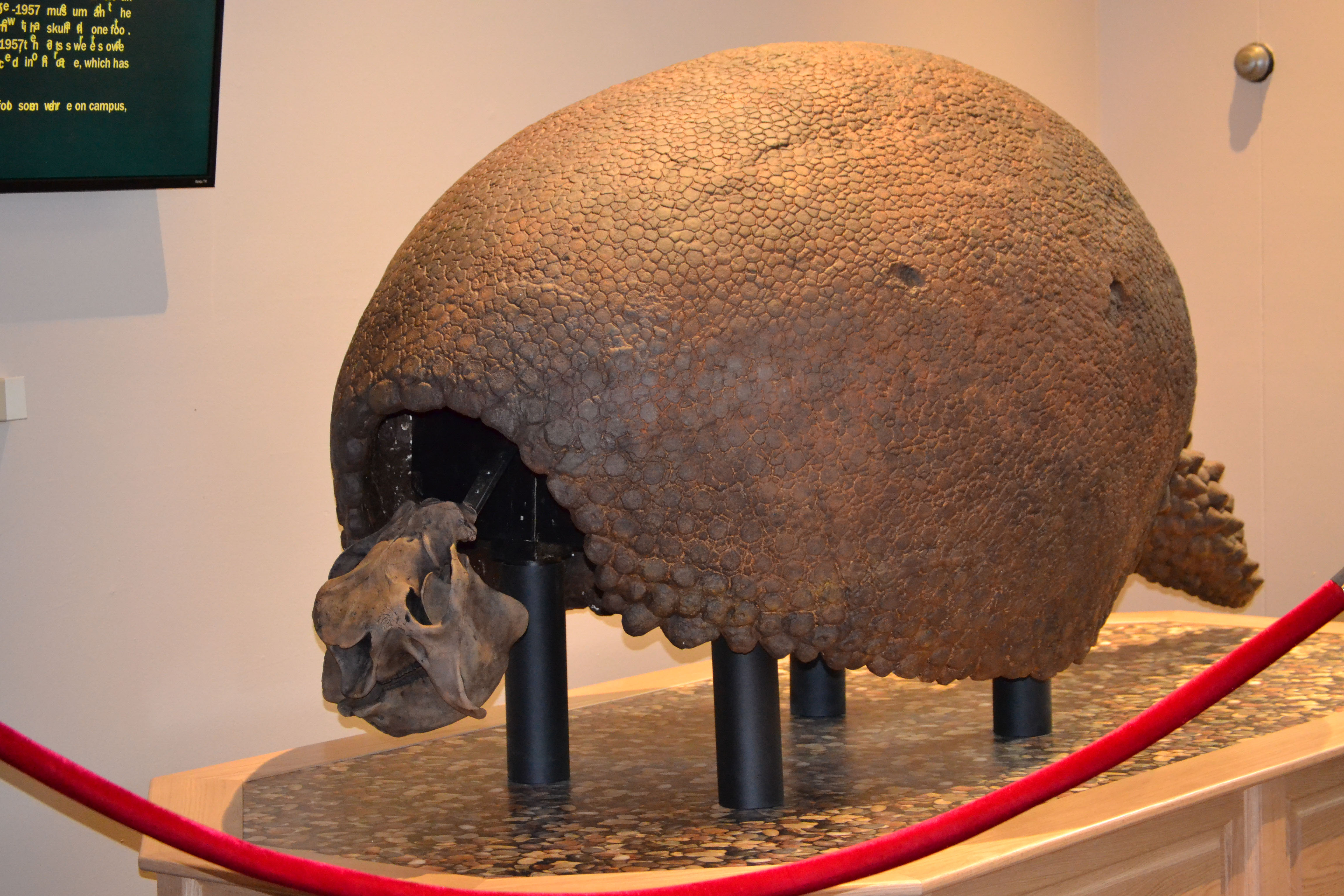
    The Glyptodon standing in the corner adjacent to the Exley Science Center’s library is impossible to miss. It is, for one thing, utterly massive—its shell alone is about the size and shape of a Volkswagen Beetle. Add on the spiky tail and skull, and the whole effect is that of a threatening, oversized armadillo, which is appropriate, given that Glyptodons, which lived between 2 million and 10,000 years ago, are relatives of the modern armadillo. This one, based on its sheer size and terrifying tail, looks much more dangerous.

    This cast of a Glyptodon shell was unearthed in the tunnels beneath the Foss Hill dormitories, and its discovery is a part of a larger project of finding and cataloging pieces of the University’s natural history collection. In order to get it out from the tunnels over the summer, a team of Earth and Environmental Sciences (E&ES) professors and students had to remove doors from their hinges to fit the massive armored dome through it. The cast has been meticulously restored, repainted, and mounted. And amazingly, the tail that was originally attached to the shell was found in storage in Exley. For the first time in over 60 years, the two are reunited. To complete the look, Professor of Earth and Environmental Sciences Ellen Thomas ordered a Glyptodon skull online, and with that, the whole animal came together: a magnificent rendering of what these mammalian creatures looked like in the Pleistocene Epoch. The completed Glyptodon, unveiled to the world on Feb. 26, now stands proudly in Exley behind a red velvet rope.

    While one of the more sensational pieces of the University’s collection, this Glyptodon shell cast is one of many casts, pieces of taxidermy, fossils, minerals, and other natural material and memorabilia that the University has in storage. For the first time in half a century, these objects are resurfacing and receiving attention, categorization, and restoration. Thomas is leading a team of graduate and undergraduate students who are working to catalog and eventually display many of these amazing pieces, which have been gathering dust for far too long.

    But in order to get a picture of what’s happening now, we need to back up.

    Orange Judd, class of 1847, was the founder of the science museum where these items were originally housed. In 1871, Judd made a gift of about $100,000 to the University to fund the construction of Judd Hall, originally called the Orange Judd Hall of Natural Sciences. Judd’s son-in-law, George Brown Goode, became the first curator of the museum.

    According to Thomas, who has heavily researched this museum’s history, Judd was meant to be like a “cabinet of curiosities.” Its displays were rooted in the prevailing notion of natural philosophy, which involved the study of all natural material: ecology, zoology, paleontology, and even history and archaeology. On display at Judd was anything from large skeletal recreations of ancient fossils to minerals to taxidermic birds, and even archaeological items, like coins.

    Materials for this museum were acquired by a variety of means: purchases, research expeditions, donations, and exchanges with other museums. While the focus of the museum was scientific research, this at the time mainly revolved around a collection of specimens. Curators of this museum were aware of the public appeal of collections and therefore opened the museum up to the public. In its beginning years, Judd was a popular place for students, faculty, locals, and visitors of the area.

    Over the years, however, attendance and interest faded. When, S. Ward Loper, the third curator after Goode, died in 1910, no one replaced him and the care of the museum fell under faculty. Likewise, the prevailing mode of scientific inquiry began shifting from observation to experiment around this time. The massive collection of specimens fell out of use, and the demand for laboratories was prioritized over the nostalgia, intrigue, and beauty of museum collections. In the end, the museum was considered irrelevant and closed in 1957. This was originally thought to be a temporary decision, but the museum was never re-established.

    When the museum closed down, the materials it housed were placed hastily in the tunnels beneath Foss Hill (which perhaps ought to be called Fossil Hill, given the number of fossils that were stored there). During the next 15 or so years, the materials collected dust and mildew. Then, around the year 1970, many of these fossils and relics were moved to the storage room on the third floor of the newly built Exley Science Center. More were placed in “The Penthouse”—a rooftop storage-space of Exley. The largest pieces remained in the tunnels underneath the Fossil Hill dorms, while others still were donated or exchanged with other museums.

    Thomas notes that some pieces were even lent to local Middletown schools and never recovered. But over the summer of 2017, Thomas and various other staff members and students uncovered some of the items that had been all but lost to the world.

    “They stuffed most of the big things in the tunnel under Foss Hill,” she explained. “And then they built—and we have just reconstructed this—and then they built [Exley], and they moved a large part of the things from the tunnels to the penthouse of this building. So the penthouse of this building also had a lot of disorganized junk…. One of the main items we were just playing with, which is our Glyptodon, we found the tail in the penthouse, and the body in the tunnels under Foss Hill.”

    Thomas notes that the adventures in the Foss Hill tunnels were incredibly exciting for her and others working on this research. Posting about it to the ongoing Joe Webb Peoples Museum blog, student Bright Palakarn ’20, who worked on this research over the summer, wrote of the discovery.

    “Our day started underneath the morning sun of Connecticut summer,” Palakarn wrote. “The expedition team was checking the necessary gear for venturing into the forbidden tunnels: this included a crowbar, reliable flashlights, and a good camera for the possible emergency selfie situation.”

    Palakarn addressed the initial discovery of the Glyptodon, too.

    “The first thing that caught our eyes was a giant wooden pallet box, off to the right in the room,” he wrote. “The condition of the box, while familiar to our experienced expedition team after our trip to the penthouse, was barely recognizable with our dim lights. Curiously, graffiti inscribed on the wall right above the box told us something crucial: ‘Clobbersaurus was here.’ After being alerted of that fact, our expedition team began scrutinizing the box more closely. We discovered what appears to be the plaster cast of a giant shell part of the Glyptodon.”

    Although the finds themselves are exciting, the brunt of the team’s current work is in trying to figure out what each of these fossils is, and where it came from.

    “We have records of people who collected things in the 1800s and we have the objects, but the records and the objects don’t agree, and in many cases we have either the records or the objects, and not both,” Thomas explained. “And so it’s a lot of work to figure out what the heck there is and where it is.”

    Student Wisly Juganda ’20 has been doing some of this work, specifically on the University’s collection of brachiopods, which are marine-shelled animals abundant during the Paleozoic Era.

    “I started with organizing the brachiopods, the 3,000 brachiopods,” she explained. “We’re planning on organizing them based on morphology, but for now, we’re organizing them based on numbers—they have labels.”

    In terms of figuring out where things are located, as aforementioned, the tunnels aren’t the only on-campus storage space for remnants from the old museum. Graduate student Melissa McKee B.A. ’17, M.A. ’18 spoke about the items in the Exley third-floor storage space.

    “A lot of them were in cabinets in the hallways, but also in different storage rooms,” she said. “I didn’t realize until this summer, but there’s a huge storage room of fossils and taxidermic birds and minerals on the third floor. There was a taxidermic peacock in there.”

    It’s true: In addition to fossils and minerals, within the third-floor storage room are taxidermic birds dating back to the 19th century. An owl sits in Thomas’ office, and McKee’s massive peacock perches on a stand in the storage room, along with many others. Biology Chair Ann Burke is in charge of the birds’ restoration; many of these taxidermic creatures will be getting new, glassy eyeballs, in addition to feather cleanings and various other treatments.

    Along with the birds, Thomas hopes to display some of the collection of bones, including a fabulous rhinoceros skull. Casts of dinosaur skeletons like the sea-dwelling Ichthyosaurus have already gone on display on the third floor of Exley; these remarkable displays greet visitors as they walk off the elevator and through the halls. A massive elephant skull will be appearing in Hall-Atwater. Thomas hopes that these items won’t just be confined to science buildings, and that one day, in Usdan and Olin, some of these marvelous specimens will be available for the public’s viewing pleasure.

    Many materials that didn’t get lost ended up in the Joe Webb Peoples Museum on the fourth floor of Exley. This museum houses many of the minerals in the University’s collection, along with drawers of fossils, and a fantastic buffalo named Greg. Researchers hope to expand this museum and are already doing so; new displays of fossils are currently being put up, along with outstanding artistic recreations of the ancient environments in which these animals would have lived. This is the intersection between art and natural history, something common in museum settings.

    Indeed, one of the most important aspects of this project is its intrinsic interdisciplinary nature. As Thomas notes, many of the students doing this work are not Earth and Environmental Science majors, and the project itself is grounded in not just biology and geology, but archeology, history, philosophy, and art. It also involves outreach and education, particularly in the local area.

    “This gives you the opportunity to talk about the philosophy of science, the history of science, the history of science in Wesleyan,” Thomas explained about her work. “It will give us the opportunity to interact with the local community in Middletown, with opportunities for schoolchildren. Looking at actual fossils and things is more fun than just staring at pictures.”

    In this vein, Thomas is also working to create an exhibit in conjunction with the archeology department, involving a display of items made from shells next to a specimen of the species of shell used. This display will be an example of the archeological and ecological sides of natural history.

    Even the Glyptodon on display in Exley has a history of its own. The Glyptodon is a cast—not an original shell—and was made in the 19th century. The original fossil from which this cast was made was found in Argentina in 1846 and is currently located in a museum in Dijon, France. This cast of the animal was obtained by Judd Hall in the 1870s—for $150. The politics of these purchases and exchanges are murky and are wrapped up in the political tensions at the time.

    Although Thomas says this has been an ongoing project for some time, it’s nowhere near finished—the Glyptodon display, though exciting, is only the beginning. But Thomas and McKee did let themselves revel in the excitement of the display, which has been received well by University students and staff alike.

    “Now the tail and the shell are reunited after sixty years,” McKee said.

    “For the first time since 1957,” Thomas added proudly.

    Indeed, the union of the shell and tail is a historic moment. And it is only one of many to come.


    Emmy Hughes can be reached at ebhughes@wesleyan.edu and on Twitter @spacelover20

  • Professor’s Bookshelf: Amy Bloom ’75

    Professor’s Bookshelf: Amy Bloom ’75

    c/o goodreads.com
    c/o goodreads.com

    Shapiro-Silverberg Professor of Creative Writing Amy Bloom, who is a New York Times best-selling author and National Book Award nominee, has written a new novel entitled “White Houses.” The book, which came out on Feb. 13, charts a love story between First Lady Eleanor Roosevelt and the journalist Lorena “Hick” Hickok, whose real-life relationship is documented through the thousands of passionate letters they exchanged, even while Roosevelt was living in the White House. The Argus spoke with Bloom about the process of writing her book, future book readings, and new literature she’s looking forward to reading.


    The Argus: This book is based off of this fairly well-documented relationship between Lorena Hickok, the journalist, and Eleanor Roosevelt.

    Amy Bloom: I think it probably depends on who you ask, but yes.

    A: So what was the process of researching for this book?

    AB: The process of researching the book was to read pretty much—not every, because it’s a pretty big category—but most of the biographies of Eleanor Roosevelt, of Franklin, of Lorena. And then, to read the 3,000 letters between Lorena Hickok and Eleanor Roosevelt, which are at the Roosevelt Library, which represents a portion of their correspondence over 30 years.

    A: How informative did you find each of these sources? Did you draw most of your material from the letters, or was it in combination with the books?

    AB: The biographies were certainly very instructive, and useful for information and timelines and various correspondences, but the letters were the thing itself. The letters were the communication between the two central figures, and so those were enormously illuminating and interesting, and passionate, and heartbreaking, all those things, as you hope they will be.

    A: Where did you get the idea for writing the book?

    AB: For my last novel, I researched the ’30s and ’40s, and you can’t really research the 1930s and ’40s in the United States without coming across the Roosevelts all the time, because they were fascinating and complicating people. Blanche Wiesen Cook’s biography of Eleanor Roosevelt talks about her relationship, writes about her relationship, with Lorena Hickok and that caught my attention. Then I went and read the letters, and then I thought, “This is this extraordinary love story, lost to history.” And not only lost to history, but in fact, torn out of history. I thought, “I would like to tell that story.”

    A: So you haven’t come across any literature, other than the biographies, that talks about this narrative and this relationship?

    AB: No, there are, I think in the last few years, there have been I think one or two books that have come out about Lorena Hickok and Eleanor Roosevelt—non-fiction books.

    A: Is this the first fictional piece [about this relationship] that you know of?

    AB: It is certainly based on facts, but I do try pretty hard to emphasize that it’s a novel—that my wish is not to argue the facts. It’s not an alternative history. It’s a novel. It is my imagining of these characters, and my imagining of things that no one is ever going to know, because no one else is in the bedroom.

    A: To that end, because this is based on two historical figures, what liberties did you feel you could take with the characters?

    AB: I felt like I could take pretty much the liberties that one would take when writing a work of fiction, which is enormous liberties, if one wished. But in fact my wish was to build from the facts. My wish was not to say, “How about if Eleanor Roosevelt was a sexy blonde Vegas showgirl who happened to marry Franklin Roosevelt.” And you can do that in a novel! But I didn’t choose to do that in this novel. I chose to work from the facts of chronology, and the known facts of their characters, and the known facts of time and space.

    A: Do you have any book readings planned, or general [events] for the future of this book?

    AB: I’m in the middle of a book tour as a matter of fact. I’m going to be in Massachusetts, then I’m going to be in Washington, D.C., then I’m going to be in Dallas, Houston and Austin, then I’ll be in Brooklyn, at Books Are Magic, at the end of next week. Then reading at the Roosevelt House with Blanche Wiesen Cook, the historian, which I’m very much looking forward to, and then the Westport Public Library, and then I’m wrapping up the book tour.

    A: Great! So diverting to your reading material, what books are currently on your bookshelf?

    AB: Well, there are a lot of books, but the truth is, at the moment, I’m reading a mystery by P. D. James when I get a chance, because I’m doing a lot of traveling. And I’m re-reading a book of poetry by Jane Hirshfield called “Given Sugar, Given Salt,” which I love. I wish I was reading more contemporary fiction right this minute, but I think I’m going to need a week or two to settle in.

    A: What are your favorite books that you’ve finished recently?

    AB: My favorite book that I’ve finished recently is “An American Marriage” by Tayari Jones. We read each other’s work, and I think it’s a terrific novel. That is the most recent book I’ve read.

    A: Is there anything in your docket that you’re looking forward to reading?

    AB: Yes, although honestly, I think I’d be hard-pressed to come up with a title for everything. There’s quite a recent Roddy Doyle book that I’m looking forward to reading, and I’m looking forward to reading Zadie Smith’s collection of essays. Those are the two that are at the top of my list right now.


    Emmy Hughes can be reached at ebhughes@wesleyan.edu or on Twitter @spacelover20.

  • All Tied Up in the Details: Seven Shades of Grey That Aren’t Completely Terrible
    All Tied Up in the Details: Seven Shades of Grey That Aren’t Completely Terrible

    c/o fiftyshadesmovie.com
    c/o fiftyshadesmovie.com

    Despite having never read any of the books nor seen either of the first two movies, I decided to watch the third film in the Fifty Shades trilogy, “Fifty Shades Freed,” on Valentine’s Day, in theaters. What had gotten into me, you may ask? I can’t say I have an answer for you. Perhaps it was my penchant for jubilant antics, or perhaps a more serious drive to understand this cultural phenomenon. More likely, I thought it would be funny.

    The film stars Dakota Johnson and Jamie Dornan as newlywed couple Anastasia Steele Grey and Christian Grey. Now that the turbulence of the past is behind them, the couple is faced with the only two marital issues that exist: unplanned pregnancy and kidnapping. Funnily enough, “Fifty Shades Freed” is less of a romance and more of an action film than I expected, which I don’t think improved it at all.

    Before going to the film, I decided, for the sake of contrariety, to write a good review. I would not focus on what made the film awful, and instead highlight the more positive facets, because this would be more challenging to write and perhaps more interesting to read. After having actually seen the film, however, I realized that this was an unwise task to set for myself and have since been struggling to think of some, or any, good things to say. But with the help of the friends I dragged along with me, and some very deep thinking, I’ve come up with a list. Here it is.

    (Also, just in case you’re interested in heeding such a warning for such a film, spoiler alert.)

    1) Christian Grey was, on occasion, a decent-ish husband.

    Yes, the power dynamic is heavily skewed in his favor—pretending otherwise would be missing the entire plot of the movie, and any slice of agency Anastasia had throughout the film was bestowed to her by Christian. But there were occasional moments of what looked like actual tenderness, like when he apologized toward the end of the film for being a self-involved prick and when he invites all of her friends to Aspen for a getaway. Still, though, he’s really the absolute worst.

    2) I did not feel vastly uncomfortable during the sex scenes (though I did still feel uncomfortable).

    The sex scenes were, I imagine, slightly dulled down from previous films, as the Greys enter their domestic sphere together and the plot shies away from the intrigue and excitement of the early scenes in the “red room.” Instead, the scenes felt even a little tired. I did enjoy the beginning of one of the sex scenes, in which Anastasia is eating ice cream on a kitchen counter and offers some to Christian, only to pull the spoon away just before he reaches it and eat it herself. What follows is less engaging. Otherwise, there wasn’t anything too totally alarming, which I have to say I appreciated.

    3) There was a moment of self-aware humor that I really enjoyed a lot.

    So here’s the scene: Ana’s just been almost-kidnapped by Jack Hyde, she’s catching her breath, and her bodyguards have him pinned down on the floor. One says: “We should restrain him!” The other replies: “I don’t have anything.” And Ana chimes in with a perfectly-timed: “We do.”

    Maybe I give this scene too much credit, but I think this is just about the most hilarious part of the film. It bridges the two ridiculous plot-lines: Hyde on the hunt for revenge against Anastasia, and the use of restraints and other various sexually-charged objects in the sexual routine of Ana and Christian—the premise upon which the books and movies are built. The scene seems to say: We know this is ridiculous, but just go with it. And as a viewer, I’m down for that kind of honesty.

    4) Ana is a good driver.

    She’s actually a great driver. Nearing midway in the movie, Ana and Christian find themselves being tailed by an SUV, and Ana manages to lose the car by driving with the deft precision of a stunt driver (which is, I imagine, exactly the person who’s actually driving in these scenes, unless Dakota Johnson raced in a previous life). Plus, she can parallel park! Which is honestly even more impressive than the speedy driving.

    5) Ana’s bangs are representative of what having bangs is truly like.

    What’s not to love about a great set of bangs? I truly enjoyed watching Ana’s bangs over the course of the movie: sometimes they were a little side swept, sometimes they were blowing up over her forehead, and sometimes they lay a little bouncily on her forehead. I have bangs myself, and they can be very unruly. Like mine, Ana’s weren’t always perfect.

    6) The octopus painting in Ana’s office is cute and reminds me of an octopus I have on a poster in my dorm.

    They might actually be the same octopus, except hers is blue and mine is a nice shade of light maroon. I liked her octopus because it made me think of my octopus.

    7) There were a couple of bits of dialogue that actually felt authentic.

    In the beginning of the film, after Ana sunbathes sans bikini top and is chastised by Christian for showing too much skin, she stretches lazily and asks him why he’s so upset. Gesturing to all the visible breasts around her (she’s at a nude beach), she says “it’s boobs in boob-land.” I just think that’s really funny and kind of sweet, that’s all.

    The other fun bit of dialogue is when Ana is with her friends in a boutique, trying on a dress that’s really low in the back. I found this a bit relatable, in that I know what it’s like to try on an outfit you love but feels a little scanty. Later, when Ana puts it on in front of a mirror, she picks up some of the fabric bunched around her stomach and says “It’s like a napkin.” Which is hilarious! I guess what I’m realizing is I love whenever Ana is slightly weird, and that’s about it.


    And there you have it: The seven things about “Fifty Shades Freed” that aren’t outright terrible. Hopefully, now you can avoid seeing the movie entirely, as you’ll have already learned the only redeemable aspects of the film. But if you do end up seeing it, be sure to bring along some friends to laugh with, and a healthy dose of willingness to allow yourself to enjoy the moments that don’t make you uncontrollably cringe and want to sink into your seat and disappear. Because, unlike the Greys’ horrible marriage, those are the moments that will last a lifetime.


    Emmy Hughes can be reached at ebhughes@wesleyan.edu.

  • WUGS: Earth and Environmental Sciences Students Found Campus Geological Society

    WUGS: Earth and Environmental Sciences Students Found Campus Geological Society

    In an effort to promote interest in geology and connect students to resources within the world of earth sciences, students in the Earth and Environmental Sciences (E&ES) Department are creating a new organization: The Wesleyan University Geological Society (WUGS). WUGS will center around providing students with field trip opportunities, grant money for research projects, and connections to those working in the field of geology, both in Connecticut and beyond.

    Prior to WUGS, no geological society has existed on campus in recent memory. WUGS will have multiple components, both Wesleyan-centric and oriented to the greater geological community. Wesleyan-centered activities will include hosting events such as selling rock candy and a Rock ID Competition, in which students compete to identify the most rocks. WUGS will also focus on the wider Connecticut area, with one of the club’s goals being to publish literature about the Connecticut Garnet Trail, a common locality for E&ES students.

    On an even wider scale, students who participate in WUGS must be a part of at least one other geological organization, be it the American Geophysical Union (AGU), the Geological Society of America (GSA), the Geological Society of Connecticut (GSC), or the National Honor Society for the Earth Sciences: Sigma Gamma Epsilon (SGE).

    A chapter of SGE is opening up on campus in conjunction with WUGS. The offices of President and Vice President of WUGS will be shared with those of SGE, while other positions, such as secretary and treasurer, will differ across each organization. SGE encourages more philanthropic actives and focuses on academics and honors, which differs from the goals of WUGS, which will be broader in nature.

    Master’s student Melissa Luna came up with the idea of starting WUGS on campus. Her motivation, she explained, stemmed from her own experiences in a geology club and as the president of her undergraduate school’s chapter of SGE.

    “When I was an undergraduate, I kept to myself,” Luna explained in an email to The Argus. “I would leave immediately after class, and would just go home and do my own thing. However, one of my professors reached out to me and mentioned that I should attend a geology club meeting. At that point, I only knew geology from what was presented to me in classes, and to be honest, that was not enough to convince me to be interested in the subject. So, I attended the meeting, and since then, I had become heavily involved in the geology club.”

    Luna explained that via the opportunities provided by this club, including field trips to mines and to natural history museums, her love of geology developed. Likewise, her involvement in this club was integral to her arrival at Wesleyan.

    “These extra opportunities are [what] led me to where I am today,” she said. “If I hadn’t known about these events organized by our geology club, I wouldn’t have met Suzanne O’Connell (my advisor), and I probably would not have met my future employers. With that being said, I really just wanted to extend and create opportunities for the students in the E&ES department, especially with graduation quickly approaching.”

    Luna worked with Jackie Buskop ’19, an E&ES major, to create both WUGS and begin the chapter of SGE on campus. Buskop explained their reasoning behind creating both organizations.

    “[We decided to] make an over-arching organization that can encompass different professional societies as well as Sigma Gamma Epsilon,” she explained in an interview with The Argus. “Because SGE has some requirements that maybe not everyone could fulfill, or want to, so we wanted to be more inclusive to people who wanted to be associated with geology and the earth sciences, but for people who didn’t necessarily fulfill those same requirements.”

    Buskop hopes the club will be a place for interesting activities and outreach, rather than focused on academics.

    “I think just having collaboration with everyone who wants to be involved will be fun, because it’s not something you have to do, it’s something you want to do,” she said. “We’re not forcing anyone to be there, so you know, it should be fun! We get to talk about what we like best, let it be volcanoes or earthquakes or rocks.”

    Likewise, she noted that membership in WUGS will not be limited to those majoring in E&ES, while SGE will be open to anyone who has met the GPA requirement and has taken at least 2.5 credits in the E&ES department.

    Although the club has various activities planned for the upcoming semester, Luna explained that she’s most excited about the prospect of “blazing” the Connecticut Garnet Trail.

    “Right now, I am excited about the enthusiasm from both the students and the faculty members about starting this organization,” Luna noted. “However, I am also excited about a particular project that will be taking place once the weather starts to cooperate. In the spring, we are planning to blaze the garnet trail as a collaboration with the Department of Energy and Environmental Protection. Basically, we are marking localities of where garnets (CT’s state mineral) can be found, and creating the paths to find them.”

    Buskop, too, is excited about the club’s prospects.

    “It’s our little baby, I want to see what becomes of it,” she said. “I was so excited to see people were interested, because I think we really needed an outlet for creativity in the sciences, something like that didn’t really exist before as much, but I think being able to combine going outside, and philanthropic work, and fundraising, and I think learning how to accomplish those activities is a rewarding skill in itself.”

    Contact either Jackie Buskop or Melissa Luna, at jbuskop@wesleyan.edu and mluna@wesleyan.edu, respectively, for more information regarding membership to either WUGS and SGE, or other geological organizations.

    Emmy Hughes can be reached at ebhughes@wesleyan.edu or on Twitter @spacelover20.

  • Into the Stacks: Senior Theses Stand the Test of Time

    Into the Stacks: Senior Theses Stand the Test of Time

    Nita Rome, Staff Photographer
    Nita Rome, Staff Photographer

    The process of writing an honors thesis is a long, arduous, and stressful one, but the culmination of the work—often in a bound hard-copy black book, with gold trim and professional-looking double-spaced pages—is, for many, worth the months of effort. This semester, seniors who are writing honors theses will see their efforts come to fruition in mid-April. Written theses will be bound and processed, and students have the opportunity to take home copies for themselves and their families.

    Of course, the rest of the world is supposed to be able to read theses, too. The University preserves a large collection of student-written theses, which are available in two distinct forms, and each form has a different level of access and means through which students can read them.

    The main storage area for student theses is with the University’s Special Collections Department, located on the first floor of Olin Library. The University preserves a single copy of almost every honors thesis written since the 1930s, which are kept in the University’s archives collection. Some early theses are arranged by department, while the more recent ones have been arranged by year and author to promote ease of access.

    Theses are non-circulative, meaning a student cannot check one out to read in their preferred location. Theses are instead treated as manuscripts, and like other objects in the University library’s Special Collections department, students can request to read a thesis in advance via a retrieval form. The student can then read it in the Special Collections & Archives Reading Room, located in Olin Library, where students aren’t allowed to have food or drinks, and can only take notes with a pencil. As such, theses are maintained in a way that promotes long-term preservation.

    University Archivist Leith Johnson, who works on the maintenance of student theses, notes that this method protects theses from the effects of frequent handling and misuse.

    “Each individual one is consulted relatively infrequently, so it’s not like there’s a lot of wear and tear,” he explained. “They’re bound, they’re in good shape, they’re in good condition—we don’t really have a problem with them falling apart or anything like that.”

    The Special Collections & Archives Reading Room is also used regularly for other rare, fragile, or notable pieces of literature in the University’s collection. This includes first editions of many books, and a collection of artist’s books, which are unique, hand-bound books made by Wesleyan students and affiliates.

    In addition to their regular storage spaces, Special Collections keeps a few copies of senior theses related to University history available in the foreground of the Special Collections room.

    “We keep them up here because they’re ready to go,” Johnson explained of these theses. “We’ve got a fair amount of material. They’re used quite a bit.”

    In addition to physical copies, the University’s library maintains online copies of theses on its database WesScholar. Hundreds of theses can be obtained and read as full-text documents via this system, though it often takes months for theses to be uploaded after submission. Students can opt out of this system, but according to Johnson, around 90 percent of students opt to include their thesis on WesScholar, as it allows for other scholars and potential employers to access them.

    “Starting in 2008, I believe, students were given the option of uploading their [undergraduate] theses to WesScholar,” Johnson explained. “And so everyone’s required to present a deposit copy to Special Collections and Archives that can be read, and additionally, you have the option of uploading [the thesis]…. Once it’s uploaded, there’s no longer a need to come here in Special Collections—it’s fully searchable.”

    Some students, however, do opt out of WesScholar, at least for some amount of time. Student Jenny Davis ’17 chose not to include her English thesis on WesScholar, and student Thienthanh Trinh ’17, who wrote a thesis in the Biology Department, explained that a potential reason for delaying accessibility on WesScholar could be interest in publishing one’s thesis in a journal. For other students, WesScholar is a method through which their theses receive attention.

    “Some students are getting read thousands of times—their theses are being downloaded thousands of times, or hundreds,” Johnson said. “But it’s really, really great to get this scholarship that students produce, that’s great work, out there.”

    In some cases, theses are accessible not just via WesScholar and Special Collections. Students will occasionally donate theses to their respective departments, thesis advisors, or to various campus organizations. You might have seen the theses located in libraries of different departments, where many are kept on display. Rather than tuck theses away, some departments will make them more available for students to poke around and explore.

    Alpha Delta Phi, for example, maintains an assorted collection of theses written by members of the fraternity, which are available for students to read in one of the main rooms on the first floor. Administrative Assistant for the English Department Liz Tinker explained that, while the English Department has no formal method of maintaining theses, some copies do still exist.

    “We do have some old bound copies but only from students who thought to give us one or from retired faculty who were given copies,” she wrote in an email to The Argus.

    Most notably, the University’s Science Library has multiple shelves of hundreds of students’ master’s science theses and doctoral dissertations, organized by department and spanning decades, with some of the earliest copies dating from the 1930s. These theses are made more accessible to students who are both interested in University science research and who are looking to cite Wesleyan research for their own projects, bypassing the longer archival system. No student senior theses are available in the Science Library, and each of these master’s and PhD theses have an alternate copy that’s preserved in the Special Collections Department.

    University Science Librarian Melissa Behney explained that until recently, the Science Library would receive a physical copy of master’s and PhD science theses, which were then stored on these shelves.

    “Until a couple of years ago—and the graduate council actually makes a decision about what’s submitted and where it goes—master’s and PhD students were required to submit a copy to the Science Library and a copy to the Special Collections and Archives,” she explained. “That is no longer the case…. We no longer receive a print copy.”

    This change matches the use of WesScholar for undergraduate research theses, as master’s and PhD science students now have the option of uploading their theses to the online database. Behney also explained that because the copies in the Science Library are considered “second copies,” there isn’t a major system of upkeep.

    “There isn’t an active preservation program, because we assume that there’s a well-preserved copy in Special Collections,” she said. “But if something came up and were damaged, falling apart, that kind of thing…. It would still be sent for preservation, still be repaired.”

    Although theses are available in the Science Library and other locations throughout campus, the primary means through which theses are accessed remain via WesScholar and the University’s Special Collections Department. Both allow reading access to theses, while maintaining their pristine status. Current students working day and night on their theses can rest easy, knowing they can expect that at least one physical copy of their hard work, alongside a digital one, will be kept for decades to come.

    Emmy Hughes can be reached at ebhughes@wesleyan.edu or on Twitter @Spacelover20. 

  • Season 4 of “Black Mirror” is Technically Stunning but Technologically Disappointing

    Season 4 of “Black Mirror” is Technically Stunning but Technologically Disappointing

    c/o Netflix
    c/o Netflix

    Editor’s Note: This review contains spoilers.

    I was highly anticipating the arrival of Season 4 of Netflix’s “Black Mirror”—and so was everyone. The anthology show is known for its biting dystopian visions: Each episode displays worlds in which empathy is rare, technology reigns, and the line between the human and the inhuman is all but obscured. This season, however, contained some of my least favorite episodes of the show and was overall less impressive than previous seasons. The social commentary was less sharp, multiple storylines were not particularly well conceived, and much of the technology felt flat, predictable, and overused.

    Don’t get me wrong, I’m a huge fan of “Black Mirror”—just read my review of the last season. I consider it one my favorite shows of all time: I love it for its clever depiction of the intersections of technology and ethical dilemmas, its delicate rendering of conceivable human and inhuman futures, and its uncanny ability to catch a viewer off guard. Year by year, the show sets high expectations for itself. And unfortunately, in spite of a few episodes that triumphed, those expectations were largely not met in this season.

    The primary problem was the lack of interesting and new technology. While I liked some of the nods to previous episode’s techy nightmares, I would have appreciated some newer, wilder concepts in this season. This was true especially for “Arkangel,” but also for “USS Callister,” “Crocodile,” and “Black Museum.” Additionally, the lack of believability of the episodes, even as potential futures, felt distinctly different from the satirical vision of early “Black Mirror.”

    An example of this is “Arkangel,” the second episode of the season. While the concept—an overprotective mother gaining access to her child’s whereabouts and memories via a chip in her brain—is an interesting one, its plot was predictable, and its aforementioned technology was fairly banal.

    The technology of “Arkangel,” which centered around full access to visual memories, is an idea previously explored in “The Entire History of You,” a Season 1 “Black Mirror” episode. Granted, “Arkangel” focused more on a mother’s access to her daughter’s memories than a person’s access to their

    c/o Netflix
    c/o Netflix

    own, but both commented on how access to all memories can destroy relationships. As a result of my familiarity with this technology, the plot of the episode felt predictable and occasionally uninteresting. I will say that using technology to examine parent-child relationships, particularly during the seminal moments of a child’s teenage years, was an interesting choice and a successful one, and overall this episode wasn’t bad. But for “Black Mirror” standards, it wasn’t great.

    “Crocodile” was also not wildly impressive; the episode began in a promising way, and then lost a bit of its momentum as the story progressed. It follows an architect named Mia who, 15 years after covering up a hit and run, reckons with the effects. We watch as Mia spirals into a spree of murders in order to maintain the threads of her life: her architecture, her independence, her family.

    To me, the more interesting storyline was that of the insurance representative Shazia, who uses memories (yep, it’s another memory-centric episode) garnered from people who witnessed a crime to piece together the events that occurred. This aspect of the show explores very real aspects of the way memory works, like the triggers of scent and the powers of suggestion, and also imagines a world in which memories become tools and evidence for police and insurance companies. Characteristically dark, the episode also has an unlikely killer, and a cynical take on human empathy. I found it effective, but it certainly wasn’t a stunner compared with other episodes and seasons.

    The worst episode of the season was “Metalhead,” which by far the least developed and least interesting. It takes place in an ambiguous age and society, starring characters entirely lacking in backstory and a situation utterly lacking in context. The episode follows a woman fleeing from terrifying and murderous mechanical dogs that aim to blow off her head. And that, essentially, is it. We witness her driving through woods. Running through woods. Hiding in a tree. Hiding in a bathroom. But we never get any more context on her as a character or on the clearly dystopian society in which she lives, which is a bit of a bummer, given that providing this detail is one of the most interesting things that “Black Mirror” does. It’s difficult to become invested in this woman as a character when we have no idea who she is. The end of the episode is supposed to be emotionally resonant—we learn that the reason the dogs came after the woman was because she was trying to obtain teddy bears from a warehouse—but it falls completely flat because we have no idea who the bears are for. The entire episode takes place in black and white, also, which feels trite and unnecessary. I don’t really have anything good to say about this one: “Metalhead” was a poor piece of television.

    Of course, some of these episodes were still tremendous. The best episode of the season was “USS Callister,” which is a beautifully plotted and designed episode with a fabulous concept and execution. The episode takes place partly in the office of a video game design company, and partly inside the game of Robert Daly, one of the company’s co-founders. His game takes place in a spaceship and is modeled after Space Fleet, a fictional Star Trek-eqsue show.

    The big twist is that Daly’s game is inhabited by encoded versions of his co-workers, who have the memories, personalities, and DNA replicas of their human counterparts. It’s an amazing concept and an engrossing plot sequence with beautiful acting. The technology was similar to that of “Playtest” in terms of human consciousnesses inhabiting games, but that was forgivable in that this direction was so different and so visually and viscerally affecting. The only issue with this episode that I found was its impossibility: You can’t get a person’s personality or memories from their DNA.

    “Hang the DJ” is, perhaps, my favorite piece of television ever. The episode takes place in a self-contained dating universe, in which a system sets two people up with one another for a certain amount of time to test their compatibility and does this serially until they find “The One.” These people seem to live perpetually in this world of serial dating, unable to remember what came before. The story follows a couple as they fall in love, are forced to spend months dating other people, and then eventually come together in an attempt to escape their world. We learn, then, that the entire episode took place inside of a Tinder-like dating app, in which two people’s encoded consciousnesses are matched up to see if given these parameters they choose to run away with one another.

    The implausibility of the show’s concept and the weirdness of this episode in relation to other “Black Mirror” episodes (Isn’t the concept the same as “White Christmas,” with people trapped in simulations forced to undergo a series of tasks?) is forgiven for the fabulousness of the storyline. However, “Hang the DJ” suffers from the same problem as “USS Callister” does: The technology is not believable enough given the glaring implausibility, and thus the episodes do not feel like dystopian warnings but rather fun, interesting ideas to entertain and then forget about.

    The best dystopias point to modern societal issues by exploring future manifestations of them, and neither of these episodes—in fact, none of the episodes of this season—manage to truly get to the core of any modern societal issues. That, I think, was the major failing of this season: It was more story than commentary, more interesting than viscerally disturbing.

    Even in “Black Museum,” which is iconic “Black Mirror,” there is a bit of a letdown in terms of technology. Who in their right mind would have their partner’s consciousness injected into their brain? Or a device with which to feel another’s pain? And the revenge plot is satisfying, but satisfying endings are not what “Black Mirror” should have. Instead, “Black Mirror” should leave us feeling sad and alone (which I know sounds dark, but that’s the show). Yes, the episode is jarring, it’s visually stunning, but it’s not believable even as a future storyline, which is the crux of this season’s problem. I want “Black Mirror” to terrify me of the world I live in today, not entertain me with dark but impossible futures.

    Although I found myself a little disappointed with this season, that’s not to say that I didn’t enjoy watching or fully dislike any of the episodes (except for “Metalhead”). Rather, I’d simply hoped for something more relevant and truly satirical: a black light on society revealing the parts that are disgusting and abhorrent, showing us grotesque reflections of ourselves. That is a black mirror. This, I’m sorry to say, wasn’t.

    Emmy Hughes can be reached at ebhughes@wesleyan.edu and on Twitter @spacelover20.