Author: Emmy Hughes

  • University Will Host Artists-in-Residence Following Reception of Mellon Grant

    University Will Host Artists-in-Residence Following Reception of Mellon Grant

    c/o wesleyan.edu
    c/o wesleyan.edu

    In an effort to expand and enrich campus engagement with the arts, the University has applied for and received a grant to host artists-in-residence as they develop original work. The grant, awarded by the Andrew W. Mellon Foundation, totals $250,000 and will be spent over the course of three-and-a-half years.

    The Wesleyan Center for the Arts (CFA) will house the project. Three artists will be hosted over the course of three years, each teaching and working on campus for a year. Throughout their time in Middletown, artists will develop a semester-long course as well as a visual or performance piece with student apprentices that will be exhibited at the end of the residency.

    Associate Provost Mark Hovey noted that this grant will expand the level of interaction with the arts on campus, as well as the duration of time artists spend on campus. While artists have previously resided in Middletown and worked with students and faculty, the University has rarely hosted artists for such a long period of time.

    “The grant came about as part of a longer discussion about deepening student engagement with visiting artists,” Hovey wrote in an email to the Argus. “Generally visiting artists come to the CFA for a single performance or exhibition, during which time they engage with students through classes and workshops as well as the performance itself.  This works well, but we wanted to try a longer arc of campus involvement, where an artist develops one or more pieces while in residency at Wesleyan. In this way, students can see behind the curtain, from the initial idea of a performance or exhibition through to the premiere.”

    Director of the Office of Corporate, Foundation, and Government Grants Carol Scully, along with CFA Director Sarah Curran, wrote much of the grant over the course of the summer of 2018. University Provost and Senior Vice President for Academic Affairs Joyce Jacobsen also worked on the grant proposal, along with Hovey. The proposal was also generated in conversation with President Michael Roth ’78.

    Jacobsen emphasized the value of hosting artists in the context of the Wesleyan and wider Middletown communities.

    “The grant will help facilitate deeper involvement by our visiting artists,” she explained in an email to The Argus. “Besides having them stage projects and installations in the Zilkha gallery and other venues, we like to bring them to campus for longer, more involved stays, preferably including classroom work, artist talks, and other interactions with the Wesleyan and wider communities.”

    A major emphasis of the project will be the use of an interdisciplinary approach, promoting artist engagement with various departments within the Wesleyan community. Courses taught by artists-in-residence will be cross-listed with relevant departments. Curran and Hovey also anticipate that courses will be available to students from diverse academic backgrounds, and not only students of the arts. Additional importance will be placed on ensuring public access to the visual and performance pieces.

    “Each artist will engage with the community in different ways unique to their own practice,” Curran explained. “The artists we are considering for this project have interests that connect to social justice movements, urban development, and the impact of art on community and economic development. The very nature of their work will create connections to the greater Middletown and Connecticut communities, but the details of each engagement are yet to be determined.”

    The University has received grants from the Mellon Foundation previously. Currently, a grant from the Mellon Foundation is in use to support the University’s Center for Prison Education, which is a program that gives incarcerated individuals the chance to take courses taught by University faculty, and work with University students, for college credit. The Mellon Foundation has also awarded the University a grant that supports the Center for Pedagogical Innovation, which provides staff with the resources, assistance, and training necessary to teach innovative courses. Via this grant, the University will hire a postdoctoral fellow in Interdisciplinary Art Practice, who will work with the artists-in-residence under the new Mellon grant.

    “The emphasis on interdisciplinary work in both Mellon grants is a long-standing Wesleyan tradition,” Hovey explained. “While our faculty are deeply committed to their disciplines, they have always strived to build bridges across disciplines to bring disparate ideas and people together. We hope and expect that this fellow and the Mellon artist residencies will work together with the CFA and Wesleyan’s outstanding faculty in and out of the arts to make the Wesleyan student experience in the arts even better than it already is!”

    Artists have been hosted by various departments previously, including choreographers and dancers Allison Orr in 2015-16 and Eiko Otake in 2017-18, both of whom were hosted by the College of the Environment. Another model of hosting artists-in-residence was developed in a Winter Session course taught by Visiting Instructor of Liberal Studies Tom Pearson, in which students developed a theater performance with an established theater professional.

    “Each residency will be different, of course,” noted Hovey, “but students will be involved both through courses and through fellowship or internship opportunities to work with the artists.”

    Curran noted that she and her team are currently in discussion with a few artists to determine who will be the first to come to campus. The first artist will be hosted beginning in July, during which time the artist will work with summer interns. The artist will then continue to reside on campus beginning in the Fall of 2019.


    Emmy Hughes can be reached at ebhughes@wesleyan.edu or on Twitter @spacelover20.

  • Is the Future Here? According to the Exhibition “The Future Starts Here,” Yes

    Is the Future Here? According to the Exhibition “The Future Starts Here,” Yes

    c/o dhadesigns.com
    c/o dhadesigns.com

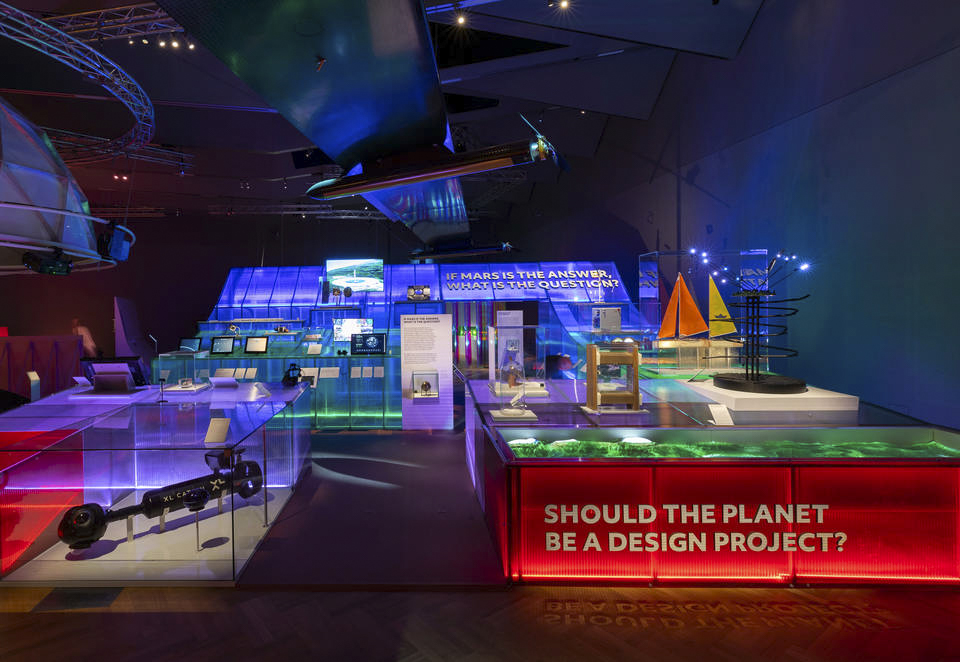
    Descend an escalator in London’s Victoria and Albert Museum of Art into an exhibition called “The Future Starts Here,” and you will enter into a peculiar room of provocative questions and provocative objects. Strange, warped music plays in the background. Objects are displayed on glowing pink, blue and green plastic-y surfaces, flooding the room with varying effusive lights.

    In effect, the room is glowing. For the most part, it is also devoid of art, or at least art in the traditional sense. Instead it houses modern gadgets and ideas that feel like the threshold to something greater, something newer: small catalysts for a future world unlike our own.

    “The Future Starts Here” is on display in the V&A from Oct. 6 to Nov. 4. It is organized into four distinct sections: self, public, planet and afterlife. Each exhibition explores the ways in which technology influences, and may continue to influence, our perceptions and lives. All of the objects on display are real, working objects, though many are models and prototypes. “The Future Starts Here” is, in a way, a cabinet of curiosities. It is a display of strange, fascinating things, which, once given a closer look, appear to draw out humanity as well as quell it.

    The exhibit simultaneously embraces and rejects the objects and the futures they embody. Many of the objects are displayed alongside questions probing at their use and invention, like “Who should own, police and regulate the internet?” and “If Mars is the answer, what is the question?” While many objects are exhibited without obvious connotation, overall, an agenda is clear: We must remain aware of the ethical implications of innovation. Some objects are clearly displayed in a positive light; an underwater probe that maps the ocean floor, a model of a city that includes green spaces and solar-paneled roofs. Others, not so much; an UberEats bike emblematic of algorithms taking the place of human bosses, a running video of a family connected to Amazon Alexa but disconnected from each other.

    Museum-goers first enter into the self section, which displays objects aimed at perfecting or cataloging  individuality. Displayed alongside objects that are strange and uncomfortable are ones that we know quite well: A Fitbit bracelet, an iPhone, virtual reality goggles. Are we already cyborgs? These objects are wearable technology that enhance our experience of reality, that we have imbued with our data, our memories, our perceptions. Here, displayed in an exhibition, they are rendered useless as tools. Suddenly, even as they are on our bodies, they are foreign. The self section also displays stranger objects, such as a portable DNA testing kit, forcing one to imagine a future in which DNA compatibility tests are administered, for example, before first dates. Two swimsuits that compress and massage muscles, designed for Olympians, float above the other objects. How can technology enhance our speed and endurance? Should it?

    Exit Self, and visitors enter into a mock restaurant, which advertises itself as a restaurant for one, in this age of living alone. Visitors can sit at one of the small tables designed for a single occupant. The restaurant feels cold, and lonely, despite an assurance that the set-up enhances the feeling of community. Yet there’s something appealing about catering for, even celebrating, loneliness.

    Moving forward is Public, which asks questions about technology and democracy: In what ways does technology improve or limit access to representation, to government? This section feels the weakest of the total exhibition. A pink “pussy hat,” for example, is on display as emblematic of organizing power post-Trump; the hat feels out of place in this cultivated cybertech world. Further along, models of cities and communal living arrangements are presented. Models include utopian visions of anarchist communities on floating islands, massive buildings dedicated to enhancing social bonds. These are fascinating. One must imagine the ways in which they enhance or diminish connection. Are we too reliant, now, on technology for human connection? How can innovative architecture change the ways in which we interact?

    c/o dhadesigns.com
    c/o dhadesigns.com

    Further along, a chrome white dome suspended from the ceiling evokes future settlements on alien worlds, as well as the 1956 futurist art exhibition “This is Tomorrow!” which played at similar themes of science fiction, art and reality. Within the dome, a concave video about climate change plays on repeat. Participants can put on headphones and lie on their backs on soft padding, looking up at it, and feel enveloped by the film. The message of the video—that we must be aware of how our climate functions, and how it is changing—is more overt than other elements of the show.

    The next portion of the exhibition is Planet, displaying objects that enhance our knowledge of space and natural planetary systems, as well as ways to enhance or surpass these systems. Planet explores habitability, terraforming, and the current space race to Mars. A small model of a Martian home is on display: it is semi-underground and dirt-covered, taking advantage of natural Martian material. The most interesting object in this section is also the most inconspicuous: a few leaves of paper with dense text. This is a copy of a bill, signed by President Obama in 2015, that allows US citizens and private companies to claim and own objects found in space. According to the didactic panel, President Obama signed this bill following a flyby of an asteroid near earth, estimated to contain 4.5 trillion dollars’ worth of platinum. This bill largely escaped scrutiny by the public eye, but it points to a precedent of allowing space to be claimed, rather than free use. Will a day arrive when Walmart owns Pluto?

    The final section is Afterlife, and it is perhaps the most interesting. One of the more provocative objects in the section is a body-sized compartment, made by the company Cryogenics, that is designed to preserve bodies after they die to later be reanimated. This is predicated, of course, on one day inventing the technology to do so, but there are those who believe we will, and wish to have their bodies prepared for it. Currently, 2,000 people have signed up for this service. They wear alert bracelets which indicate that their body ought to be preserved on ice as quickly as possible after death. The effect of this display is a strange horror and fascination, and a wonder if perhaps one’s own post-death plans are lacking.

    Another display focuses on an app, called Eterni.Me, which allows users to create an interactive digital avatar based on themselves. The app was inspired, partly, by an episode of the dystopian TV show Black Mirror, called “Be Right Back,” which warns against this very idea. The implications of the app are profound. Will there come a point when consciousness is code? It may seem like a far-fetched idea, yet advances in artificial intelligence point to a future in which this may be possible.

    In the end, that’s the theme of this entire exhibition. Each of these objects has the capacity to, in some way or another, profoundly change the future. Yet the exhibition asks visitors to remember that they have the power to activate, or not activate, these objects, as well as the responsibility to decide. The exhibition is an imagining of the future, a display of objects that have one foot in today, and one foot in tomorrow. Yet the show is, in many ways, not about the future. Instead, at its core, “The Future is Here” embraces the now.


    Emmy Hughes can be reached at ebhughes@wesleyan.edu.

  • Not Horsing Around: Lorenzoni ’20 Wins National Equestrian Competition

    Not Horsing Around: Lorenzoni ’20 Wins National Equestrian Competition

    c/o Sarah Jacobs
    c/o Sarah Jacobs

    Located about a 15-minute drive from campus is Movado Farms, where a couple times a week a group of Wesleyan students heads to ride horses. This is Wesleyan’s equestrian team. Alessandro Lorenzoni ’20, a member of the team, recently competed in the national collegiate competition and won first place in his event. This is the first time a member of the club has qualified for the national competition, and also the first time a Wesleyan student has won first place in a national equestrian event—a historic moment for the club.

    Lorenzoni and the rest of the University’s equestrian team are a part of the Intercollegiate Horse Show Association (IHSA), which includes over 400 colleges across 45 U.S. states and some Canadian regions. The overall IHSA competition has various levels prior to the national competition. Students can compete as individuals and as representatives of their school. Wesleyan is too small of a team to obtain enough points to qualify for team events, but according to Lorenzoni, club members often do well on individual competitions.

    The competition structure has three primary levels. Students must first compete against other schools in their region, and the students who receive first or second place in a competition go on to compete on the zone level. The first- and second- place individual winners in the zone competitions get a chance to go on to the national competition, which, this year, was held in Harrisburg, Penn. Students earn points at each competition, which are then tallied up and compared with other individuals and schools. Lorenzoni advanced through the regional and zone competitions over the course of the semester, finding himself, excitingly, qualifying for nationals for the first time.

    Upon finding out that Lorenzoni would advance, his fellow club members needed to figure out how to get him to Pennsylvania for the competition. On May 3, team captains Emily Hilton ’18 and Sarah Jacobs ’19, accompanied by their trainer, drove Lorenzoni down to Pennsylvania and stayed in a hotel for the night before his competition.

    “Sarah and Emily offered to drive me to Harrisburg, at the Harrisburg Show Complex, so we left Thursday afternoon, they drove me until late at night, we arrived probably around midnight, and we stayed at a hotel,” Lorenzoni explained. “Our trainer, Louisa Fedora from Movado Farms, was also there. And so we got some shut-eye, and then Emily and Sarah, as well as Louisa, went to the coaches’ and captains’ meeting at 6 a.m. They came back, we got breakfast, and went to the show complex.”

    The national competition spans multiple days, with a variety of events over the course of each day, depending on the specific competition. Lorenzoni competed in an event on Friday, May 4. Within the events in the national competition, there are two different subsets: equitation on the flat, and equitation over fences. Equitation over fences involves a rider and horse jumping over fences on a set course, while equitation on the flat—which is Lorenzoni’s event—involves a flat ring, where competitors show the judges that they can control the horse in terms of speed and motion, and are judged for posture and style.

    The relationship between horse and rider is, if not the most important aspect of equestrian riding, then certainly a vital one. At these competitions, riders are randomly assigned a horse from a pre-set group to ensure maximum evenness in the field. Riders have only a short amount of time to get to know their horses.

    “I drew a horse I got along really well with, Liam,” Lorenzoni explained. “I then got geared up, got on, and then we went into the ring.”

    Lorenzoni, along with representatives from schools across the nation, went through the 15-minute course, in which he demonstrated his skills as a rider. He then dismounted and waited among the other riders to find out his score.

    “Once the judges are satisfied, they ask you to line up in the middle, and they ask you to get off your horse,” he explained. “You walk over, and then you’re basically in a line, and they start calling you out from last place to first.”

    While Lorenzoni waited, name after name was called, until he was the only one left. Lorenzoni was caught off guard when realized he’d earned first place.

    “It took a second to realize,” he admitted. “But it was definitely exciting!”

    The group had to leave soon after Lorenzoni received his first place score. They grabbed an early dinner, and then returned straight to Wesleyan that night. It was a short trip for the group, but an undeniably exhilarating one.

    According to Hilton, Wesleyan’s equestrian team has been on campus since the early 1990s. The team practices multiple times throughout the week, with sessions based on availability. Movado has “schooling” horses, meant for teaching, that students can ride. The team also has bi-weekly competitions on Saturdays, hosted by various schools, at which Wesleyan students compete. Common opponents include the University of Connecticut and Conn College.

    “We’ll drive up there, usually in the early morning, then compete during the day, and come back in the evening,” Lorenzoni explained of the Saturday events.

    Lorenzoni noted that he’d been riding for several years prior to coming to Wesleyan in a style of riding called Western. The IHSA competitions use the English style, which involves a different saddle, different cues to communicate with the horse, and a different posture in the rider.

    “I’ve been riding English since last year, so the two semesters last year, as well as this semester and last semester,” Lorenzoni said. “And then previously, I’d been around Western horses a little bit. There’s quite a bit of difference. I kind of had to relearn from scratch what I was doing—kick off a lot of old habits from Western. If you look at a Western rider and an English rider, you’d see a lot of differences, so it was a bit of a process to figure that out, but I had a great coach and great captains.”

    The team, overall, is incredibly excited for Lorenzoni, according to Hilton and Jacobs. While other members have made it to the zone competitions in the past, Lorenzoni has overcome a significant hurdle in advancing to the national competition. He repeatedly stressed that he could not have advanced this far, let alone have won, without the help of other members of the team.

    “I couldn’t have done it without Emily and Sarah, our coach Louisa, and everyone else on the team who helped me out throughout the semester,” Lorenzoni said. “I really couldn’t have done it without them. I owe them a huge amount.”


    Emmy Hughes can be reached at ebhughes@wesleyan.edu and on Twitter @spacelover20

  • Waste Not? Want Not! Confessions of Two Failed Zero-Wasters

    Waste Not? Want Not! Confessions of Two Failed Zero-Wasters

    Earth Month was last month. As any self-respecting environmentalist knows, Earth Month is the time to really show the world some respect. This past month, the University’s sustainability community sponsored by the Zero Waste Challenge for students to try to produce as little waste as possible over the course of the week. We—Sarah Mount ’20 and Emmy Hughes ’20—tried this out. And completely failed. This crosstalk is our account of the process, as well as a rant about the ways the University fails to promote campus sustainability. Enjoy.


    Sarah Mount: Are you recording?

    Emmy Hughes: Yes. Hello! I’m Emmy.

    SM: I’m Sarah Mount!

    EH: So, Sarah and I tried to do Zero Waste Week. Sarah, can you describe a little bit about what that actually is?

    SM: Well, the Zero Waste Challenge is a challenge in which you try to produce zero waste for four days. We had to go four days trying to produce no waste, or at least, see how much waste we accumulate in those four days. Attempt to reduce to zero, but then collect everything you do produce.

    EH: Yeah, it’s two-fold, as Sarah said: you have to try to accumulate no waste, but if you do have waste, keep track of it, so that way you can sort of see—even when you’re attempting to produce no waste—how much you actually make. So it’s like a mental thing, and it’s an environmental thing. It puts the “mental” in “environmental.”

    SM: Oooh, I like that. I like that a lot.

    EH: Sarah and I, for context, are both involved in the sustainability world on campus.

    SM: Hey man, I run my own volunteering group that deals with sustainability.

    EH: Right! You should talk a little bit about that!

    SM: Okay, so Bread Salvage is a group on campus where we pick up bread from a local bakery—it’s donated bread, so I think the bakery closes on the weekends, so it technically expires during that weekend time. It doesn’t really expire, but the “best by” date is then. Best by dates are ridiculous and stupid because they don’t indicate when things go bad, they just say when things are no longer “the best.” This bakery can’t sell the bread, so they donate it to us, and we deliver it to local schools. So it works with closing the gap between food insecurity and food waste, which is a big issue in the country.

    EH: Brilliant! So that’s what Sarah does, which is crazy admirable. Meanwhile, I am an Eco Facilitator, which means that I work closely with a freshman dorm, working to promote sustainable practices and mentalities within that dorm. The job can be all over the place, but those are the main components. I’m working with shortening shower times. So yeah, in essence, we both try.

    SM: We both do try.

    EH: Sarah tries more than I try, but we both try. And so we made this pact to do Zero Waste Week last week.

    SM: Actually, we made a pact to do an eight-day zero waste challenge, in which the first four days, we collect all the trash we normally produce. They say that the average American produces four pounds of trash per day. I think it’s ridiculous, so I wanted to collect my trash to see if that could possibly be the case. And then the second week, we were going to try and really get zero waste.

    EH: Yeah, so that was the goal. But I personally met with some challenges. My first challenge was utter laziness. Here’s the thing about sustainability. Even though Sarah and I are the kind of people this challenge was really meant for—people who really do care about sustainability—the fact that I completely didn’t try is indicative how ingrained non-sustainability is in everyday practices in people’s lives. Maybe. Or maybe I’m just bullshitting and I suck. But the first problem was laziness. The second thing is that in some ways, this school makes it easy to not produce waste, but in a lot of other ways it doesn’t. Like if you’re going to get a take-out meal from Swings—even if the containers are compostable, which I’m not sure they are—there’s no composting container there—

    SM: And no recycling container—

    EH: So it’s just not going to happen.

    SM: And even if you’re eating there, a lot of times they still give you the takeout container, and the utensils are plastic.

    EH: Yeah, so that’s unfortunate. And, of course, at Usdan, you get a receipt every time! You can’t not have this receipt. So you automatically have a bit of waste. I know these aren’t major challenges, and a lot of it was my own fault, as I said, but to put it in short words: I completely failed this challenge. I didn’t even bother to collect my trash. I maybe put one piece of trash in my backpack and then threw it out a few hours later. Sarah, what was your experience?

    SM: So I was like, alright, Zero Waste Week, Emmy and I said we’d do this challenge. We kind of forgot about the first bit of the challenge, we kinda both mutually were like—

    [Both sharply intake breath and let out a long sigh through teeth in unison]

    SM: So we didn’t collect our trash beforehand. Maybe if we’d talked about it more?

    EH: We didn’t talk about it much.

    SM: You have to take responsibility, and we didn’t. That’s what we learned. The second part, I was like, okay, “Maybe I’ll just collect my trash and try to be zero waste-y, whatever.” And that sort of went okay.

    EH: Where did the trash go?

    SM: The trash went in my room. Some of it was kind of gross. I went to Weshop one day because I was late for class, and I needed food, and I got one of their sandwiches, and it had hummus. There was hummus on the package, and it was kind of gross, and I had it in my room for like a week. Not to mention that I got a quiche one day, and the quiche paper, I wasn’t sure if it was compostable or not. So quiche waxy oily paper in my room was for a long time. Eventually, I started putting my trash in plastic bags so it wouldn’t smell, but then I was just generating more trash.

    EH: The package in which you keep the waste is also waste. That’s pretty deep.

    SM: Funny, but also very true. It had to be airtight so the smell wouldn’t come out. In the end, nothing rotted, but I felt bad about it and my room kind of smelled a little bit.

    EH: Okay, so what did we learn?

    SM: We learned that being sustainable is really hard. We learned it takes a lot of responsibility and we have to hold each other accountable. And that’s difficult. It’s difficult to keep each other accountable. And it was difficult for me to keep these things this trash—I had to keep them in my backpack for a while, and I compost a lot on campus, and there’s not a lot of compost locations on campus. So if we could make things easier that would be a huge step. And also no one knows what’s compostable or not.

    EH: I completely agree—it’s not to say that the University is a failure and that the students are amazing. The onus is on us, in a lot of ways, to try to be better. But it should also be on everyone. We should have composting locations all around campus.

    SM: And we should take them seriously!

    EH: The information is there! Just read it! So in conclusion, what we learned is, it’s difficult, the University needs to offer more places to recycle and compost, and we all need to try harder.

    SM: Especially us.


    Emmy Hughes can be reached at ebhughes@wesleyan.edu and on Twitter @spacelover20.

    Sarah Mount can be reached at smount@wesleyan.edu.

  • Saga Prioritizes Accessibility and Innovation

    Saga Prioritizes Accessibility and Innovation

    c/o Amazon.com
    c/o Amazon.com

    I was never the kind of kid who read graphic novels—it always seemed to me to be a world that I just couldn’t break into. Every time I got my feet wet, I would run into someone who had such an intimidatingly deep well of knowledge about Watchmen or Spiderman that I figured I could never achieve that level of devotion and so didn’t bother to try. I guessed that I would always appear on the fringes of that world, a bit unwelcome, a bit of a try-hard. And comic-lovers were people, in my mind, who’d spurn fake fans, like I’d inevitably be.

    I got over this, though. Which is not to say that now I’m deeply enveloped in this world. (I’m not). But my great realization was that I don’t have to be the greatest comic devotee in order to deeply enjoy certain graphic novels for what they are: gorgeous pieces of storytelling. Graphic novels are really pretty amazing in that they are an avenue that allows readers to viscerally explore fantastical worlds, to witness art and writing in constant dialogue. They allow for the exploration of color, fonts, and design in incredible ways. There’s really nothing like the experience of reading them. And so I’m a little sad I didn’t let myself get into them for so long. It was only upon coming to college and meeting with new, graphic novel-loving friends, and Olin’s small (but good) collection, that this love could grow.

    If you, too, are looking to get into graphic novels but aren’t sure where to start, or are a little intimidated by the sheer number of series out there, I’d really recommend reading Saga. Saga is a sci-fi-ish, romance-ish, fantasy-ish series set in space, following the unorthodox love story of characters Marco and Alana. The pair emblematizes the definition of star-crossed—Alana hails from the planet Landfall, while Marco hails from Wreath, Landfall’s moon. Landfall and Wreath are locked in an incredibly bloody war, which involves half of the galaxy. Marco and Alana have a daughter, Hazel, who has the horns of Marco’s people and the wings of Alana’s. Hazel is a bit of a symbol of peace (or a mutant, as some characters view her), but she is also the narrator of the story, guiding readers through her birth up through her childhood, as her family fights for survival.

    Saga is a fabulous series, in part because of its accessibility, but mostly because it’s engrossing as hell. It’s full of well-developed, strange characters. Take Upsher and Doff, a journalist and a photographer, also a couple looking to prove the existence of Hazel. The two hail from a homophobic planet of fish-people, and as they navigate getting the scoop, they must also navigate trying to exist in a world that rejects them. Other characters swirl in and out of the pages: a novelist writing anti-war rhetoric under the guise of trashy romance novels, a babysitter who’s actually just the ghost of a dead 15-year-old girl.

    The most recent volume of Saga, Volume 8, came out this past December, and I finished it in about an hour a couple of days ago. This particular issue (spoiler alert!) covers the process of Alana finding a way to get her dead second child removed from her womb, as well as the torture of the mercenary The Will, who, early on in the series, was also on the hunt for Marco, Alana, and Hazel. The series refuses to be morally black and white, providing complex histories and motivations for people on all sides of the war, ensuring no character is 2-dimensional.

    In Issue 8, Petrichor, a trans woman from Marco’s moon, is particularly well-developed. The group meets Petrichor in a war prison, and Petrichor aids the group in their escape in exchange for boarding their ship. In this issue, she battles it out with a family of horse-human hybrids on the abortion planet. The issue also gives glimpses into her past, in which it becomes clear she is plagued by a lost love. She has a wonderful scene in this issue in which she performs an elaborate magical ritual, involving wrist-slitting and lightning, by the end of which she says, “Please. Send me someone to fuck.”

    To be honest, this is probably my least favorite issue of Saga so far. In a conversation with my friend Grace, we parsed out why that was the case for us, and we realized that it’s because this issue seems to pick up a lot of different story arcs—like the abortion, the family of centaurs—that are subsequently dropped off. Perhaps they’ll come back in later issues, but for now, it sort of feels like I was reading this issue just to get to the next one. Most issues don’t follow this pattern, though.

    The series in general is well-worth a read. It’s fast-paced, incredibly engaging and full of likable, complex characters. In addition, the paneling of images isn’t too complex (something I’ve run into with other graphic novel series). So, in general, it’s really excellent for someone just dipping their feet into this kind of reading.

    Reading Saga is also romantic for me, in a way. It lets me imagine what it would have been like to collect comic books as a kid, waiting for the next issue to come out, and when it finally does, gulping it down in minutes before pouring over it more slowly later, admiring the pictures, taking in the plot. It’s a beautiful medium, really, and in college, a convenient one. The graphic novels are purely escapist and don’t require much deep thinking, which means they’re a fast break from the ordinary hectic nature of college life. I’d highly recommend reading graphic novels in general, and Saga is a wonderful way to enter into this world.

    Emmy Hughes can be reached at ebhughes@wesleyan.edu and on Twitter @spacelover20.

  • Argus Reporting in Times of War: WWI and WWII
    Argus Reporting in Times of War: WWI and WWII

    During historical moments, global conflicts cause extreme and indelible impacts on even the most minute scales, which has certainly been true for the University community in times of war. Often, the rapid changes are encapsulated by the reporting of the era. A hunt through The Wesleyan Argus archives demonstrates some of the ways in which campus culture, and by extension, campus reporting, has been impacted by the rise of conflicts around the globe—most markedly in two moments within World War I and World War II.


    Reporting in The Later Years of World War I

    On Nov. 11, 1918, the Armistice (the agreement which brought World War I to an end) was signed in a small French village, marking the formal victory of the Allies and Germany’s official defeat. Most of America’s involvement in the war took place during 1917, and as such was fresh on the mind of students in 1918 and 1919. This is reflected in The Argus’ reporting from that time.

    “Please Help,” reads the title of one short piece from the Jan. 13 issue of 1919, the first of that year. As is the case with many articles dating from the late 19th century, the article is short, and regularly refers to The Argus’s own reporting, speaking as a mouthpiece for editors and the way they aim to run the paper. The article makes a declaration that The Argus intends to increase the number of pieces about World War I—though then only known as “The War”—in upcoming issues. The article came at a time of light reporting for The Argus—the regular bi-weekly mode of publishing having been suspended due to lack of students and funds.

    “For the remainder of the year,” the article reads, “partly because news is slack, but more especially for a matter of record, it will be the policy of the Argus to gather as many articles pertaining to Wesleyan and the war as it can gather in. It would be a mistake, in our effort to return to normal conditions, to forget the immeasurably greater things that have just gone by, and to neglect the broadening possibilities connected with any discussion of the war.”

    On the adjacent page, an advertisement reads, “THE ARGUS is desirous of printing any interesting news of WESLEYAN AND THE WAR. If you have letters from men in service, or other information that you are willing to have published, please communicate with H. B. CHALLELL, Managing Editor, Eclectic House.”

    In future issues, more articles related to the Great War begin to crop up. Front-page titles include “Another Wesleyan Man Decorated in France,” and “Dean Nicolson Held Important War Post.” Many ensuing pieces were profiles of members of the Wesleyan community who played roles in the war effort, demonstrating The Argus’ endeavor to highlight University involvement.

    True to their word, The Argus also published letters from servicemen.

    “The Argus is glad to print the following letter from Wesley O. Ash ’17, who is with the American army of the occupation. Ash won the Croix de Guerre for conspicuous bravery near St. Quentin in October,” The Argus reported in the Jan. 16 issue of 1919.

    As time goes on, the articles began to wane. “Curriculum Clubs to Resume Pre-War Basis,” reads the title of one in the Jan. 27 issue of 1919—after this article, little mention was made of the war in major headlines. In addition to the student curriculum, reporting returned to its pre-war basis around this time, too.


    Reporting After Pearl Harbor

    Though World War II was already raging, America’s involvement in the war began officially on Dec. 8, 1941, after the bombing of Pearl Harbor the day before. America, as a result, went into a bit of a tailspin, which certainly did not exclude the University.

    The front page of the Dec. 8 issue of The Argus contained several articles pertaining to the bombing of Pearl Harbor. Each one, in its own way, tied the bombing back to the Wesleyan community. “Wesleyan Students to Go to Washington,” reads one article, noting that three University students, upon hearing news of an attack, immediately made plans to fly to the capital. Another, titled “Wesleyan Senior Lives in Area Being Bombed by Japanese,” reported on a student from Honolulu named Peter E. Russell, who gives a description of his understanding of the military situation within Honolulu.

    “I just can’t understand it,” he was quoted as saying, in reference to the attack.

    The most remarkable article from this date was titled “Brains and Bullets…” and commented on Wesleyan’s role in the war, encouraging students that it is their responsibility to get involved. No authors are mentioned.

    “The normally well-ordered life of the average college man has in one day been thrown askew,” the article reads. “Their foremost problem now is to find the way each can best serve his country in her period of trial. College men with the advantage of education will be expected to fill positions of leadership in the present crisis. Brains as well as bullets are now at a premium in our all-out fight against aggression. Factors permitting, it is the responsibility of each college man to his country to continue and complete his college education that he may develop his capabilities to best serve his country.”

    The following issues continued to report on this attack. The Dec. 11 issue of 1941 included an article that contained the “denouncements of Japan” from a multitude of colleges via their student newspapers—referencing the Amherst Student, the Yale Daily News, and the Daily Princetonian, among others.

    The Argus also reported on the immediate effect this attack had on the administration’s attempts to protect against “sabotage” and “air attacks.” An article in the Dec. 15 issue of The Argus included the front-page article, “Physical Education Department to Sponsor Emergency Corps,” which described this phenomenon.

    “The purpose of the Wesleyan Emergency Service will be to provide assistance by organized groups of men in enforcing black-outs, combatting fires, sabotage, floods, or acts inimical to national defense in Middletown, and to provide whatever service is required in the safety and welfare of Wesleyan University and the surrounding community,” the article reads.

    As time went on, the following issues made less mention of the necessity of Wesleyan student participation in the war. WWII raged around the university, but Argus reporting begins to focus on sports and preparation for prom, allowing a sense of mundanity to return to a hectic time.


    Emmy Hughes can be reached at ebhughes@wesleyan.edu and on Twitter @spacelover20.

  • Sprinklers Flood Butterfields C, Students Temporarily Evacuated

    Sprinklers Flood Butterfields C, Students Temporarily Evacuated

    c/o Chris Wang
    c/o Chris Wang

    Butterfields C flooded after the building’s sprinkler system was set off by a student on the third floor on Saturday, April 28.

    The flooding was caused by a student pulling a sweater down from a shelf, which subsequently hit a sprinkler in the room. The sprinkler system, according to those at the scene, went off for around 20 minutes before firemen could turn it off. Students in the building were evacuated for the day.

    According to Director of Public Safety Scott Rhode, the incident was reported at 11:09 a.m. on Saturday morning. The fire alarm went off around this time, and students exited the building. Students then received an email update at 1:14 p.m. that they could return to rooms and pick up any essential items and were told they would receive an update on the situation by 5 p.m. At this time, much of the building was without power.

    An update then came at 5:06 p.m., informing students that if they lived in rooms without water damage, they would be allowed to once again return to grab items. Students were told they would know by 7 p.m. whether they could return for the night.

    But at 6:43 p.m., all students were informed that they could officially re-enter the dorm.

    “EVERYONE can go back to their rooms. Yay!” the final email reads. “For the residents that were affected by the water, you can go back as well. There are fans in every hallway as well as a humidifier. So it will be noisy. If you’d like to turn off the humidifier before you go back to bed, then you can, but it must go back on in the morning!”

    Area Coordinator (AC) Alexia Thompson, who was on duty at the time, was called in early in the morning and informed of the situation.

    “When I got there, students were in the Butts, the Fire Department was already there, and people were outside, so I got briefed on what was going on because they were getting people out of the building,” Thompson said.

    Thompson’s main priority was ensuring the evacuated students in towels and robes could return to their rooms to get dressed. Thompson also kept students updated on when they could return to their dorms.

    “I thought the fire department knew how to turn it off, but apparently they didn’t, so it kept pouring out,” she explained. “What I was being told was just, ‘As of now, no one can go back in the building.’ So I gathered all the students—I had them in two sections—I gathered the students who were in the courtyard of Butts C area, and I said, ‘Hey folks, water’s pouring out and you cannot go back in. If you are on this particular wing of the building, the power is shut off, I was informed about that, it’s best that you come back and I’ll keep in touch with you through email.’”

    According to Director of Physical Plant Alan Rubacha, the sprinkler system in the Butterfields is akin to most others on campus. A pipe connects water from the City of Middletown to a network of pipes in Butterfields C, which is designed based on codes concerning how much water should be distributed throughout the building.

    “Fire projection heads are tapped into the pipe that contain a fluid in a glass tube,” he explained in an email to The Argus. “As the fluid heats up to a certain temperature the glass breaks allowing a plug to be pushed out of the pipe by the pressure of the water and then water continues to flow until it is shut off. The system is designed with a series of valves and drains to allow it to be shut off and tested. The system is also interconnected with the fire alarm so that it will set the alarm off with the flow of water.”

    Rubacha also noted that the flooding in Butterfields C indicated the need to ensure sprinkler heads are covered in the future. This is the case for most sprinkler systems on campus, but because Butterfields C was not originally constructed with the sprinklers, much of the piping is exposed, leaving many sprinkler heads uncovered.

    “This flooding event highlighted the need to protect some of the heads that may be vulnerable to unintended contact and potential damage as occurred this weekend,” he wrote. “Working with the City of Middletown Fire Marshal’s office it was agreed that all of the heads vulnerable to unintended contact will be covered with a cage. This is common throughout campus in mechanical rooms where fire sprinkler heads are exposed to unintended contact and damage.”

    A student who lives on the third floor of Butterfields C took responsibility for the flooding. In an email to the Butterfields C mailing list with the subject line “From a Sorry Butthead,” the student addressed the dorm members affected by the sprinklers.

    “I’d like to apologize for yesterday,” the student wrote. “My room had the sprinkler that went off. To set the story straight, I was pulling a sweater down from my top shelf at arms length and on its way down, the sweater hit the sprinkler and set it off. The firemen were unable to shut it off for quite some time because the system is programmed to empty the entire water tank if a sprinkler is set off.”

    The student also noted that she felt that this incident indicated that the sprinkler system was evidently outdated.

    “The fire marshal also saw the sprinkler and said it is not up to code,” the student wrote.“It’s about 5 inches from the shelf and there is supposed to be an 18 inch clearance around it so it’s not accessible. They said they would probably have to remodel all rooms with this design.”

    The student ended the email by mentioning damaged items and told dorm members that there is a current plan to address the University in coming days to determine the best course of action. The student asked dorm members to let them know of anything students want to bring to the University’s attention and gives “sincere apologies” for any sentimental items that were damaged.

    According to Thompson, some students had damaged items, while others only had floor damage. Though she does not have much information at this time, Thompson explained that the University is currently asking students for lists of damaged items, though no course of action with regard to compensation has been formally set.

    “I do think the University will do something for kids,” Thompson said.

    The student who admitted responsibility closed their email with a reiteration that the flooding was accidental.

    “Please understand this was a complete accident,” the student wrote. “I did not think grabbing a sweater could actually bring the ceilings down.”


    Emmy Hughes can be reached at ebhughes@wesleyan.edu and on Twitter @spacelover20.

  • WesCeleb: Jackson Barnett ’18

    WesCeleb: Jackson Barnett ’18

    c/o Jackson Barnett
    c/o Jackson Barnett

    Jackson Barnett ’18 is a Twitter success story. A true WesCeleb, Barnett made a name for himself via Twitter before he even stepped foot on campus. The Argus sat down with Barnett to discuss the WesWings pail named in his honor, his creation of a queer Christian support group, and his views on being a Southern belle in New England.


    The Argus: Why do you think you were nominated as a WesCeleb?

    Jackson Barnett: OMG, because of the pail. The pail is like the culmination of everything good that ever happened in my life.

    A: Can you explain?

    JB: So, WesWings named a breakfast pail after me. They don’t have admitted students gatherings in rural Alabama, so when I was a prefrosh I took to Twitter. I made a bunch of Wesleyan friends on Twitter and pretty early on WesWings followed me. We became internet friends before I even got to Wesleyan. And then three years of sweet friendship followed. They even follow my finsta. They just tweeted me one day and were like: “the Jackson Pail is happening.” I was like holy shit.

    A: So, what’s in the Jackson Pail?

    JB: First, hash browns, like a regular pail.  Then, an egg, however you please, but I prefer over-easy. And finally, biscuits and sausage gravy, because I’m a Southern belle. I’m asking WesWings to call it the dbarnett@wes Pail if they do it again before graduation (my wescam handle). They did the pail the day after Doug Jones won, so that a big moment. I was like, “Thanks, I got you a Democrat, thank you for the pail.”

    A: So besides the fame brought by the pail, what else are you involved with on campus?

    JB: I’m like a caricature of a Classics major. I pretty much only take Greek classes. I took “Gender and Sexuality in Ancient Greek Culture,” which we all called Gay Greek Sex, which was fun. I play piano for different events the campus needs. I played the orchestra piano for a couple plays this year.  Also, I’m involved in the Protestant community on campus.

    A: What do you do with the Protestant community?

    JB: I helped start a support group for LGBTQ Christians, so that was cool. I started to realize at the end of my sophomore year that there wasn’t really a place for queer people and trans people in the Protestant community to not have to explain themselves to other people. That was something that I knew was missing and even though it’s a small group, everyone needs their group. And it’s been cool because we’ve started to unlearn a lot of the bad things we were told in church. Some of us go to church in Middletown. There are some cool activist churches in town.

    A: Yeah, I was curious, what kind of protestant community exists in Middletown?

    JB: So, I’ve gone to the church on Court Street a good bit. They have a nice gay flag, it’s cute. It’s a super progressive church. I’m not fully involved, but, for example, I’ve heard the preacher talking about accompanying people to their ICE deportation hearings. And that’s just really cool. A lot of the people who need to work through their stuff about being queer and/or trans and a Christian didn’t necessarily have such a community growing up.

    A: So, I heard you wrote a thesis. Can you talk about that?

    JB: I wrote about the transition to oligarchy in Athens in 411 B.C.E. during the Peloponnesian war. I’m still sort of in residual stress. But, I’m starting to get feedback and it’s good feedback, so that’s helpful. Also, earlier this week I ordered my whole thesis on a t-shirt. There’s this website that can put 40,000 words on a t-shirt. I found the link because some person on Twitter who is getting her PhD at Columbia got her thesis on a scarf. The tweet went viral, so I went to the website and sent it to my mom and she was like, “omg of course I’ll buy you this when you finish your thesis.”

    A: Wow, very cool. So, what have you been up to post-thesis?

    JB: Sleeping a whole lot. I found my old Nintendo DS, so I’ve been playing Mario Kart a lot. And balancing going out a lot with a lot of rest.

    A: Do you have post-grad plans?

    JB: I laugh about this because I never would have expected to do this, but I’m actually moving back to Alabama. I grew up about an hour outside of Birmingham and now I’m moving to Birmingham. I’ll be living there as a member of AmeriCorps, working with low-income families in Alabama. So, that will be for the next year.

    A: What was it like to move from Alabama to college in Connecticut?

    JB: It was definitely super weird. I became friends with a lot of Southern people (on Twitter), so I found people who could relate. But, there’s a lot of things that I just can’t understand. I can’t understand having grown up in New York City. I was in Chicago last summer for six weeks taking a class and in the middle of my time there I was like I need to leave. I drove like two hours into Indiana to see the sky. All of New England just doesn’t really make sense to me. Physically, it’s just so dense. I don’t think people who grew up here realize how dense it is. I guess it makes sense that I’m moving back home because each time I would go back home since I started here, I would like it a little more. It made me realize the things I like about Alabama.

    A: What do you like about Alabama?

    JB: Everyone is really friendly. People are really hospitable. Also, everyone knows everyone else’s business, which I like. I mean people don’t sweep stuff under the rug in the South. You know everything, even the bad stuff. Alabama is a really corrupt state and there’s no delusions about it not being corrupt. That can be kind of nice.

    A: If you could go back to freshman year, is there anything you would change about your experience at Wesleyan?

    JB: Well, I think I would have liked to have been very gay earlier. And I mean everything happens for a reason, but sometimes I wonder, did I waste my freshman year? But, everyone has to come to their own realizations on their own time. I never have fully felt like totally immersed at Wesleyan, partly because we don’t really spend that much of the year here. So, there’s definitely times when I’m like I should have done this sooner or realized that earlier. But, at the same time, I’m glad I’m at Wesleyan and I’m glad that I’ve done what I’ve done.

    A: Do you have any parting wisdom for Wesleyan students?

    JB: Oh, yes. First piece of parting wisdom — the single major is good! I’m just a classics major, I don’t have a single certificate or a minor. And if that’s who you are, then embrace it and go for it. Because chances are that then by senior year you will have finished all your requirements and just writing a thesis and/or taking less classes. Like, I got to take pipe organ the whole year, which is something really fun that I never would have thought about doing before, but then I had space in my schedule. And now, I’ve played in some Second Stage stuff. So, I would say if there’s anything you haven’t done senior year, I would say this is your time to do it.


    Claudia Stagoff-Belfort can be reached at cstagoffbelf@wesleyan.edu.

  • German Haus Fire Raises Questions About Emergency Preparedness
    German Haus Fire Raises Questions About Emergency Preparedness

    c/o Wesleyan Public Safety
    c/o Wesleyan Public Safety

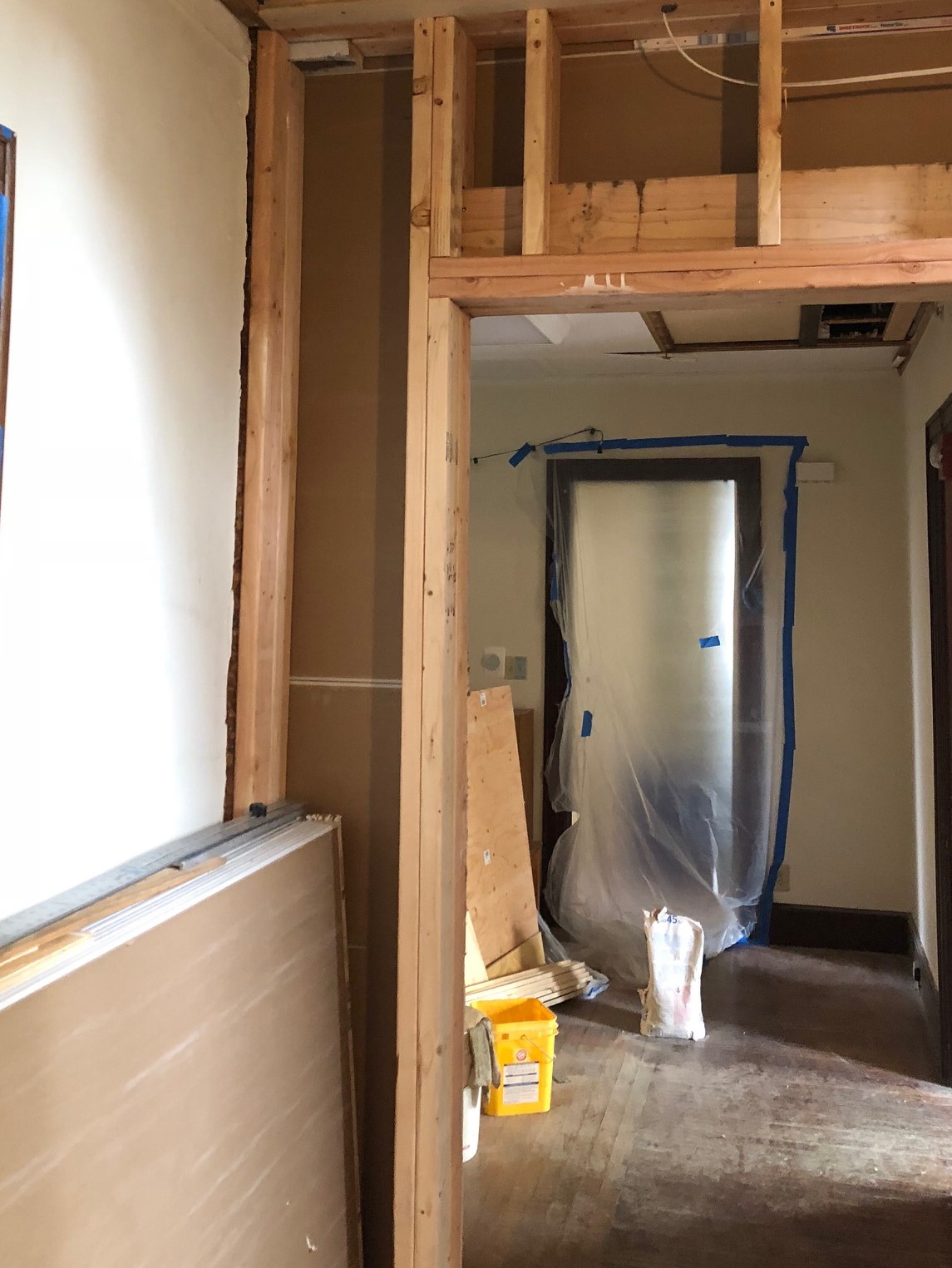
    Last Tuesday, April 17, twelve students packed their belongings into small bags or boxes or duffels and hauled them back to 65 Lawn Avenue, their home. These students had been displaced by a fire in the German Haus, and were forced to vacate for two weeks due to unsafe conditions and air quality concerns.

    On March 30th, Olivia Backal-Balik ’20 and visiting international student Ranja Armbruster, both residents of the program house, were in the kitchen baking banana bread when another house resident, Amy Ren ’19, entered the room and asked her housemates if they smelled anything smoky. Backal-Balik and Armbruster assured her that it was probably just the smell from the oven, which they had just turned on. But Ren insisted that the scent was abnormal, that it really did smell of fire.

    “We ran to the common area and you could hear the cracking of the fire in the wall and we were like, ‘Okay, why is the fire alarm not going off?’” Armbruster recalled. “Olivia called 9-1-1 and Amy called Public Safety and then the fire alarm started like five minutes later…. I literally ran out in my socks. At one point it started to rain.”

    It was concerning to the residents that they had detected the fire before the fire alarms did.

    “At first it was one of those things we were the most [upset about]” said Lola Sounigo ’19, a resident of the house who was out of town at the time of the incident. “It’s like, this could have been really dangerous—what if we were asleep and the alarms didn’t go off? [But] Fire Safety has checked the alarm and said that they were fully working and that they were about to go off, so it was just a question of timing. But obviously, when you hear about this story, it’s shocking and scary.”

    The incident was the result of an electrical fire, which began in the basement and spread through the inside of the walls, eventually reaching the first floor of the house. While the exact cause of the fire is unclear, there has been speculation that a squirrel may have bitten through a wire and caused electrical malfunctioning that eventually led to the fire’s ignition. Many University-owned residences, from senior wood frames to program houses are prone to this kind of hazard due to their age.

    “These wood frames are pretty old, and it’s not German Haus’s fault,” said Alexia Thompson, the Senior and Program Housing Coordinator. “We do fire safety checks two times a year, so we had our fall semester ones already, and that’s why we really stressed having a grounded extension cord, not burning any candles, not burning incense, that type of thing.”

    c/o Wesleyan Public Safety
    c/o Wesleyan Public Safety

    The night of the fire, residents were assigned temporary housing. But they were only allowed back into the house for five minutes that evening to retrieve some of their belongings, many of which had been damaged in the fire or reeked of smoke. The Office of Residential Life (ResLife) offered the residents no material accommodations, so most were left with an empty room and to rely on friends for the most basic accommodations.

    The residents felt frustrated with the way the University handled their situation. The house composed an email to ResLife, as well as Class Deans Jennifer Wood and David Phillips. The email highlighted a range of residents’ concerns, including fear for their physical safety.

    “No fire alarms sounded until well after we had contacted the fire department,” the email reads. “Thankfully, no one in the house was injured by the fire. However, had we not been lucky enough to have a resident notice or had the fire occurred when residents were asleep, we would not have been alerted to its presence until it was likely much larger and significantly more dangerous.”

    The email also expressed the residents’ dissatisfaction with how their relocation was handled.

    “The night the fire occurred, we were offered rooms, but were not provided with any bedding or towels,” the email continues. “When it came to moving our belongings we were offered no help or support. There was minimal communication regarding the move, and we were only told a possible timeline yesterday, April 5th.”

    Thompson stressed that her main concern was that students had a roof over their heads the night that the fire occurred.

    “Unfortunately, we do not carry any sheets, covers, or towels, which is something [that we are] now, retroactively, working to fix,” Thompson said. “It was unfortunate that that first night they [had to] borrow from a friend if they wanted to use the assigned room.”

    Residents also felt that their compensation was unsatisfactory. The University was able to provide them with $100 worth of Middletown Cash to alleviate cleaning costs, an additional $100 in each resident’s bank account, and additional meal points loaded onto resident’s WesIDs. In the email, Haus occupants requested to receive housing points and more assistance in restoring other items that were damaged in the fire.

    “We believe the University ought to take better responsibility for their management of the situation,” they wrote. “While we do recognize the addition to our middletown cash [sic] for the laundering of our clothes, we feel that such a contribution is not enough, as it will hardly begin to cover the many washes and dry cleanings we will have to continue to do in order to restore our belongings and does not account for the extensive time commitment it has been and will continue to be to restore the contents of an entire home. Considering the disturbance done to our program house community, as well as the manner in which relocation was handled, we also request a lottery boost for next semester’s housing.”

    Unfortunately, ResLife was not permitted to give German Haus residents additional housing points.

    “Housing points were designed in case there wasn’t enough housing for students who didn’t necessarily get class-appropriate housing, they received a point to help make up for that for the next year,” said Thompson. “It’s not necessarily for the case of emergency…. In [cases where] we’ve had other natural disasters happen, such as the tree falling on the roof on Home Street, or the tree in front Russian house, students did not receive points…when they had to be relocated, because that’s not what [they’re] designed for.”

    Since German Haus residents have moved back into 65 Lawn Avenue, things have mostly returned to normal, though some still complain of the smoky aroma that permeates the entryway. Ren will not be moving back into the house. The fire knocked down an entire wall of her room, so she had to move all of her things out of the house, which made it easier for her to stay in her new home. 

    “It was definitely more scary and more annoying at first than it was in the end,” said Sounigo. “It could be so much worse, it was just bad luck.” 


    Sasha Cohen can be reached at srcohen@wesleyan.edu.

    Jane Herz can be reached at jherz@wesleyan.edu. 

  • McCalmont Places University’s Relief Map Collections Within Campus, Global Histories

    McCalmont Places University’s Relief Map Collections Within Campus, Global Histories

    c/o Emmy Hughes, Features Editor
    c/o Emmy Hughes, Features Editor

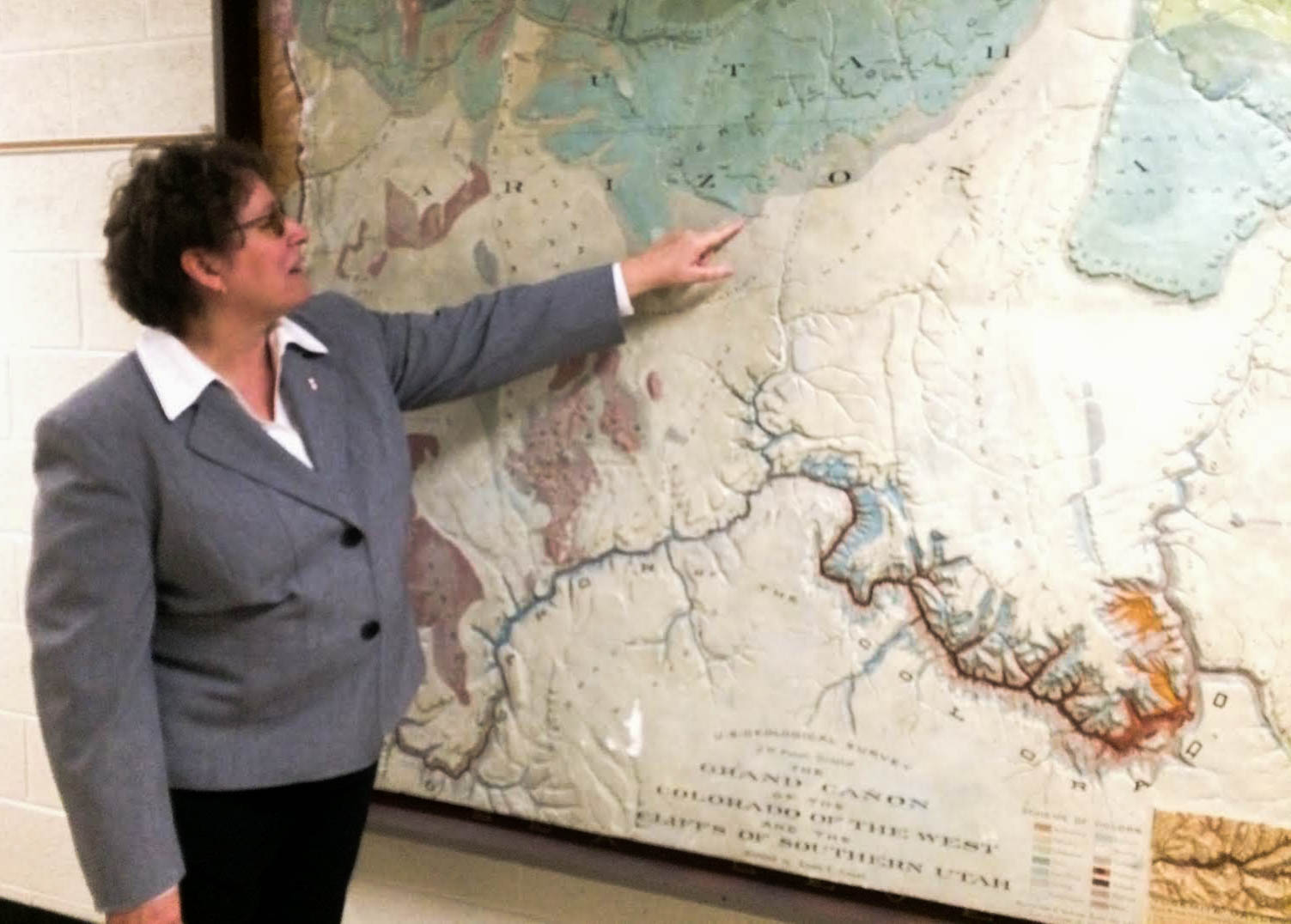
    On the walls of the third and fourth floor of Exley Science Center are massive, three-dimensional maps, dating from the 19th century, painted in peeling colors, and adorned with hand-written labels in an old cursive hand. One red and orange 3-D map displays pointy mountains in France; another, in lighter beiges and blues, shows the curves and fractures of the Grand Canyon. Despite their size and beauty, the maps are perhaps easy to ignore if you’re a student or professor who’s wandered these halls many times. But for geographer and relief model expert Melanie McCalmont, these maps are incredible relics and are part of the reason why she made the journey to Wesleyan this past week.

    McCalmont, a geographer specializing in relief models, three-dimensional maps that show elevation, came to campus from Monday, April 16 to Thursday, April 19. Over the course of her visit, McCalmont met with various members of the Earth and Environmental Sciences (E&ES) Department, gave a talk, and spent time pouring over the Wesleyan’s old records and maps. Her visit coincides with the current efforts to revitalize and reinstall pieces from the University’s old natural history museum, which was located in Judd Hall from 1871 to 1957. McCalmont’s interest lay primarily with the relief maps located on the third and fourth floor of the Exley science building.

    While we stood admiring the relief model of the Grand Canyon on the third floor of Exley, McCalmont explained that her entry into the world of relief mapping was a bit unorthodox.

    “I got my degree, and when I went to grad school, I went to the University of Wisconsin at Madison,” she said. “And at that building, it’s an 1850s building, they had these 3-D models, so I would say to people, ‘Where did this come from? Because this is pretty cool!’ and I’d get ‘I don’t know!’ Nobody really knew anything about it. When I looked into what’s called the history of cartography, the history of mapping, they had a little tiny paragraph about relief models. So I realized it was a place where I could do some research. I just loved these things.”

    One of McCalmont’s favorite aspects of relief models is their palpability—the fact that they can be touched and handled, the groves followed with a finger. This, says McCalmont, gives the 3-D maps something digital maps lack.

    “I’d worked in computers for a decade,” she said, “And when you can actually come up and feel the data, it just, bam, got me.”

    McCalmont is currently writing a biography of Edwin E. Howell, a prominent relief modeler who lived between 1845 and 1911. Howell was the main person who elevated the practice to an art and made prolific relief models in America in the 19th century. Howell has a strange connection to Wesleyan in that he worked for his brother-in-law’s company, Ward’s Natural Science, which was the supplier of the Orange Judd Museum of Natural History.

    “[Henry] Ward was an entrepreneur, and he contracted Orange Judd,” McCalmont explained. “He said ‘Hey! You’re building this fabulous new building for natural sciences. What you really need is a fabulous collection to go with it. That’s what I have!’”

    In July of 1970, Judd signed the contract to obtain Ward’s collections for the Natural History Museum. From November 31 through December 31 of that year, Judd and his team helped to set up the collections, including the Glyptodon that is currently on display in front of the Science Library. The group then came back in March of 1971, and again in May, and between that time the collection was fully assembled, and the museum was born.

    McCalmont explained that in her research of Howell, via the many diaries she has been transcribing, she discovered many references to Middletown, Conn. She looked the city up and found Wesleyan. After researching a bit, McCalmont discovered that Wesleyan was in the midst of a revival of its old museum. She promptly decided to come down, offering to give a talk in exchange for a chance to look at Wesleyan’s collections.

    On the Grand Canyon relief model, the name “J.W. Powell” is written in proud letters near the bottom. McCalmont also explained the connection between Powell and Howell (other than the name similarity), noting that the two were involved in mapping adventures.

    “[Howell] went with John Wesley Powell [to the Grand Canyon],” she said. “And you know how you get in rubber rafts and go down the Grand Canyon? Well, they did it in wooden boats. John Wesley Powell actually only had one arm, because it got shot off in the Civil War. They had made a couple of trips down, but they wanted to really get into the data of it. So this model—they’re all copies—but it’s the first commercial relief model ever done in the United States. And we are still doing them. Now they’re made with 3-D printing.”

    McCalmont also described the major influence behind the Grand Canyon model, which happened to be one floor above.

    “Howell got the idea to build this from the French model that’s back upstairs,” explained McCalmont, referencing another model located in Exley that displays mountains in France.

    The French relief model was made in 1838 by a geologist named George Poulett Scrope.

    “One of the most unfortunate names in science,” McCalmont said of Scrope’s surname.

    Scrope’s purpose with the creation of this French map was to demonstrate the ways in which magma can form—to show that it doesn’t simply flow out of a volcano in the form of lava but can coagulate in magma chambers beneath the surface of the earth. This map helped to demonstrate the geography and geology of this area in a tangible and straightforward way.

    McCalmont also explained that these relief models are, in their own ways, forms of virtual reality. Rather than writing about a place in words, maps can transport and envelope a viewer. The maps were intended to be massive so that an interested person, standing close enough, would have her entire view obscured by the map. This was an intentional decision, a way to transport a viewer to the place.

    She additionally described the process of creation of these maps. Howell would take contour maps of the region of interest and blow them up to the size that he wanted. This was a complex process. A lithographer would have to take a photograph of the map and draw by hand. Then Howell would use plaster to form the 3-D map along the contours, using pins to mark relative heights. The map was then smoothed over in clay. A negative would be made, and the negative would then be used to make copies, which were each painted and then distributed.

    Later that afternoon, McCalmont gave a talk to a collection of Wesleyan University students and staff, most of whom were members of the E&ES department. Over the course of the talk, she described the history of relief mapping within its proximity to Wesleyan and also commented on the value of the objects in Wesleyan’s collections as learning tools. She pointed to a curved map of America, as located in the Joe Webb Peoples Museum on the fourth floor of Exley as a means of understanding the curvature of the earth.

    “It’s the tactile dimension of these things that makes the information so much stronger,” she said.

    And it’s true—after speaking with McCalmont, I found myself tracing the relief maps as I walked by them, imagining the depths of the canyon, the heights of the mountains, and the hands that made these geographic features come to life.


    Emmy Hughes can be reached at ebhughes@wesleyan.edu and on Twitter @spacelover20