Author: Andrew Fleming

  • WesCeleb: Tyler Clarke ’18

    WesCeleb: Tyler Clarke ’18

    c/o Tyler Clarke
    c/o Tyler Clarke

    While she might not admit it, Tyler Clarke ’18 is one of Wesleyan’s most prominent socialites. You might know her as director of X-tacy. Or maybe you know her from her involvement with Psi U. Or perhaps you know her as a senior interviewer. But you probably don’t know her feelings about “Daddy” John Finn, her take on finessing the system, or, most importantly, her WesCam priorities.


    The Argus: Why do you think you were nominated as a WesCeleb?

    Tyler Clarke: Hmm…I don’t know. I like people a lot. I like getting to know the different communities on campus and just not really siloing myself to one area. So, just getting to know most of Wesleyan could have been why I was nominated.

    A: So, you’re a socialite?

    TC: No! I wouldn’t say that at all, I just genuinely think that people have different things to offer…

    (Eavesdropping on the interview, Austin Dhillon ’18 mutters, “She’s such a socialite.” All others listening in on the conversation unanimously agree.)

    TC: It’s just nice to get to know people, despite whether or not they’re a part of your normal social circle or who you would normally hang out with.

    A:  So, besides clearly being a socialite, do you think there are things you’ve been involved with on campus that have made you more of a notable presence?

    TC: Probably dancing, that’s something I came in doing immediately freshman year, so being able to get into that community and performing within the first two months of school was probably helpful in getting to know people.

    A:  Can you talk more about your involvement with dance?

    TC: Yeah! So, I was a part of four dance groups my freshman year: WesShuffle, Kalalu, Fusion, and X-tacy, but then I had to drop two of them because it was just too much of a time commitment. Now I’m currently the director of X-tacy and a part of Kalalu and I love it! I’m still challenging myself as a dancer, but also meeting so many new dancers. It’s really fun to do something I love on a collegiate level and it’s probably one of the last times I’ll be able to dance this seriously and perform.

    A:  Very cool, so is there anything else that you’ve been involved with on campus that you’ve really loved?

    TC: Well, WesBurlesque, but that’s dance related. Psi U is pretty cute, I think. It’s something I didn’t imagine myself doing at all. Then, I did it my sophomore spring and met so many new people, like all these random LA bros or film people who I never would have connected myself with. Ben Velaise [’18], for example, is one of my best friends today and I definitely attribute that to Psi U.

    A: If you woke up tomorrow as a freshman in Bennett again, knowing what you know now, would you go about your next three years the same as you have? Would you change anything?

    TC: I think I would take more risks. I feel like I played it pretty safe. In general, each year I was trying to make sure I wasn’t doing anything too ridiculous, but none of that matters. And as a freshman, you come in so hot and you’re worried about everything, but it’s not that deep. No one is really paying attention to you. Even now, still no one is paying attention to you, so don’t be afraid to be ridiculous.

    A: Are there any clubs or classes you wish you had taken/gotten involved in your time at Wes?

    TC: Yeah, maybe Econ because I have no idea about Econ in any realm. Oh, and math classes! I came in thinking I was a math major, but after taking Calc I, I didn’t want to continue, but I still love math to this day.

    A:  On the flip side, have there been any classes or professors that you’ve had that you’ve loved?

    TC: [Professor of Government, Emeritus] “Daddy” John Finn…was one of the only professors to teach law classes. I took The Judicial Process with him and we spoke about the First Amendment and the Bill of Rights. The class solidified my decision to go to law school. I’m not sure if I want to practice law necessarily, but that class made me interested in at least studying the law more. I loved every second of that class and was fully engaged the whole time.

    A: What’s the biggest change you’ve seen at Wesleyan over your time here?

    TC: I think socially, and maybe it’s just me because I’m involved in Greek Life, but the notion around Greek Life is so different than when I was a freshman. I feel like it was so shunned, especially given the time period when I was a freshman, but I feel like now everyone, including seniors, are much more interested in rushing. And maybe senior year is different, but I feel like there are no silos of environments. The lax team that lives next to me I’m genuinely good friends with and freshman year I didn’t know them at all.

    A: Are there any Wesleyan secrets/tokens of knowledge that you can impart on us now that you’re leaving soon?

    TC: Hmmm…always take the elevator up to Usdan, don’t walk up the stairs. Steal from Weshop whenever you can because it’s a cartel. Really, you can do anything if you just pretend that you should be doing it. And always finesse the system. That being said, I do work for admissions so…

    A:  Speaking of admissions, how did you get involved working there?

    TC: I applied as overnight hosting coordinator the summer before my freshman year, which I actually didn’t get initially. Ethan Savel [’18] had it but ended up quitting, so I was next in line. That’s how Ethan and I became friends. I stayed doing overnight hosting for two years, then I went to front desk when I got back from [study] abroad and now I’m a senior interviewer! And I’ll be reading applications for the class of 2022.

    A:  How has it been being a senior interviewer?

    TC: It’s been so great. I genuinely like meeting the students who are applying, they have so much to offer in the span of 25 minutes. It’s so cool to see how much they’ve already done at like 17/18 years of age. I was not that phenomenal at that age, so it’s humbling.

    A: What have you gained from your experience at Wesleyan that will stick with you in the future?

    TC: Over the last four years, Wesleyan has definitely given me a better sense of self and confidence. I’m so much more solidified in who I am than when I started at Wes. I’m no longer trying to compete with other people, but just actively trying to better myself. I think that’s advice I would give to people just starting at Wes, like don’t be so stressed about being perfect, just do you. Don’t underestimate yourself just because you feel like there’s people in a class or around you who are better at something than you. Stop stressing.

    A:  So, last question is a little tougher, but who’s going to be the first person that you WesCam?

    TC: Omg, that’s an important question. Hmm…Okay, so I’m not going to say it on the record, but I will say, his initials are E.C.


    Claudia Stagoff-Belfort can be reached at cstagoffbelf@wesleyan.edu.

  • The Top 5 Easiest Things to Bring to Any Holiday Potluck
    The Top 5 Easiest Things to Bring to Any Holiday Potluck

    c/o kitchentreaty.com
    c/o kitchentreaty.com

    “Would you mind bringing something?”

    If you’re anything like me, those five words are the worst words you could possibly hear. It’s that time of the year, folks: the time for the dreaded holiday potluck. You know the drill. You’re invited over to your best friend’s house, or maybe it’s your crazy aunt’s family get-together that she insists on hosting every holiday season. Either way, you’re forced to cook. You’re panicking because the pressure’s on. You want to wow everyone with your fabulous dish, but the last time you tried to make cookies you set the fire alarm off. Well, panic no more, because I have a list of 5 easy dishes that require little to no effort to make. I guarantee that if you bring any of these dishes to your potluck, even if it’s your weird neighbor’s Christmas party, it’s sure to be a huge hit. People may even suggest that you star in the next season of Bravo’s Top Chef. Maybe.


    1. Mini Caprese Bites

    Because who doesn’t love cheese?

    Ingredients:

    2 cups of mini mozzarella balls (you can find these at most supermarkets, such as Whole Foods, Shaw’s, Trader Joe’s, etc.)

    2 cups of cherry tomatoes

    1 cup of fresh basil

    Salt and pepper

    1 cup of balsamic vinegar

    Toothpicks


    In a small skillet, pour the balsamic vinegar and cook over medium heat to reduce the vinegar. This should only take 5-10 minutes, make sure that you stir occasionally.

    Take a toothpick and stick one cherry tomato, a basil leaf, and one mozzarella ball. Season with salt and pepper, and then use a teaspoon to drizzle some of the balsamic reduction onto each appetizer. Sprinkle with salt and/or pepper.


    1. Roasted Brussels Sprouts with Garlic and Parmesan

    These are the star of the show every time.

    Ingredients:

    1 pint of brussels sprouts

    4 to 6 tablespoons of extra virgin olive oil

    5 cloves of garlic, peeled

    Salt and pepper

    1 tablespoon of balsamic vinegar

    Container of parmesan cheese


    First, heat the oven to 400 degrees. Slice brussels sprouts in half. Heat the extra virgin olive oil in a pan over medium heat until it begins to simmer. Put the sprouts in the pan cut side down, add in the garlic, and sprinkle with salt, pepper, and parmesan cheese.

    Cook the brussels sprouts over the medium heat until they begin to brown on the bottom. Then, transfer them to the oven. Roast them for about 10-20 minutes, until they’re very brown.

    Stir in balsamic vinegar, sprinkle with more salt, pepper, and parmesan. You can serve this hot or warm.


    1. Baked Macaroni and Cheese with Bacon

    This one speaks for itself.

    Ingredients:

    One box of elbow macaroni

    ½ cup of butter

    ½ cup of sifted flour

    4 cups of milk

    2-3 teaspoons of hot sauce (I recommend Cholula)

    2 cups of sharp cheddar cheese

    2 cups of crumbled bacon (If you’re lazy, you can buy these pre-packaged at any supermarket)


    Cook the macaroni using the directions from the box and set aside. In a medium saucepan, melt the butter over low heat and then add the flour. Stir until smooth. Turn it up to medium heat and add milk until the mixture is thick. This will take approximately 10 minutes.

    Add the hot sauce, cheese, and bacon. Pour the mixture over the pasta and stir together. Pour the macaroni and cheese into a 9x13in baking dish and top with any extra cheese or bacon bits you have left over. Bake in a preheated oven at 350 degrees for 25-30 minutes, or until the top is golden brown.


    1. No Bake Peppermint Fudge

    You don’t even need an oven to make this one!

    Ingredients:

    3 cups of semisweet chocolate chips

    1 can of sweetened condensed milk

    Crushed candy canes for topping (Easiest way to do this is to put candy canes in plastic Ziploc bag, and roll with rolling pin)

    Cooking spray


    Line an 8-by-8 inch square baking pan with aluminum foil, and then spray with cooking spray. In a medium saucepan over low heat, combine the chocolate chips and the condensed milk and stir together until melted. Pour the mixture into the baking pan, making sure to spread it evenly. Sprinkle on the crushed candy canes, and refrigerate for 2 hours. When ready to serve, cut into small squares.


    1. Christmas Monster Cookies

    These cookies are HUGE and are sure to leave people full for hours.

     Ingredients:

    1 ½ cups of peanut butter

    1 cup of packed brown sugar

    1 cup of granulated white sugar

    1 stick of softened butter

    3 large eggs

    1 tablespoon of vanilla extract

    4 ½ cup of oats

    2 teaspoons of baking soda

    1 cup of chocolate chips

    1 cup of holiday M&M’s

    Cooking spray


    Preheat your oven to 350 degrees and spray cookie sheets with cooking spray.

    In a large bowl, combine the peanut butter with the sugars and the stick of butter. Mix well, and then put in the eggs and the vanilla. Put in the oats and the baking soda. Then, stir in the chocolate chips and M&Ms. Put large spoonfuls onto the cookie sheets. Bake for 10-12 minutes, and then let cool for 5 minutes.

    And there you have it! Five foolproof holiday potluck recipes that are sure to impress anyone and everyone. Good luck surviving the actual potlucks, though.


    Jane Herz can be reached at jherz@wesleyan.edu.

  • Glam Rock and Girl Friday Star Lisa Jackson Returns for Two Nights Only
    Glam Rock and Girl Friday Star Lisa Jackson Returns for Two Nights Only

    c/o arsnovanyc.com
    c/o arsnovanyc.com

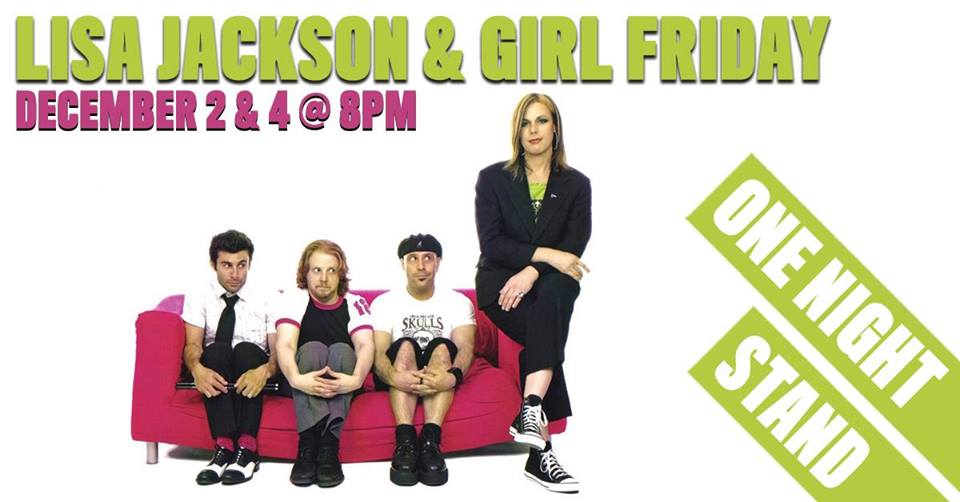
    New York’s glam rock star Lisa Jackson and her band Girl Friday have returned this weekend after an 11-year hiatus for two sold-out charity shows at the Ars Nova in Hell’s Kitchen. The group—which features Jackson on lead vocals and guitar, Steve Lavner on keyboard, Jeff Gurner on bass, and Freddie “Boom Boom” Sanchez on, unsurprisingly, drums—initially broke out onto the New York music scene in the early aughts, playing a punk rock sound with lyrics challenging gender and societal norms. Their first performance took place this past Saturday, and Monday night might be the last chance ever to see Jackson and her band. The Argus conducted a phone interview with Jackson to talk more about the importance of glam rock, the experience of bringing the band back together, and the necessity for visibility in the gender-nonconforming community.

    The Argus: What was it that made you come back to do these shows?

    Lisa Jackson: The real story is that my wife is turning 30 this year and I said to her, “What do you want for your birthday?” and she said, “I want a Lisa Jackson Girl Friday show.” [laughs]. So I said okay but was very nervous about it because it had been a long time. But things started progressing and it all came together very quickly.

    A: A lot of your songs include powerful social messages. Was the current political climate also a factor in these shows?

    LS: My wife and I both live in D.C. and we’ve become very politically active since the election of Trump. We’ve gotten involved with our community action group and an organization called OUR Restroom, which is focused on having non-gendered signage on restrooms. It made me realize that my band had really developed a very solid voice for trans women and trans people. Over the course of rehearsing, I realized that we have a gift in all these songs we’ve created. Trans people need to be very visible right now, given the current political climate, and so I thought I should use this as a platform to bring awareness.

    A: Proceeds from these two shows will go to the Transgender Legal Defense and Education Fund, correct? That seems like a great cause.

    LS: They have several services they do for trans people. One of the ones I find most important is the Name Change Project, which helps trans people through the legal process of changing your name on all of your documents. That can be a little overwhelming; I did it twelve years ago. It’s really nice to have an organization that provides lawyers, pro bono, to help you work through it all.

    A: So your music genre is, at least in part, glam rock, where musicians embrace gender-bending and a level of theatricality in their performances (e.g. David Bowie, Jobriath, New York Dolls). When did you first get involved in this style?

    LS: I grew up in the ’80s, so a lot of my influence came directly from MTV and the big stars: Michael Jackson, Madonna, Boy George, and the hair bands of Van Halen and Mötley Crüe—so they weren’t glam rock, mostly. But my older siblings were listening to everything from the ’70s, which included Bowie—who was more in his glam rock decade then, I would say. I don’t know that I was super aware of his influences, though, until I started transitioning and identifying more as a queer person. I think glam rock for me is about pushing social norms and expressing yourself in fun or flamboyant ways that may or may not make a statement, you know?

    A: It’s amazing that all four original band members were able to come back together after almost a decade of separation. How has that been?

    LS: It’s been really really satisfying. We were unfortunate in [that] we had a very cliché rock and roll break up where we all got mad with each other and didn’t speak for close to ten years. It got to the point where we really didn’t know why we didn’t speak to each other. We just didn’t. Now I think everyone has such a different perspective on what we created together and such an appreciation for it that it’s been a lot of fun to get our relationship back with each other.  

    A: Will these really be your last shows, the last chance ever to see you perform?

    LS: It’s a question that everyone is asking because the shows literally sold out in a matter of two weeks. The response has been really great, but I think right now we’re super happy that we’re doing this and that the venue and the fans are so into it that we do not have any plans of future shows. I think it puts it out there for us, though, that if we want to do a show, it’s definitely there for the taking. I would say ask me again on Tuesday morning, and I might have a more solid answer [laughs].

    A: What has this experience of bringing the band together meant for you personally?

    LS: As I do this again, I’m remembering that for me this whole band Lisa Jackson + Girl Friday was a platform to transition and during the time that I was doing that, I don’t think I quite understood me or what was happening for me. And so, for any people out there who are non-gender conforming, I just wanted to express my gratitude for their experience. It’s a tough row to hoe sometimes, and I’m grateful for the opportunity to get on stage again and be a visible presence for trans and non-gender conforming people. It’s a very unfortunate time with the current administration and the attitude that we see in America. We have to stick with and stick up for each other right now.


    Andrew Fleming can be reached at apfleming@wesleyan.edu

  • Wesleyan Language Tutor Program: A New Collaboration With Middletown
    Wesleyan Language Tutor Program: A New Collaboration With Middletown

    c/o middletownsports.org
    c/o middletownsports.org

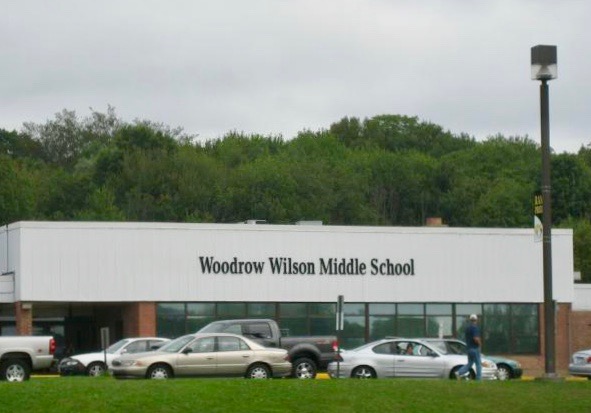
    Last semester, a collaborative project began between the University and local school district officials to bring on students from Wesleyan Spanish courses as tutors for English Language Learning (ELL) students in their classes at Woodrow Wilson Middle School. While the program began small, with only 10 tutors, it has since more than doubled size and has solidified its status as a key outreach program with the Middletown community.

    The idea for such a collaboration had been discussed for years in the district, according to the Woodrow Wilson’s ELL Department Chair Linda Johnson, but it was Adjunct Professor of Spanish Ana M. Pérez-Gironés who finally brought it to fruition.

    Pérez-Gironés’ inspiration for the project came after seeking volunteer opportunities for her Spanish students to serve the Middletown community using their Spanish language skills. After reaching out to Peggy Carey Best, Director of Service Learning at the University, and Johnson at the middle school, Pérez-Gironés realized this visiting tutors plan was perfect not only for her heritage speakers but her language-learning students as well.

    “It immediately was so appealing and exciting,” said Pérez-Gironés. “It quickly went beyond my Spanish for heritage speakers class and I opened it for whoever wanted to volunteer.”

    Pérez-Gironés also noted that the enthusiastic support of Professor Typhaine Leservot, Chair of the Romance Languages and Literatures Department, was key to lifting the program off the ground.

    Johnson and Pérez-Gironés began organizing the project at the beginning of last semester, a task which involved learning a myriad of volunteer protocols as well as getting background checks for each student who would go to the middle school. Furthermore, the two had to figure out how to make the University’s short academic calendar align with the complex block scheduling system of Woodrow Wilson.

    They began the project in March, sending in only a handful of tutors who would be a prototype for years to come. Participating students were shuttled to and from the middle school for one hour and 40-minute shifts once a week. While the launch was successful at matching up tutors and ELL learners, the two groups struggled at first to overcome awkward social barriers (the middle school students did, after all, suddenly find themselves with towering undergrads following them around the halls).

    Fortunately, this tension has already begun to fade as the students and tutors have bonded over time. In fact, Woodrow students were invited to campus at the beginning of the semester for a pizza lunch.

    “The more time they spend with each other, the more comfortable they become,” said Johnson. “It is reassuring for the English Language Learners to know that there is someone who can help explain things in their own language.”

    In an interview with the Argus, Wesleyan student coordinator of the program Phoebe Howe ’18 expressed how glad she was to see the students’ growing ease with one another. She joyfully recalled how, during the lunch meeting, students and tutors went around the room and talked about what languages they spoke and what excited them about the program. Howe began working to help coordinate the program alongside Pérez-Gironés and Johnson towards the end of last semester and has been essential to its increasingly smooth operation.

    “Both Phoebe and Ana [Pérez-Gironés] have gone out of their way to find qualified people to work with our students,” Johnson said. “Both are responsive to our needs and really dedicated to creating a positive experience both for the Wesleyan students and our English Language Learners.”

    After assisting with the establishment of the program, Howe looks forward to how it will continue to grow from its small group of passionate organizers.

    “I’d love to see it stick around for awhile,” Howe said. “The good thing is we’re staying patient setting a solid foundation, getting a couple of really good dedicated tutors going in the program and hoping to expand from there, and hopefully all the kids who need us get help.”

    Howe also noted that University tutors have received their own sign-in sheet when entering the middle school, indicating their growing presence.

    Now that the program at Woodrow Wilson is up and running, its organizers are looking for ways to expand it, and not only with more Spanish-speaking students. Howe described how she, Johnson, and Pérez-Gironés teamed up to match an ELL student who speaks Tamil—a Dravidian language spoken by the Tamil people of India and Sri Lanka—with a University student who speaks a similar dialect.

    The three are also seeking ways to go beyond the middle school and spread University tutors throughout the school district.

    “There is such a need for language help in all of our schools…elementary through high school,” Johnson said. “It makes sense to start our partnership growth with the high school and then expand out to the elementary schools. I am hoping that we will be able to accomplish this within the next year or two.”

    As Howe is stepping down next semester, it will be up to current tutors like Vanessa Baker ’20 to help achieve these goals. Baker looks forward to stepping up as the student coordinator next semester.

    “The tutoring program has been wonderful this year,” Baker said. “I have loved getting to know the students and watching them grow throughout the semester. I am looking forward to continuing the program and hopefully helping it get bigger and more established on our campus. The role of the tutors has the potential to be extremely impactful, and I hope as I continue with the program I can help it to grow.”

    In addition to this program at the middle school, Pérez-Gironés has also set up a course for next semester where students will be able to earn credit and receive a more formalized understanding of language pedagogy. Her Second Language Pedagogy for Grades 8-12 (SPAN 412/FREN412) class next semester will allow students to work with teachers at the local high school identify authentic materials for them to use in their classes.

    Programs like these are and will continue to build important ties between Middletown schools and the University. The work of Johnson, Howe, Baker, and Pérez-Gironés not only breaks down linguistic barriers in the classroom, but also the rigidly separate worlds of the public school system and the private university, encouraging the open sharing of resources.


    Andrew Fleming can be reached at apfleming@wesleyan.edu.

  • Thanksgiving, More Like No Thanks

    Thanksgiving, More Like No Thanks

    For most of America, Thanksgiving means food, and family, and football. It means overcooked turkey and passive-aggressive comments about your English and American Studies double major. And it means coming together over pumpkin-flavored dessert in order to talk about the gratitude you feel.

    But for some people, Thanksgiving is just another Thursday night—with the added benefit of not having to go to class. I’m one of those people. On top of the obvious moral case against celebrating genocide (which is a pretty strong argument, I think), it makes little logistical sense for my family to go through the hassle of a big Thanksgiving dinner when there are only three of us. So what does one do instead of a stereotypical Thanksgiving?

    My answer: absolutely nothing. My day began at around 2 p.m., completely missing the parade and waking myself up with a nice bowl of dry Cinnamon Toast Crunch. I called a single family member to wish them a happy Thanksgiving (my 105-year-old great-grandmother who is the most amazing woman on the planet). I did some homework, took a walk, and later sat motionless for an impressive amount of time.

    It may seem strange to some that our day was not spent preparing appetizers and putting things in ovens and burning ourselves. I find that food is often an important aspect of families coming together, with recipes passed down and family secrets about how to cook the perfect turkey. Food is a big part of a lot of cultures, especially around the holidays, and the impossibly deep and rich culture of many American families is more or less defined by how, when, and where that family eats. But for us, food was never really a way to come together, which is strange given how much I love the experience of sharing a meal with somebody. (I find that it’s one of the most intimate things you can do with a person). Food for my family is more just a means of keeping us alive. Thanksgiving is no exception.

    For dinner, my family and I embarked on our blasphemous anti-celebration by going out to dinner, joining other non-traditional celebrators in quiet contemplation of how incredibly normal this particular Thursday was. We sat at a booth, ordered some bottled water (According to the town, the tap water is “almost” safe to drink), and talked as little as possible. My father, perhaps nostalgic for the Thanksgiving celebrations of his younger days, ordered the turkey dinner special, complete with cranberry sauce and mashed potatoes. I ordered a pasta dish and ate my side salad of mostly iceberg lettuce quietly. Eating quietly is an art passed down in my family mostly on my father’s side, despite my mother’s constant attempts to try to open up a conversation. When my meal came, I kept my eyes locked on my penne as I ate quickly and without much thought. We skipped dessert, I double checked my mother’s addition skills when it came time to pay the check, and we drove home and each went to our respective parts of the house.

    This all probably sounds kind of sad to a reader who loves a big family celebration during the holidays. But for me, it’s just our normal. I prefer it this way. As important as food is to me personally, it matters little in the context of my relationships with the people in my family. Turkey dinner isn’t a way to bring us together. Instead, the meals we share are kind of cold (emotionally, not temperature-wise) and eaten hurriedly and without much conversation. It’s why Thanksgiving doesn’t really matter in our family and why big meals are more awkward than anything else. Quiet and separate is how we live our lives, and it works for us. It’s not necessarily a negative thing, just a different way of coexisting. Thanksgiving disrupts that, which is why I’m looking forward to my penne vodka again next year. I imagine I’ll be thankful for that.


    Spencer Arnold can be reached at sjarnold@wesleyan.edu.

  • Wune Wahjet: the Institutional History of Indian Hill Cemetery

    Wune Wahjet: the Institutional History of Indian Hill Cemetery

    William Halliday, Photo Editor
    William Halliday, Photo Editor

    The mile-long cemetery bound by Washington, Butternut, Vine, and Cross Streets sits atop Wesleyan’s campus. It’s the final resting place of Everett Bacon, an all-American quarterback from the early 1900s, three governors, three generals, and many city mayors. A long-cherished spot for shooting film theses, the graveyard’s scenic beauty has historically attracted students and Middletown natives alike.

    “Indian Hill Cemetery is an integral part of our community,” said University President Michael Roth ’78 in 2015.

    Whether the Indian Hill Cemetery is a location that University students quickly walk past or whose spookiness compels them, the true history regarding the graveyard’s construction is where the most frightening story resides. And the “official” history as told by the cemetery’s founders may not be as untarnished as it appears.

    Indian Hill Cemetery was constructed in 1850 by the Indian Hill Cemetery Association, an organization formed by Middletown’s elite in the midst of the Rural Cemetery Movement. This mid-19th-century campaign intended to use cemeteries as a means of forming a distinctly American national identity.

    “Creation of public monuments and pastoral cemetery landscapes revealed Americans’ ability to adapt borrowed aesthetic forms to create their own usable past through self-commemoration,” explained Blanche Linden-Ward, a speaker at Indian Hill Cemetery’s induction ceremony.

    However, Sarah Kavanagh ’04 has written how such “borrowing” of Native American culture and tradition was actually an opportunity for the appropriation and extermination of Native American identity.

    “I will argue that the creation of Indian Hill Cemetery was a project aimed at planting an Indigenous extinction narrative into the American land itself,” Kavanagh proclaims.

    In the mid-19th century, the Wangunk tribe was still present in Middletown and resided on Indian Hill, which had been put aside for “the heirs of Sowheag,” a Wangunk chief. Europeans claimed that this tribe was extinct, a falsehood that became central to Europeans who were attempting to cement an American identity and origin story in the area. The production of such extinction myths served as the basis for the cemetery’s construction. To allow for the birth of American identity, according to Kavanagh, the Wangunks were to be transformed into the “hallowed ashes of a race.”

    University President Stephen Olin, another speaker at the cemetery’s opening ceremony, supported this agenda.

    “The cemetery, he hoped, would present the illusion of an ‘immemorial [American] past’ upon which to build a ‘limitless future,’” Kavanagh explains in her essay.

    Olin’s intentions proved persuasive. Indian Hill Cemetery’s founders, quite aware of the existing power imbalance between Native Americans and white settlers, refuted accusations of hostility in their relations with the natives. Even after stripping the Wangunk of any right to the land, these founders kept the land’s original name, Wune Wahjet, translated to “Indian Hill,” which served as both a facade of respect for Native American heritage and a subtle mark that ownership of the hill had changed hands. A plaque of an Indian—in attire that inaccurately depicted what natives of New England would wear—was placed atop the gates of the cemetery. The founders took little notice of the current history of the Wangunk and, in cementing their own identity, altered the natives’ existing culture. The Wangunk’s existence was turned into a history. 

    William Halliday, Photo Editor
    William Halliday, Photo Editor

    Reverend Frederic J. Goodwin, the keynote speaker at the cemetery’s commencement, exploited indigenous culture to demonstrate the necessity of the European presence.   

    “He drew parallels between indigenous peoples and Americans by stating that given the choice, Americans would pick the same location to lay their loved ones to rest as the indigenous peoples had,” Diana Dominguez ’18 explained in an article on the cemetery. “And that whites ultimately seemed destined to suffer the same fate as Native Americans, ‘the people who perished.’”

    “An identity’s constitution is always based on excluding something and establishing a violent hierarchy between the two resultant poles,” Stuart Hall adds in his book “Questions of Cultural Identity.” “An identity is not a point of origin and stability, but is constantly destabilized by what it leaves out.”

    Renée Bergland concurs in “The National Uncanny,” arguing that the establishment of the Indian ghost in literature and art is what preserves the American identity.

    “In the case of Indian Hill Cemetery,” Kavanagh asserts, “the Indian is quarantined alongside, and thus equated with, the dead.”

    However, to criticize the foundation of Indian Hill Cemetery is not to dispute the value of its current presence. As it stands today, the Indian Hill Cemetery Mission Statement is to “…maintain the Native American heritage of the land.” The existence of the Wangunks during the mid-19th century and the hostile relationship between European settlers and Native Americans are facts now recognized on the cemetery’s website.

    Nevertheless, the task of historicizing the treatment of Native Americans in the Middletown area still remains a complicated issue. 

    “The most tangible evidence of that which comes to mind is the human remains of Native American tribes that are still possessed by the University, not because we want to possess them now–we’ve been trying to repatriate them—but because back in the day they were stolen from people who were regarded as subhuman,” Roth said of the University’s complicity in shameful historical moments in an interview with The Argus earlier this year. “It’s disgusting, it’s horrible, and I think you learn from that history, but we can’t erase it. The guilt is not useful, but learning from history, and the University’s participation in racist and exploitative acts, I think that is useful. And there are professors here who teach classes in that and develop publications about it. And I think that’s really useful because, like other institutions in this country, we did participate in events that, in other moments, we came to view as horrific.”


    Claudia Stagoff-Belfort can be reached at cstagoffbelf@wesleyan.edu.

  • Professor Kilgard Talks Kilonova’s Killer Implications
    Professor Kilgard Talks Kilonova’s Killer Implications

    c/o NASA
    c/o NASA

    This summer, on Aug. 17, the detection of an astounding phenomenon known as a kilonova sent shock waves through the astronomy community, generating far more excitement than this summer’s total solar eclipse. As the news spread, over 70 observatories pointed their telescopes to galaxy NGC 4993, 130 million light-years away, to witness the astounding kilonova unfold.  Wesleyan Research Associate Professor of Astronomy Roy Kilgard, who studies the X-rays emitted from binaries of black holes, neutron stars, and/or white dwarfs along with many other astronomers and physicists, was very excited by the news. The kilonova was so groundbreaking it led Kilgard, New York Times, The Washington Post, Science Magazine, and many other journals and newspapers to weigh in on the event.

    “It is incredibly rare to observe a new phenomenon for the first time,” Kilgard said.

    He went on to compare the astronomical spectacle to NASA’s launching of the first Hubble telescope as an event that will “change science forever.” But first, what really are kilonovas?

    The phenomenon occurs when two neutron stars combine. These stars form when a very massive star of about 10 to 20 times the mass of the Sun explodes. During the explosion, the outer layers of the star collapse inward due to the force gravity, causing electrons, which normally occupy free space in an atom’s outer shells, to be pushed into the protons located in the nucleus, leaving behind a very dense neutron core, known as a neutron star. Astronomers for over the past 50 years have wondered what happens when one neutron star faces off with another.

    This summer, scientists observed two extremely dense neutron stars growing attracted to one another and entering into a spiral of doom. In Kilgard’s words, this event was similar to ice skaters linking hands and spinning around one another. The neutron stars increased the speed of their rotation as they spiraled closer and closer. Once they reached a certain distance, they began exchanging masses and ripping each other apart, causing gravitational waves to ripple throughout space. When the exchange of mass was complete, the two stars combined to form one very massive object, firing jets of brilliant gamma rays into space.

    Though the phenomenon itself was not visibly detectable, the detection of both a short gamma-ray burst, which refers to a tremendous amount of gamma rays released in a short amount of time, and the detection of gravitational waves—the distortions in space-time—essentially proves the existence of a kilonova. 

    To thank for the detection of gravitational waves is LIGO, the Laser Interferometer Gravitational-Wave Observatory. This observatory has been operating for two years and previously detected gravitational waves emitted from four black hole-to-black hole mergers.

    c/o NASA
    c/o NASA

    “Gravitational wave observatories like LIGO have completely changed the way we think about astrophysical unsolved problems now,” Kilgard said.

    Physicists from LIGO won the Nobel Prize in October 2017 for directly detecting gravitational waves, and Dr. Kilgard predicts they will win another Nobel Prize soon for gravitational waves detected from the kilonova.

    Several conclusions have been drawn from the event. Two seconds following the detection of gravitational waves, the NASA Fermi Telescope detected a short gamma-ray burst. These observations led scientists to conclude gamma-ray bursts of about two seconds are produced when neutron stars merge. Furthermore, these simultaneous signatures of gravitational waves and short gamma-ray bursts confirm Einstein’s prediction that gravitational waves travel at the speed of light.

    In addition to elucidating the origin of these bursts, the kilanova has revealed how the heavier elements on the periodic table are created. While elements lighter than iron are formed during the slow fusion of lighter elements as a star runs out of gas, heavier elements are formed in a rapid process that can only occur in a neutron-rich environment. Previously, it was known that supernovas produce some of the heavier elements. However, the small quantities of heavy elements observed from these events does not explain the relative abundance of elements such as gold, silver, platinum, and uranium observed throughout the universe.

    Astronomers used a variety of observational methods to discover kilonovas. Nine days after gravitational waves and gamma rays were detected from the kilonova, the Chandra Telescope detected X-rays. Then, many different types of light were detected from the expanding debris of the explosion in what some would describe as fireworks erupting throughout the electromagnetic spectrum. Signatures of heavy elements were detected in high quantities from the expanding cloud of debris. The Hubble Telescope detected infrared light from expanding debris, which is thought to have been released by the radioactive decay of elements formed. All of the different types of light detected across the electromagnetic spectrum supported the theory that these elements were formed rapidly when the neutron stars merged.

    While the merger of binary neutron stars has informed the scientific community about how the universe works, it ultimately creates more questions than it answers. Many scientists have been led to ask: What formed as a result of this merger of neutron stars? It is possible the merger could have formed a very massive neutron star or a relatively small black hole.

    “More observations about the size constraints of neutron stars will be necessary to answer this question,” said Kilgard. 

    Furthermore, while the merger of black hole binaries and neutron star binaries has now been observed, a neutron star-black hole merger has yet to be seen. Researchers wonder why this is and what the result would be.

    The ultimate question, however, is how frequently kilonovas like this one occurs. LIGO has only been storing recordings for the past two years.

    “Do Kilonovas occur frequently enough to produce all of the gold in the universe?” Kilgard asked.

    Only time will tell.


    Leila Etemad can be reached at letemad@wesleyan.edu. 

  • Bachelor in Pizza-dise: A Perfect Date at Vero Cucino Rustico

    Bachelor in Pizza-dise: A Perfect Date at Vero Cucino Rustico

    c/o yelp.com
    c/o yelp.com

    Following up on a recommendation from Mukshud Ahamed ’19 via email, I decided to branch out from Main Street cuisine and visit the restaurant Vero Cucino Rustico. 

    “Vero will put all else in the area to shame,” he wrote.

    Intrigued, I decided to visit. But with my typical date busy that night (about 800 miles away), I decided on the next best thing: a date with seven Argus staff members who I made compete directly for my affections. Think of it as “The Bachelor,” but mostly focused on the food rather than the people.

    I came to Vero Cucino with high hopes and a minivan dangerously full of hungry copy editors. Immediately upon walking into the restaurant, those high hopes were fulfilled. The staff was incredibly accommodating of eight people showing up without a reservation. The ambiance was that perfect low-light Italian feel, and two curly-haired Italian men played live music that ranged from Frank Sinatra to Louis Armstrong. Vero started off with a great impression and continued to impress as the night went on.

    Amidst contestants’ attempts to gain my attention—sorry, Argus staff—I was able to take in a really awesome atmosphere, combining classic looks with a bunch of those hilarious “I drink a lot of wine” placards that moms really like. I really like them as well. Vero’s humor is mom humor, which is also my humor. Go figure. Our waitress Kelly was fantastic throughout the night as well, keeping us happy, well hydrated, and well supplied with bread. This proved to be my downfall. You know how people always tell you not to fill up on bread? Well, I did. And I have little shame about it. The bread was freshly baked and really, really good. It almost made me forget the fact that I was about to eat a lot more bread once dinner came.

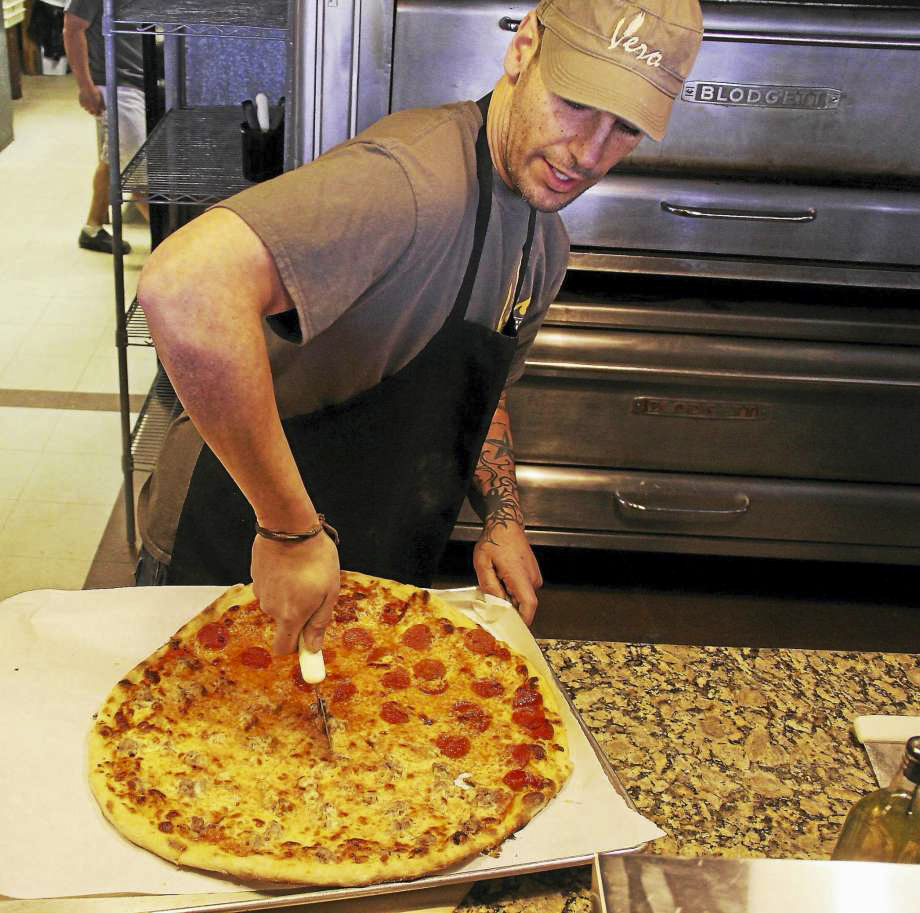
    Per the recommendation I received, most of us (cough, cough) decided to split a few different kinds of pizza among us. Those who did not were automatically taken out of the running for winning the date. The pizza at Vero is very different from what you normally get in Middletown. It had a thinner crust, noticeably fresher ingredients, and a difficult to describe kind of old-school taste: a little charcoal-y, but in a good way. This was solid pizza. It’s the kind where it’s almost artisanal, like the chef was creating a painting rather than a carb-heavy cheese dish for a bunch of hungry adolescents. The care that went into this pizza shines through and can be felt with every delicious bite. And that care is what sets Vero Cucino apart from other restaurants in the area. It strives to be something different, a return to a country and a time period of which I have absolutely no concept, though I imagine old Italy is mostly just eating pizza like Vero’s. Its success in this area comes from the effort to set itself apart.

    So what did I learn during my trip? First, I learned that the logistics of a date with seven people is somewhat more complicated than with one person. As much as I love the Argus staff, I’m pretty certain three separate parts of my 2004 Toyota minivan nearly broke during the trip over. I learned that there should be no shame in eating a lot of bread before dinner, especially when Kelly just kept bringing more, and definitely when it’s as good as Vero Cucino’s. I learned that anyone who makes fun of how much bread I ate is automatically disqualified from the Bachelor-esque contest I set up (basically half the table). And I learned that there is some really, really good and different food out there, even in Middletown, if I have the opportunity to seek it out.

    As I was told in the email I received, this pizza really did rise above the other places that I’ve tried in Middletown. Was it the best pizza I’ve ever had? No, but I would easily put it in the top ten (which is actually saying a lot; I have tried an embarrassing amount of pizza in my life). For convenience’s sake, it may not be the best option. It’s definitely a drive, not a walk (unless you are comfortable with walking on the shoulder of the highway) and can be difficult if you do not have a car on campus. But if you find the means to travel, take advantage of them and visit Vero Cucino.

    As for the contest, as I know everyone is on the edge of their seat. Taking into account all of the disqualifications (for not getting pizza, for making fun of my bread-eating, and for insulting my car), I actually ended up as the winner of the competition. And I feel like a winner because I got to take home all of the leftovers. Better luck next time, Argus staff.


    Spencer Arnold can reached at sjarnold@wesleyan.edu.

  • ‘Fuck Your Ivy League Sweater’: Diet Cig Does Not Disappoint at Alpha Delt
    ‘Fuck Your Ivy League Sweater’: Diet Cig Does Not Disappoint at Alpha Delt

    c/o upsetmagazine.com
    c/o upsetmagazine.com

    “This next song is good for making out with your partner or lover or friend. Consensually!”

    The New York-based duo Diet Cig, composed of Alex Luciano on vocals and guitar and Noah Bowman on drums, came to campus on Saturday, Nov. 11 to rock out for an audience of students in the Alpha Delta Phi living room. The band’s music captures something of the college angst surrounding self-doubt and love, with simple and affecting lyrics and a hype, unapologetic sound. Their Alpha Delt performance was youthful and glittery, with Luciano’s vocals bending like guitar strings and Bowman’s drums hammering along.

    Luciano met Bowman when he was performing with his then-band Earl Boykins in 2014. She approached him asking for a light and the two hit it off. Their first EP, Over Easy, came out in February of 2015 and in 2017, their first album, Swear I’m Good at This, was released. Diet Cig has been touring since.

    Wesleyan student band Flaccid Ashbacks opened the show with a properly punk tone, featuring covers of songs like P!nk’s “So What” and The Beatles’ “I Saw Her Standing There,” as well as original tracks from their debut album, Try the Soup. The living room dance floor swelled as students flooded in, enjoying the opener and preparing for the headliner.

    As soon as they walked on stage, the band members of Diet Cig set an attitude that was at once electric and casual. Before taking over center stage with her bouncy energy, Luciano deftly removed her striped undershirt from underneath her white tee. Bowman, for his part, placed a rubber ducky on a metal rod next to his drum set. A duck for luck? We think it worked.

    After receiving a warm welcome from the audience, Luciano gave a brief speech directed toward the femme and nonbinary audience members and the importance of listening to rock. This struck a chord with die-hard fan Chloe Thorburn ’20, who noted how important this was for her experience of the concert.

    “She was very positive towards femme people and nonbinary people and she was very encouraging of us being there,” Thorburn said. “She kept being like ‘I love that you guys are taking up all this space!’”

    The band then opened with hits off Swear I’m Good At This, ranging from hardcore basement punk songs like “Link in Bio” and “Bite Back” to the make-out songs (see: intro) like “Apricots” or “Bath Bomb.” While the Alpha Delt venue worked to amplify Diet Cig’s classic college band sound, these slower songs, which Luciano plays with the acoustic guitar on the album, had a provocatively different sound when performed live on a grumbly electric.

    Fans were continually chanting for the duo to play the album’s no. 1 hit “Sixteen,” which features your reporters’ all-time favorite lyrics:

    “When I was sixteen / I dated a boy / With my own name / It was weird / In the back of his truck / Moaning my name / While trying to fuck.”

    The liveliness and hilarity of the lyrics were all the more palpable in a live setting, and audience members (including your reporters) were thrilled and chanted along.

    The band’s final song was, of course, “Harvard,” their all-time greatest hit, which portrays an ex-girlfriend ragging on her past boyfriend’s new fling with a college girl. There was no choice but to sing along with Luciano: “Does it feel better / To be in an Ivy League sweater?”

    Do Wesleyan students, as members of one of the Little Three, derive extra satisfaction from the song’s spiting of America’s most exclusive universities? The question remains.

    “Fuck your Ivy League sweater / You know I was better.”

    In terms of stage presence, Luciano was not shy of jumping and bounding around the stage during the performance. She jumped on and off Bowman’s bass drum repeatedly and showed off her signature leg kick, her cheeky smile never leaving her face. This excited movement contrasted Bowman’s; for the most part, he remained out of the spotlight, steadily focusing on getting the drum tracks just right and backing up his singer.  

    Regardless of their different stage movements, both band members seemed to thoroughly enjoy performing. Between songs, Luciano would engage the audience in a conversational and light tone while Bowman, in turn, supplemented her words with the occasional laugh and consistent smile. Luciano, at one point toward the end of the concert, jumped with a giggle into the arms of a couple of audience members in the front row.

    One of the more remarkable aspects of the concert was the personable vibe emanating from both members of Diet Cig. This was clear from the frequent smiles and the conversational tone of the music and interludes.

    “I workshopped a bunch of jokes for you guys today,” Luciano said in between songs. Then, with a laugh: “I don’t think I’m gonna tell any of them.”

    After the concert had ended, the chords of the final song still ringing in audience members’ ears, Bowman and Luciano began packing up the stage, both offering hugs and handshakes to any remaining students who came to speak to them. When Thorburn approached Luciano to compliment the performance, for example, Luciano responded with an enthusiastic: “Thank you. I love your eyeliner!”

    “I was thrilled to hear that,”  Thorburn said after the show. “I had put on special blue eyeliner—it was the night for some fun eyeliner—and I’m so glad she noticed!”

    The duo invited fans to catch them on Fountain after the show.


    Emmy Hughes can be reached at ebhughes@wesleyan.edu and on Twitter @emmyughes.

    Andrew Fleming can be reached at apfleming@wesleyan.edu. He cannot be reached on Twitter. 

  • Study Abroad Office Strives to Offer Equal Opportunity

    Study Abroad Office Strives to Offer Equal Opportunity

    c/o commons.wikimedia.org
    c/o commons.wikimedia.org

    To study abroad or not to study abroad? This dilemma, practically universal among liberal arts students, presents more complications for some than others. Along with the notions of excitement and romance that come with living in foreign country, so too come financial woes. Students looking to study abroad are forced to ask themselves: can I afford it? Thankfully, the University ensures its students that the answer to this sobering question is invariably, ‘yes.’

    “I feel like it’s a very egalitarian approach here at Wesleyan,” said Emily Gorlewski, Associate Director of Study Abroad. “Since financial aid is able to be applied towards study abroad and since there is so much institutional financial aid, it really means that any student should be able to study abroad.”

    When University students study abroad, they pay the same tuition that they would pay if they were on campus. This is true whether these students pay full tuition or are on financial aid.

    “They pay Wesleyan tuition,” Gorlewski explained.  “[This] enables them to then transfer the credit and grades back from their study abroad experience to here so it appears on their Wesleyan transcript. But [they] don’t pay the residential comprehensive fee, they pay the actual cost of whatever their program is charging for their room and their board.”

    The Office of Financial Aid also compensates for additional expenses that students encounter when studying abroad.

    “We do an estimate for all the other expenses that students are going to need on their program,” said Gorlewski. “So if the food is not covered, we estimate how much they are going to spend on food, we estimate how much they are going to spend on airline tickets, personal expenses, books and supplies, any one of a number of other expenses they might have on their study abroad program that they wouldn’t necessarily have here.”

    The inclusivity of the University’s policy is reflected in its study abroad statistics. Associate Director of Financial Aid for the class of 2021 Michelle Jarvis explained that there is little disparity between the number of financial aid and non-financial aid students who choose study abroad.

    “Approximately 20 percent of students are studying abroad this fall,” said Jarvis.  “Over 40 percent of students studying abroad this fall are financial aid recipients, just slightly lower than the total percentage of students on financial aid.”

    While the University’s study abroad policies appear reasonable for students receiving aid, students who pay full tuition sometimes take issue with the fact that they have to pay Wesleyan tuition to enroll in outside study abroad programs that may be less expensive. Gorlewski explained this home-school tuition policy, which requires students to pay University tuition when receiving credit for study abroad, is common among comparable institutions and makes the most economic sense for the University.

    “It is so that the University loses less money by the students going abroad,” said Gorlewski. “It also makes it more possible for us to offer financial aid for study abroad… since we’re losing less money…we can afford to offer more aid. I have gotten pushback [for the home-school tuition policy] … Especially when it’s a parent who didn’t expect it and then they get a bill and they weren’t expecting to get a bill…they find that unpleasant… So we try to be as transparent about it as possible.”

    While the home-school tuition policy may at first seem unreasonable, it effectively serves to level the study abroad playing field. As Gorlewski explained, the alternative would likely lead to a hierarchical system of study abroad, wherein students who could afford to independently pay for study abroad would do so, and students on financial aid would be forced to stay on campus.

    Wesleyan seems to effectively ensure that all students are presented with the opportunity to study abroad.

    “Not every school does it like this,” said Gorlewski. “But I love that [we] make it an equal opportunity.”


    Sasha Cohen can be reached srcohen@wesleyan.edu.