
Poetry reading by Fishman presents troubling images
What does it mean to bear witness? Author Charles Fishman along with audience members and guests pondered this question late Wednesday night. Fishman read from his many published poetry anthologies and talked about bearing witness to troubling moments in history, especially in regard to Jewish experiences.
Fishman has published poetry since 1977 and has a new book, “5000 Bells,” coming out later this year. He taught English at SUNY-Farmdale for 14 years. He has concerned his life work with the difficult task of bearing witness to events that he was not actually present at. His work addresses personal trauma and responds to the difficult question of communicating tragedy through poetry, the most condensed form of language.
This Russell House event was purposely held on the 65th anniversary of Kristallnacht. Kristallnacht, or the night of broken glass, occurred in Nazi Germany on the night of Nov. 9, 1938. The Nazis ransacked and looted more than 750 Jewish run and owned businesses, and killed hundreds of Jews. More than 30,000 Jews were captured and sent for internment at concentration camps.
Fishman read poetry from five different books, all about hard times in European history. The first selection was not poetry, however, but the opening to his book, “Blood to Remember.”
“The secret to redemption lies in remembrance,” Fishman said at the end of his introduction.
The rest of the night’s selections stuck with this theme: The greatest thing humans can do is simply to remember, even if they were not there when the tragedy took place. The worst is to forget.
“Toledo,” a poem about the Spanish Inquisition and the murder of Federico Garcia Lorca in 1936 at the hands of his government, was an extremely important poem for Fishman to write. He confided in the audience that he even went to Toledo to pay homage to Lorca, and wrote the poem in Spain.
The poem’s contents, along with the rest of the night’s mood, can be summarized by one special line in the poem, which stresses yet again the importance of remembering: “Here is where the names are written in the facing history of blood.”
One poem was different from the rest. Written in response to a newspaper article Fishman had seen, it tells of the murder of his favorite teacher from his adolescence. He said that he wrote the poem in honor of all teachers because they had had such a profound affect on his life.
The audience was silent while Fishman read his poems. All his poems were very long and powerful, not exactly light listening. Some members fidgeted uncomfortably during graphic explanations of concentration camp deaths, others closed their eyes while hearing about the expulsion of Jews from Spain in 1492.
“It was extremely intense, more meaningful than just reading and buying his book on my own. The topics were so horrific, but he read it with awe and disgust. The elevations in his voice really conveyed what the poem meant,” said Sam Schwartz ’05.
“The poems were very difficult to hear, but very beautiful,” said Cecily Berberat ’06.
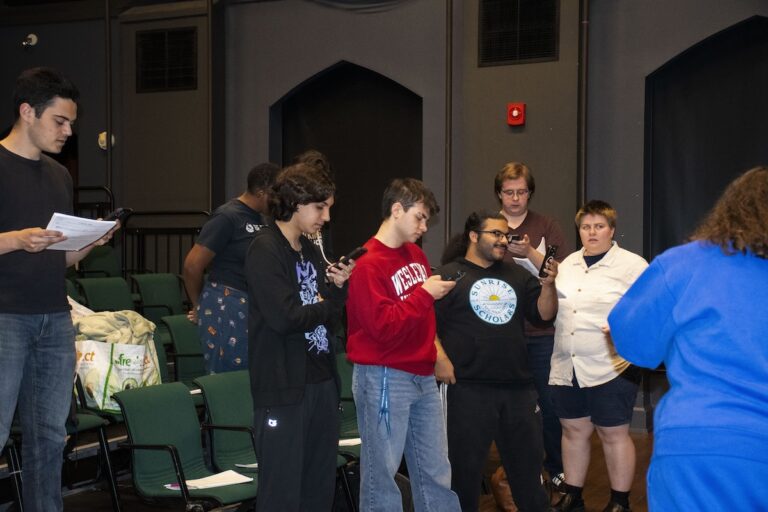
A brief reception followed the reading, allowing members of the audience to interact with Fishman one on one, and discuss the difficult topics and emotions brought up in his work.
Those in attendance didn’t leave with a warm fuzzy feeling on a cold November night. They did leave, however, with one more piece of the difficult puzzle of how humanity can bear witness to and honor through remembrance the travesties of its past.


Leave a Reply