
Spirits, community invited to Zilka to celebrate dead of the Dead
Bright colored paper cutouts dance across the ceiling of the Zilkha Gallery, bringing attention to an altar adorned in skeletons, candles, food and even a cat’s hairbrush. The installation of this ofrendas, or offerings in memory of loved ones, was constructed in celebration of Día de los Muertos (Day of the Dead). It is also part of the Alegría Mexicana Festival, which is being hosted in the Center for the Arts in order to bring the contemporary arts and culture of Mexico to the University.
“No collection of Mexican Folk Art is complete without skeletons and the Day of the Dead,” said Annie O’Neill, a Gardiner, NY-based artist responsible for assembling the ofrendas.
O’Neill, who is the sister of Nina Felshin, Curator of Exhibitions for the CFA, has accumulated a great deal of knowledge about Mexican art. After spending time living in Mexico, she ran a gallery in New York called the Mexican Folk Art Annex for 14 years, and later developed quite a collection of Mexican Folk Art. Much of the display in Zilka Gallery was borrowed from O’Neill’s own personal collection.
Pamela Tatge, Director of the CFA, described the production as a “moment of community involvement,” with the CFA inviting Middletown and Wesleyan community members to bring their ofrendas to be included in the altar.
“When I originally brought in my objects there were only three other contributions,” said adjunct professor of German studies Vera Grant, who brought objects to remind her of nature and family gatherings at Cape Cod, Mass. “It’s amazing to see it all grow into this, life’s bounty.”
Though not many people contributed ofrendas beforehand, photos and notes were added to the altar throughout the opening celebration Tuesday evening.
“This mysteriously appeared on the altar this afternoon,” O’Neill said of a blue egg.
Among the ofrendas, people left a can of sardines for a grandfather, a Hershey’s bar for a friend, and a hairbrush for a lost cat.
“The spirits of the dead come back once a year to partake of their favorite parts of life,” O’Neill said, explaining people’s contributions.
Reactions to the display spanned a wide range of emotions.
“The main idea of the altar is to come eat the essence,” said Octavio Flores, Adjunct Associate Professor of Romance Languages and Literatures. “The spirits extract the essence and then their relatives eat it after because it’s meaningful.”
“I remember for my grandmother, [the altar was up] for four days. I remember it was four days because as a kid I was just waiting for the good stuff,” said Heric Flores, Manager of Instructional Media Services for ITS, reinforcing the importance of food in the tradition of the ofrendas.
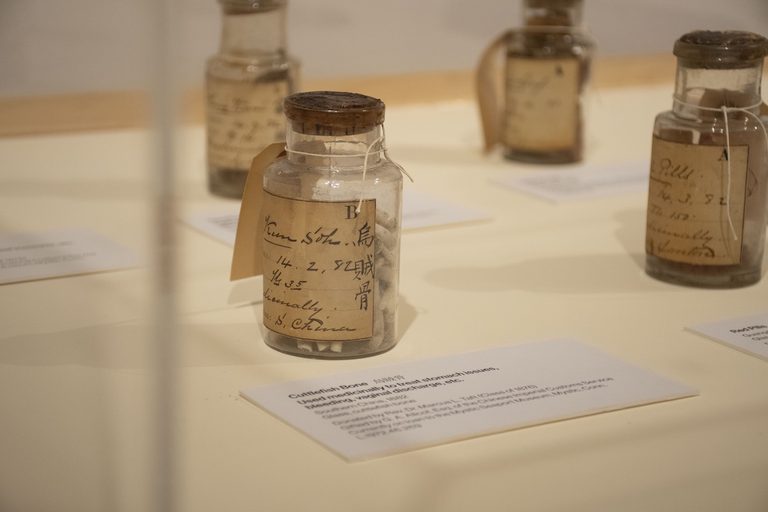
The Zilkha ofrendas includes traditional foods such as pan de muerto, symbolic bread of the dead, corn, and sugar skulls as well as empty beer bottles. Due to its location in the art gallery and the six day duration of the display, this altar is limited to non-perishable items, just giving the overall idea of the food offerings.
“[The altar] is very nice but it needs more food and liquor,” said Nora Casagrande of Higganum, Conn. who teaches high school Spanish in Middletown. Casagrande suggested there should be tamales and atole, a chocolate-like drink made from corn.
Traditionally, altars are full of burning candles and incense to help guide the spirits to the altar. Due to the gallery restrictions, this could only be mimicked. This omission bothered several viewers. Another common complaint centered on the more arbitrary additions of folk art for the sake of representing Mexican culture.
“In creating a display by adding random images they’re taking away the practice of Day of the Dead and they’re just turning it into an art display instead of a living cultural practice,” said Marta Martinez ’05.
Mexican students on campus were also disappointed in the University’s lack of outreach and inclusion of the Mexican community in the whole organization of the Alegría Mexicana Festival.
“I think that their representations are disappointing and I wish that we could have worked together to have some real feedback on these images and on what they were creating,” Martinez said.
Students were looking for more forums and discussion, to give an explanation and context for the events being presented in the festival and why they are significant in contemporary Mexican culture.
“There weren’t student dialogues included,” said Jacinta Gonzalez Goodman ’07.
Although there is a source of tension because of Latino Awareness Month and the CFA’s separate Alegría Mexicana, Gonzalez Goodman does acknowledge the CFA’s efforts.
“It’s great that they’re doing cultural events,” she said, “but it’s very difficult because there is a thin line between presenting another culture and objectifying it through stereotypes.”
Still, for others, the altar and celebration at Zilkha provided the perfect forum for being able to discuss the Mexican culture and holiday of el Día de los Muertos.
“We are not afraid of death,” Octavio Flores explained. “We laugh at it. There’s nothing we can do to avoid it. It’s not taboo.”
“We create poetry about it,” Heric Flores continued. “We create poems about our friends who are living, too; it’s humorous.”
Despite the different personal views regarding the ofrendas, the aesthetic content and subject matter of the altar provoked reflection and discussion over a wide range of sentiments and opinions.
“It’s befitting we have an election today,” said Robert Grant ’64. “We’re honoring the dead as we’re producing more.”
The altar will remain on display at Zilkha until Sunday. Go reflect for yourselves and create your own opinions.


Leave a Reply