
Alumnus brings soldier memorial to homecoming weekend
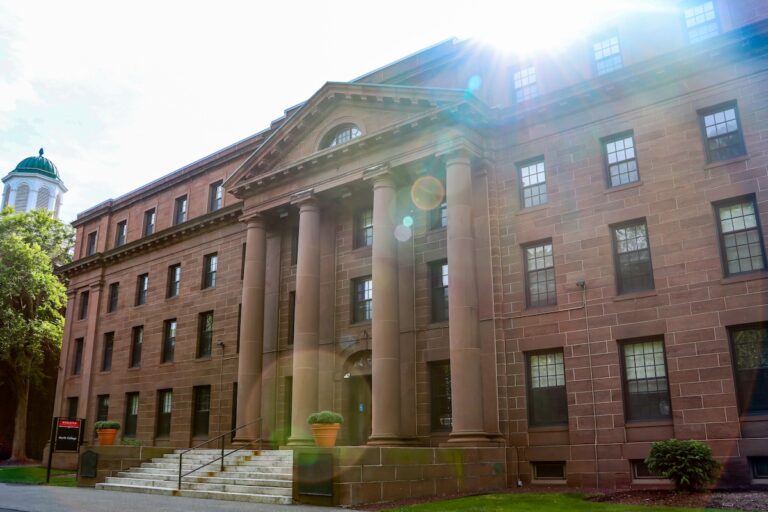
On Saturday afternoon, Nicholas Cohen ’97, with the help of Mike Butterfield ’06, exhibited a memorial to American soldiers killed in Iraq and Afghanistan in front of the Science Center.
The memorial, called “Honor the Fallen,” consisted of 1,204 pictures and brief biographies of fallen soldiers stretched from one end of the Science Center patio to the other. The memorial was brought from its original home in New York City’s Union Square Park for homecoming weekend.
Cohen, an army veteran, created the memorial in response to what he perceived to be a nationwide negligence of those who had died in Operation Enduring Freedom and Operation Iraqi Freedom.
“I wanted to impress upon people that this is the real deal,” he said. “People are dying.”
Cohen debuted the memorial in New York on Sept. 10 after two months of working to get a permit for it. According to Cohen, the timing of the opening ended up attracting unexpected attention and some of the media spun it as a political statement about 9/11. Reuters and the AP were both present at the unveiling of the memorial.
“The news trucks were looking for events,” Cohen said.
Despite the political arguments and controversy surrounding the operations in Iraq and Afghanistan, Cohen maintains that the memorial is not a partisan statement.
“The reason to be nonpartisan is, for example, because fathers and mothers don’t want to see their child’s memory used for political purposes,” he said. “Whether for or against the war, you should be thinking about the soldiers and grieving their loss.”
The power of the memorial comes in part from the shock of encountering its presentation. Laid out flat in three rows that stretch several hundred feet each, the memorial creates a harrowing feeling of vastness.
“The best reaction you can get is when people are not expecting to see someone who has been killed as a result of the war,” Cohen said.
Because the memorial was brought to Wesleyan on short notice, almost no one was aware of what it was as they walked by on their way to athletic contests or seminars.
This unexpectedness produced the type of reaction that Cohen was looking for, he said. Most students and parents paused and spent at least a few minutes in quiet reflection upon seeing it. Many could be seen shaking their heads or heard emitting a subdued gasp at a soldier who died very young, was survived by children or came from a town they recognized.
When asked, many students said that the reality of the deaths and of the individuals was very poignant.
“A lot of them are the same age as Wesleyan students,” said Bruce Holstein ’70.
His daughter, Abigail Holstein ’05, added, “kids [of those killed] will grow up without fathers and mothers.”
“You don’t get that idea when you read a few names in the paper,” said Cameron Hummels ’04. “It is a lot of people.”
“You never get a sense of scope [about the deaths],” said Butterfield, the student organizer of the memorial. “A lot of the power of it is that you get to see the big picture.”
Cohen said that he planned to take the memorial to Columbia University next and that he would display it as often as possible before the November election.
He expressed gratitude towards Wesleyan, and especially Mike Whaley, Dean of Student Services, for allowing the permits on such short notice. He added that he was looking to bring the memorial back to Wesleyan in the future.
Leave a Reply