
Harvard professor reflects on Brown v. Board of Education
The continuing value of the Brown v. Board of Education trial was discussed Tuesday by Charles V. Willie, the Charles William Elliot Professor of Education, Emeritus at Harvard University.
“Nobody is wise enough, smart enough or rich enough to go it alone,” Willie said. “So you all better start praying for diversity.”
According to Willie, the main lesson Brown v. Board of Education can teach today is that the more people receive education, the more valuable education becomes in our society, which is why equity and justice are important in education.
“Diversified collectivity has a better chance of adapting to a changing environment than a homogenous one,” Willie said.
His talk focused on the historical effects of segregation among major decision-making groups.
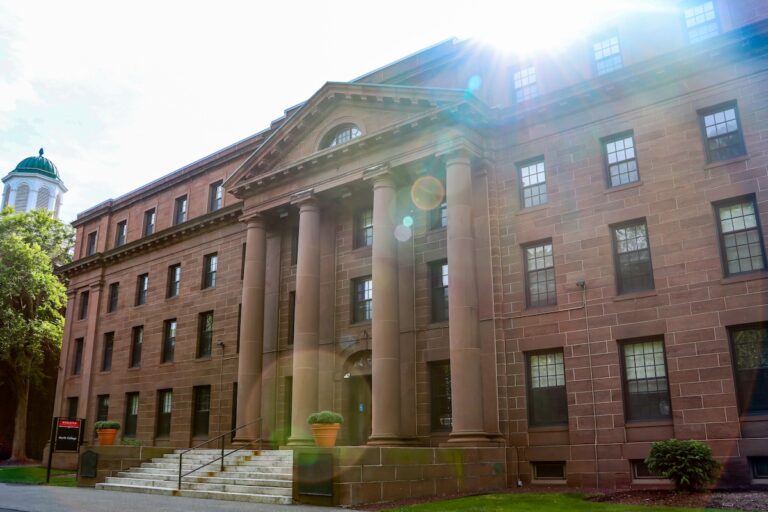
The lecture, sponsored by the Raymond E. Baldwin Foundation, competed for audience with the impending Vice-Presidential debate. About 70 interested faculty and students filled out the lower level of the Memorial Chapel.
“He infused a zealous passion for equity and justice with well-formulated arguments and examples demonstrating the successful legacy of Brown v. Board of Education,” said Zeb Zankel ’05. “But, moreover, he aimed and succeeded in inspiring the audience to seek service opportunities and knowledge among those outside of your own group, no matter how you identify yourself. It was a true wake-up call to embrace diversity, not for diversity’s-sake, but for all of the educational benefits that diversity can provide.”
Willie connected the Brown v. Board decision to his own life, by discussing attending a segregated “colored” high school in Dallas. According to Willie, non-white schools were so poorly funded that there was only one “colored” high school for all of Dallas, so students had to attend high school in shifts.
“He seemed like he wanted to convince us that the achievements of the Brown v. Board of Education decision are things that we should value but I think most of the Wesleyan community already holds those ideals in high esteem,” said Anna Talman ’05.
According to Willie, even a school like Wesleyan may not be as open to diversity and equality as it should be. In their brochures, all private New England colleges mention excellence, but none mention equality, he said.
“In some ways people need more exposure to his perspective about the interdependence and uniqueness of certain groups,” said Carol Wright, visiting instructor in African American Studies.
One student, who declined comment, thanked Willie for doing the ethical and foundational work, which has made it possible for her to attend Wesleyan. Other students asked questions about the work that he has done in helping to desegregate schools in Boston.
The Lecture was part of Wesleyan’s celebration of the fiftieth anniversary of the Brown v. Board of education decision. It was followed up with panel discussions on Wednesday. Also a part of the celebration is a lecture by Dred Scott and an art installation in the lobby of Olin, designed for audience participation entitled, “Blacks Only/Whites Only.”
Originally trained in sociology at Syracuse University, Willie currently teaches at Harvard’s graduate school in education. Willie is a specialist in issues of segregation, race relations, education and public health. In addition to writing more than 25 books and over 100 articles on these issues, he has been the vice president of the American Sociological Society and has served on the Presidential commission for mental health. Willie is most known for his involvement legal cases involving issues of desegregation in varying roles across the country.
Leave a Reply