
Professors Analyze Election Results in “Making Sense of the Midterms” Government Department Talk
With the purpose of analyzing the recent election outcomes, the Government Department hosted a talk, “Making Sense of the Midterms,” on Monday, Nov. 9, 2026. The event, which featured Associate Professor of Government Logan Dancey, Professor of Government Erika Franklin Fowler, Assistant Professor of Government Steven Moore, and Associate Professor of Government Justin Peck, was attended by roughly 50 students.
According to Peck, the event aimed to help students apply the theories and concepts that they encounter in government courses to the real world.
“Ideally, they will be better prepared to make sense of contemporaneous political events if they see how political scientists interpret them,” Peck said.
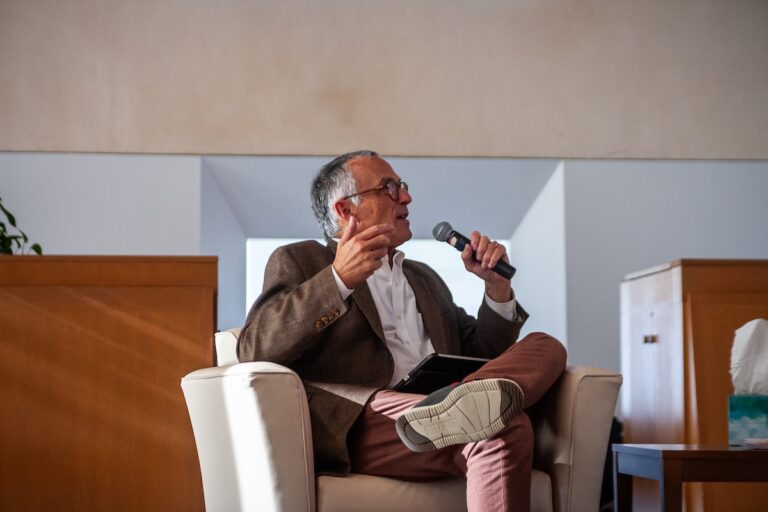
Logan Dancey
The talk began with Dancey arguing that the midterm results were not atypical, and that they followed the theory of Thermostatic Public Opinion, in which public opinion swings in the opposite direction of the current president’s party. Dancey cited an example of this effect regarding public opinion on immigration.
“Heading into the 2024 presidential election, immigration was seen as a really good issue for Republicans, as public opinion suggested that lots of people felt the Biden administration had been too relaxed in their immigration enforcement,” Dancey said. “By 2026, public opinion had turned, and many thought that the Trump administration was too strict in their immigration enforcement.”
Other factors that contributed to the Democrats’ sweep, according to Dancey, included their greater level of enthusiasm when turning out to vote after two years of dissatisfaction with the current administration. The higher cost of living also drove down approval ratings for Trump, similar to the election of 2024.
According to Dancey, the most surprising developments were in the swing states. Each of the 25 states that Trump won three times in a row in previous elections significantly shifted blue. The Democrats will now be entering Congress with a majority that is similar to the first year of Barack Obama’s presidency.
Erika Franklin Fowler
Agreeing with Dancey that the political switch of Congress was expected, Fowler highlighted a pattern that emerged in this and previous elections: voters were more likely to side with the party they thought would deliver lower costs of living.
As Director of the Wesleyan Media Project, which records and interprets political advertising in real time, Fowler drew attention to the advertising strategies used in midterm campaigns. She referenced how there was an average of $7 billion spent on advertising; $11 billion if additional costs are included.
According to Fowler, 87% of general election spending was focused on areas that voted for Trump in 2024, revealing that both parties were aware of the power of new Democratic candidates. Cost of living was a common platform across party lines. Democrats talked about the cost of health care, gas, and groceries, while Republicans reminded voters that the other party raises taxes. Democrats also focused on government ethics and underlined government corruption.
“The [Wesleyan Media Project] put together some numbers that show that government ethics was through the roof this cycle, in particular by Democrats,” Fowler said, referring to an increase in Democratic ads attacking Republicans for government corruption and in-office scandals. “And some of that messaging was particularly explicit. Basically, that ‘your member of Congress was trading stocks while you are having to foot the bill,’ essentially.”
Fowler emphasized that during every election, political scientists wonder whether this will be the last year of TV advertising. This cycle, while audiences still received advertising from their TVs, other media platforms were utilized for campaigning. Another notable development was that many state sponsors chose to air their political ads nationally rather than just in the state.
Fowler states that many political scientists refer to this as the first “AI election” due to AI’s large presence in political ads. She also mentioned that AI was able to make video production easier for under-resourced campaigns.
However, there was also a trend in political advertising where candidates would change the words or actions of the candidate they were running against. Sometimes the changes in those videos intentionally appeared fake for a satirical effect. According to Fowler, some voters became confused about whether hyper-realistic videos were real.
Steven Moore
Drawing from his experience of growing up in the Deep South of South Carolina, Moore began his talk by calling the political shifts in the South “truly remarkable.” He largely attributed the result to Black and Brown voters, who turned out and voted Democrat at greater rates than in 2024.
Moore attributed the result to multiple factors. He noted the existence of educational polarization, the political theory that less educated voters move toward the GOP and college-educated voters toward Democrats, which affected Black, Hispanic, and Latino voters in 2024. But there was no evidence of this in the recent election.
According to Moore, another reason for the results in the election could be the role of economic concerns and the cost of living. With the Trump administration recently being proven responsible for the inflation that was previously attributed to Biden, there was a greater push to vote for the Democratic Party within these racial groups.
Moore noted that the threat of deportation and an uptick in violent Immigration and Customs Enforcement arrests have factored into Hispanic and Latino voters choosing the Democratic Party. Similarly, historically Black districts in the South are being gerrymandered. With their political rights under threat, Black voters are turning out to vote at greater rates.
“The turnout rates for this group were quite high for a midterm election,” Moore said. “In South Carolina, I believe turnout for Black voters was around 500,000, which is maybe only 50,000 less than we saw in 2024, and we usually see a much greater drop-off between general elections and midterm elections.”
Justin Peck
As the last panelist, Peck ended the talk by bringing up the effect of the Iran War’s on the election’s outcome. He described the war as a large reason for Trump’s tumbling approval ratings.
“I think one clear way to interpret the results is a clear demand from the public that this war end immediately,” Peck said. “And I think the result here is the strongest electoral signal in a generation that the public, in a bipartisan way, rejects a kind of elite-based foreign policy consensus that transcends both parties.”
Peck mentioned that since 2008, both parties have struggled to elect a president who would avoid wars, a platform that Trump ran on. Trump’s war in Iran is largely perceived as an explicit betrayal of his promise, and the election revealed a bipartisan majority that doesn’t approve of the administration’s foreign policy.
In terms of what might happen in the coming months, Peck is betting that there will be “no meaningful change.” He anticipates that the Democrats might further criticize Trump’s leadership, say that Congress should be consulted more in war decisions, but they largely won’t change the war funding or leadership makeup.
Attendees found the event to be knowledgeable and meaningful.
“I found the event to be insightful,” Abigail Price ’27 said. “I especially appreciated the range of perspectives the panelists brought. Each of the panelists had a different area of focus, which enriched the quality of discussion.”
Students also expressed interest in attending more events around the political landscape of the country.
“I would definitely attend more events that discuss the current political landscape,” Mackenzie Mertel ’30 said. “I think events like this one, that explain the potential outcomes of certain political things and/or what certain political things (like elections) mean overall, are very educational.”
Elyse Mathews can be reached at esmathews@wesleyan.edu
Raiza Goel can be reached at rgoel@wesleyan.edu

Leave a Reply