
From the Argives: Unveiling Skull and Serpent and Mystical Seven, Two of the University’s Oldest Secret Societies
Wesleyan students have likely heard whispered rumors about the famed secret societies lurking around campus. Mystical Seven was founded in 1837 and Skull and Serpent emerged in 1865, which means these exclusive societies pre-date the founding of the University’s well-known Greek fraternities, such as Psi Upsilon and Alpha Delta Phi. Despite the closed-door nature of Mystical Seven (commonly referred to as M7) and Skull and Serpent, both organizations historically have played powerful roles in campus life, with certain evidence suggesting their continued influence today. Throughout the centuries, The Argus has captured all the most interesting chapters of the history of Skull and Serpent and Mystical Seven.
Foundation
Founded in 1837, Mystical Seven began as a secret literary fraternity but later became a senior honor society in 1867. An Argus article published on March 16, 1942 characterized the society’s signature use of the number seven.
“[T]his fraternal organization was based on an intricate system of secret symbols, mainly connected in some way by the numeral seven,” the article said.
The University’s first president, Wilbur Fisk, personally approved the society’s constitution in 1837, which shows how closely the society and the administration were tied. Mystical Seven’s first official headquarters were in the attic of North College, then a dorm.
According to an article by Mitchell Plave ’83 and Daniel Tarb ’83 published in The Argus on March 4, 1980, Skull and Serpent was founded in 1865 “as Mystical Seven’s rival in attracting the ‘right people.’” There is no consensus on who founded the society. Many sources across The Argus archives claim that it was either Stephen Henry Olin, the University’s acting president after the death of William Shanklin, or Shanklin himself.
Meeting Places
The first and original North College, Mystical Seven’s meeting place, was destroyed in a fire in 1906. According to University Archivist Leith Johnson in the Sept. 18, 2013 issue of the Wesleyan University Magazine, the suspected cause was a Mystical Seven candlelight ritual. The Argus wrote in the March 1942 issue that the fire “brought the loss of many treasured relics of the Mystical Seven.”
After the fire, Mystical Seven lacked a regular meeting spot until 1912. Somehow evading consequences, the group then commissioned the construction of a new congregation space, often referred to as the society’s temple, on Wyllys Avenue, across from what was then Fayerweather Gymnasium. Eric Segal described in the April 9, 1976 issue of The Argus that this “templum,” as Mystical Seven members refer to it in the article, was designed to have “7 sides, a seven-sided chimney, 7 windows, 7 sections to each window.”
“They did not acquire a permanent meeting place for 49 years,” Phil Rayhill ’54 wrote in the Nov. 9, 1951 issue of The Argus. “In the interim, they convened at different spots on the campus and in Middletown always maintaining the utmost secrecy in their movements.”
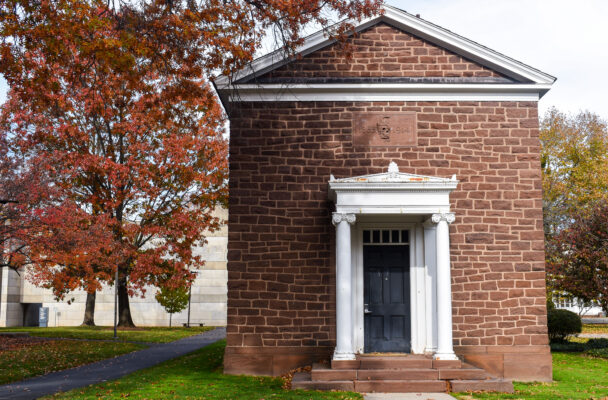
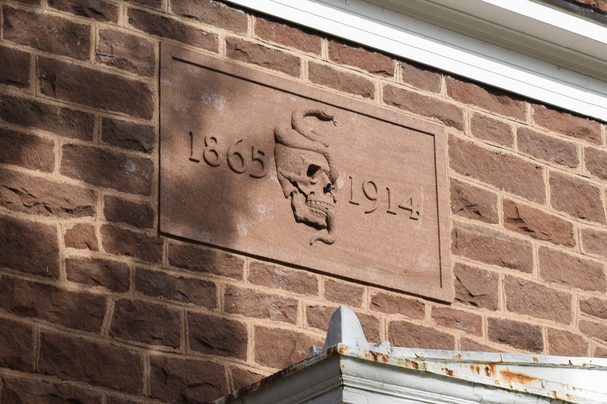
Rayhill also describes that, in 1914, the Skull and Serpent Tomb was erected by famed architect Henry Bacon. Bacon also designed the Eclectic Society and Olin Memorial Library, among other campus buildings, and, most notably, the Lincoln Memorial in Washington, D.C.
In the 1930s, the University purchased both societies’ buildings and allowed them to lease the buildings until 1970. After the leases expired, the University required both Mystical Seven and Skull and Serpent “to justify their existence in order to allow them to continue in their buildings,” according to the March 1980 issue of The Argus.
Suspiciously, Mystical Seven’s base of operations on Wyllys Avenue also succumbed to a fire in 1995. According to the Oct. 14, 2008 issue of The Argus, the burned building remained unused and standing until it was razed in the summer of 2007.
Membership
After the Civil War, Mystical Seven followed Skull and Serpent’s decision and restricted membership to only upperclassmen. The Argus wrote in the March 1942 issue that the society temporarily changed its name to “The Owl and the Wand” and distinguished itself by inducting only the most prominent students on campus. “What remained was a self-proclaimed group of campus leaders,” they wrote.
“A rare aggregation of the editors, college-body officials, athletes, and other unique personalities of the class… the intellectual, social, dramatic, and athletic life of the college,” said Mystical Seven Treasurer Karl P. Harrington, class of 1882.
The banned underclassmen eventually went on to form Delta Kappa Epsilon.
Robert L. Kirkpatrick ’60, Vice President of the University’s Relations in 1976 and a member of Mystical Seven from 1959–60, was quoted as saying that members were selected for “leadership potential, wealth,” and to “establish connections that could be used after graduation,” furthering the distinctive and slightly pretentious personas the societies emitted.
Traditionally, students must be tapped to be eligible to join either society. Sue Bodnar ’82 noted in the Nov. 15, 1977 issue of The Argus that the two groups conferred on which organization got which members. “There was a certain agreement between the societies,” she wrote. “The outgoing seniors of each society would meet to discuss which society would tap certain prominent juniors.”
This created a very insular system, as Mystical Seven member Daque Tirado ’96 noted in the Nov. 15, 1996 issue.
“For a while it was a society based on people picking their friends,” Tirado said.
“Mystics are chosen by individual seniors and are more or less friends of friends,” Bodnar similarly wrote. “The Skull still votes on new members, therefore the element of prestige still remains in being voted in and tapped.”
Rituals
Segal wrote in 1976 that one of Mystical Seven’s better-known events is the “Ritual of Initiation,” which was written at the same time as the society’s constitution.
“Somewhere in the Ritual, there exists such events as the ‘Wampum,’ the ‘Coffin,’ the ‘Ancient Nick,’ and ‘J. Hardenbroke,’ none of which have any significance to those not initiated into ‘the Mystica,’” Segal also wrote.
Mystical Seven also used many symbols related to its eponymous numeral.
“Seven books, the seven-pointed star, and the mystic ‘seven-sided poems,’ [which] have seven lines of seven words, seven syllables in each half line, seven letters in each word, all seven notes of the scale in each phrase,” Segal wrote.
Relations with University Administration
“Skull and Serpent members had always maintained a close working relationship with the administration which frequently consulted the members about University affairs. Many secret society members maintained their interest in Wesleyan after graduation; Mystical Seven and Skull and Serpent were a ‘breeding ground’ for administrators and trustees,” Plave and Tarb reported.
Competition
Despite many similarities, Mystical Seven and Skull and Serpent have a long history of contention. Between bad-mouthing and vandalism, the two developed a feud that continued decade after decade.
“For many years, there was a strong rivalry between Mystical Seven and Skull and Serpent. Each group’s record books were constantly stolen by the other group, and once, in the sixties, the Skull’s door was removed,” Segal wrote.
Bodnar verified this competitive nature by quoting members of each society. She noted the superiority many Skulls felt over Mystics.
“One Skull alumnus in the class of ‘51 [said], ‘We were definitely the superior group with the Mystics trailing far behind.’” Bodnar also quoted a Mystic alumnus, who said: “The Skulls used to feel very superior, but in reality it was the Mystics who had a far greater say in the campus mood.”
Secrecy
Despite the enigmatic character essential to these organizations, The Argus has revealed the caveats of the societies’ secretive natures.
“The University does not allow secret societies as such…. So we remain mysterious but not secret. The membership is no secret, nor, of course, is the headquarters,” Segal wrote, quoting Willard Lockwood, the director of the University Press and the faculty coordinator of Mystical Seven in 1976.
Throughout the decades, both Mystical Seven and Skull and Serpent advertised their activities and spotlighted their members in The Argus. In many yearbooks and class photos, the societies were listed alongside other public clubs and activities, such as sports teams, student government positions and classic Greek fraternities. The November 1951 issue printed a photo of the members of Skull and Serpent on its front cover, including the members’ names and photos.
Aspects of the society were public-facing, but a deeper knowledge of the group was reserved for inducted members. Rayhill detailed an exclusive interview with an anonymous member of Skull and Serpent.
“…the society had planned a year of extensive activity about the campus. However the nature of this activity, as always, remains secret,” the student said.
Throughout their histories, both Mystical Seven and Skull and Serpent have been open about their membership and participation in exclusive activities, despite their claims to secrecy. The Argus’ May 9, 1961 issue even published the time and date that Skull and Serpent would be tapping rising seniors, “advising students to stay in their rooms until the event ended.”
Fall into Obsolescence
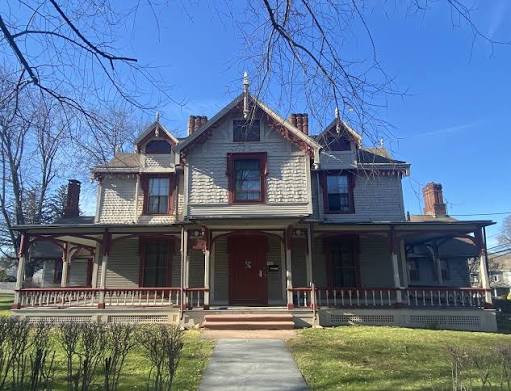
The Argus seldom mentions Mystical Seven and Skull and Serpent today, although they are known to still have an active presence on campus. The current house of Mystical Seven is located on the corner of Lawn Avenue and Pine Street, in the ultra-modern gray building that looks out of place among traditional homes. It occasionally hosts invite-only parties, staying true to its exclusive nature.
In an Argus article published on Oct. 28, 2019, Spencer Arnold ’19 speculated about the return of the Mystical Seven after Michael Whaley, Vice President for Student Affairs, sent a photo to the entire University of a group of robed individuals gathered around the Douglass Cannon.
Not much is known about the extent to which Skull and Serpent has survived into the modern day. Arnold wrote that the society’s last public appearance was in 2016, when a video surfaced of its members participating in the Mannequin Challenge.
Chloe Rappaport Crowther can be reached at crappaportcr@wesleyan.edu.
“From the Argives” is a column that explores The Argus’ archives (Argives) and any interesting, topical, poignant, or comical stories that have been published in the past. Given The Argus’ long history on campus and the ever-shifting viewpoints of its student body, the material, subject matter, and perspectives expressed in the archived articles may be insensitive or outdated, and do not reflect the views of any current member of The Argus. If you have any questions about the original article or its publication, please contact Head Archivist Hope Cognata at hcognata@wesleyan.edu.



Leave a Reply