
From the Argives: The Hauntings of 202 Washington St.
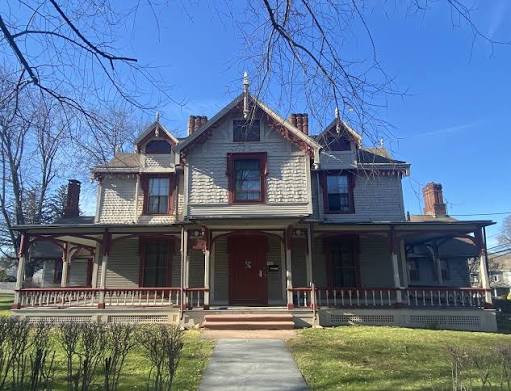
The University campus consists of an, at times, jarring juxtaposition of architectural styles. One prime example is the nearly 280-year-old Gothic Revival house still standing at 202 Washington St., once called the “Gingerbread House” for its storybook-esque structure. The University has long laid claim to this living slice of history, and currently the space is used as student housing.
Throughout the past two decades, 202 Washington has been a program house, most notably Full House, Music House, and Writing House. Now, it is used as general independent living for students. However, long before students occupied this mansion, it was home to various influential Middletown residents, who may continue to haunt its halls today.
According to a 1985 Argus article, the house was built in 1755 when Middletown was a prosperous shipping port. Around this time, the home had various owners, notable men, beginning with Chauncey Whittlesay, a prominent merchant, and then by Charles Richard Alsop, the mayor of Middletown from 1843–1846 and later a senator for Connecticut in 1855. During his time living in 202 Washington, Alsop entirely remodeled the house, which was formerly in the Georgian style, to be in the style of Gothic Revival.
Later, in 1910, the house was sold to Frank Bentley Weeks, who was a Connecticut state governor and a trustee of the University. In 1935, The Argus reported that Weeks “died suddenly at 7 o’clock last night at his Middletown home on 202 Washington Street.”
After Weeks’ death, the house was gifted to the University and has since been used as student housing. Its slightly decrepit exterior is a mark of the decades of students that have lived there, who have left the house in a state of mild disrepair.
In 1966 it was converted into a fraternity house occupied by Kappa Alpha. The fraternity added an awkward additional structure to the back of the house with more dorms “which destroyed a large rose garden.” This structural addition still exists today, and the contrast between the original Gingerbread House and its comparatively nondescript add-on gives the house a slightly disjointed appearance. Similarly, the interior of the house displays a mix of new and old: While most spaces have been remodeled to accommodate dorm-style living, many of the rooms still display charming tiling and old brick fireplaces, reminiscent of the house’s glory days
A quick search in The Argus archives for 202 Washington St. yields numerous advertisements for parties at the house throughout the decades. For example, a 1984 article promotes a Saturday night party: “Discover Gingerbread – room to room party. Drinks, dancing, delights. Everyone welcome. 202 Washington Street. $1, 10 pm.”
Not only have centuries of residents left their mark on the house’s physical condition, but students also report a “haunted” atmosphere. A 2012 Argus article tracing the history of 202 Washington St. includes testimonies from students recounting their paranormal experiences in the house.
“I had dreams of a woman in a Victorian dress just staring at me,” Chi Le ’13 said. “It was really creepy. And during the daytime, when I’ve been in the house alone, I’ve heard old music.”
The newest generation of 202 Washington residents have had similar supernatural incidents.
“I think the whole vibe of the place is definitely really creepy,” Tessa Chaet ’29 said in an interview with The Argus. “I mean, just look at it!”
Chaet recalls one specific paranormal encounter with a spirit in the bathroom. “One night I woke up in the middle of the night at 1 a.m. to go to the bathroom, and I swear I heard the door open and someone come in,” she said. “But when I went out no one was there.”
In particular, she noted feeling a constant presence following her around the house.
“I don’t like to walk around alone…sometimes I hear muttering through the walls, or I’m walking through the halls, and I hear live music being played,” Chaet said. “Also, the doors often move on their own. The corner of Washington [Street] is scary in general. There are lots of accidents, and I feel like the house is cursed.”
The long history of people that have lived and died in this house provides persuasive evidence for these accounts of paranormal presence. Perhaps it is the ghost of Weeks that still haunts the unsuspecting students of 202 Washington St.
Beth Huggins can be reached at bhuggins@wesleyan.edu.
“From the Argives” is a column that explores The Argus’ archives (Argives) and any interesting, topical, poignant, or comical stories that have been published in the past. Given The Argus’ long history on campus and the ever-shifting viewpoints of its student body, the material, subject matter, and perspectives expressed in the archived articles may be insensitive or outdated, and do not reflect the views of any current member of The Argus. If you have any questions about the original article or its publication, please contact Head Archivist Hope Cognata at hcognata@wesleyan.edu.


Leave a Reply