
Zach Bryan Grows Up on Young Manhood and Other Donatable Organs
The mythically prolific Oklahoman singer and songwriter Zach Bryan has consistently released lengthy albums and chart-topping EPs since he was discovered on YouTube almost 10 years ago, singing outside his Navy barrack with a beer by his feet. He now holds the record for the largest ticketed concert in the United States, having sold out Michigan Stadium—colloquially known as the Big House—in Ann Arbor, Mich. last year, and has reached megastardom that sometimes feels distant on our campus but palpable in my native Appalachia.
On the heels of his latest sold-out world tour, With Heaven On Tour, Bryan released an eight-song EP, Young Manhood and Other Donatable Organs, on Oct. 16. The EP, combined with a memoir of the same name and a mammoth two-hour interview with Matthew McConaughey posted on YouTube, marks a change in his work. Bryan, now sober and married, returns to his troubled adolescence in the wake of turning 30.
Young Manhood continues in the sonic vein of Bryan’s recent work with upbeat tracks like “Backwards” and “Dog Days” crafted for stadiums, interspersed with contemplative ballads, notably “Lies,” which features Lana Del Rey.
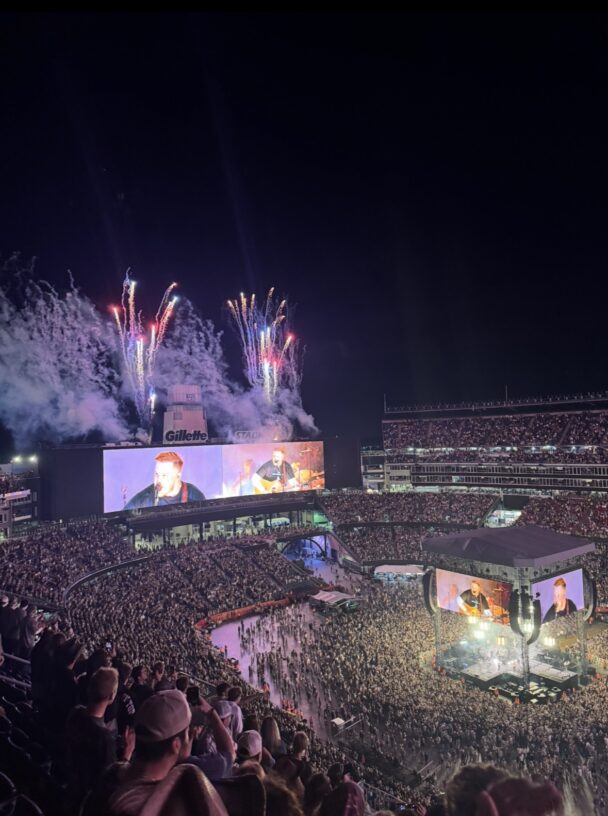
While his career began with an acoustic guitar, Bryan has scaled his arrangements for sold-out arenas (his penultimate tour stop at Gillette Stadium broke the attendance record and left me stuck in the parking lot for over two hours). He now tours with a 20-piece band, including a horn section and a string quartet, that allows for monumental musical swells seldom found anywhere else. Despite the increased sonic scale, much of his lyrical content remains Bryan’s standard: incredibly personal and often self-hating fare, with him wondering, “If you could write a book on the man that you once were / Would you write about drinking or would you write about her?” on the opening track “Lodi When.” In the Zach Bryan universe, he regrets nothing besides drinking or women, and often both. Death always looms above; what has changed is his attitude.
This was by design. In the McConaughey interview—a rarity for the singer who communicates mostly through his music and ill-advised social media posts (until he recently made the decision to deactivate Instagram)—Bryan shared previously unknown stories of childhood abuse, lonely days growing up on a naval base in Japan, and newfound sobriety. The EP’s title was inspired by his being tasked with making arrangements for his mother’s deathbed as a 19-year-old while his father was gone and his sister was too distraught. Bryan recounted a realization about manhood after being asked to sign organ donation forms, saying that, “even when you’re dying, people are going to come and ask, and they’re going to need…. I’ve given my heart and my soul and my lungs.” He spent the next 10 years on military bases, in bars, and venues singing to hundreds of thousands of people, reconciling with what fans, record executives, and family asked him to be. The EP considers his past, but with the knowledge that, as he sings on the final song “You’ll Get By,” “You’ll get by / Just fine / And you’ll find God / At the end of every road.”
His songs have always felt like the work of a man walking a dangerously fine line, communicating with all that is reckless and indulgent: a Jack Kerouac with a guitar who journeys to the dark on our behalf, or perhaps because he never had a choice in this pilgrimage. Bryan’s obsessions with Kerouac and Ernest Hemingway is well documented, including his $12.1 million bid for the original manuscript of “On the Road,” and other works. A man inclined towards booze and the open road with a history of tumultuous relationships, Bryan’s beatnik persona has never felt forced.
After his first-ever YouTube videos, shot at Naval Air Station Jacksonville in Jacksonville, Fla., went viral, Bryan recorded an album in an Airbnb with his Navy supervisor (who now gets a cut of every song’s proceeds) and friends, stapling mattresses to the walls to make a studio. They drank beer and played music for days, and Bryan was drunk enough uploading the album with multiple misspelled song titles, with “Condemned” becoming “Condemened.” His song “28,” commemorating his 28th birthday, felt partially like an acknowledgment that he did not succumb to The Great American Bar Scene that he named the song’s album for, and avoided membership in the 27 Club.
But after spending his twenties doing what he called “Kerouac-ing” with his buddies, a solo cross-country motorcycle trip ended with him drinking a 40-ounce Budweiser alone on a curb in Washington at 3 p.m. Bryan wondered, “Man, why am I drinking right now?…. What am I celebrating?” While he said, “I drank a lot in lieu of Kerouac, I drank a lot in lieu of Hemingway,” he now considers the effects sobriety has had on his own life, wondering “what Kerouac could’ve wrote if he had 50 more years.”
Young Manhood is his first time writing sober, and the sense of emotional clarity he has gained is notable. The anger and grief that have defined his work and life are no longer a live wire but instead processed and channeled from a distance. Some of his earliest work had an enticing rawness that lay not just in the stripped-back production but in a sense that he was prodding a gaping wound with every raspy note. Instead of cursing his genes, he approaches his mother’s alcoholism and the hardships that resulted with a seemingly newfound appreciation for their connection on the new song “Is the Blue Tangled In You?” Even his voice has less of an edge.
I didn’t know about his sobriety when I saw him perform on Saturday, Oct. 3, and I commented to my friend about how fitting the beers placed by each microphone on the four-pronged stage was.
Now, knowing they were non-alcoholic, they feel like another symbol of memory in a performance that often dwells in the past. Hearing these songs about Oklahoman expanses, written and performed drunk for years, sober in Massachusetts, felt like nothing short of a miracle. This distortion of time and space was deeply felt, as my friend and I found ourselves caught between the Bostonian inflections in the voices of the cops outside and the accents that pushed forward as we sang “Heading South,” my vowels warping back to when I was a hostess in Tennessee. We were behind a group of intoxicated high schoolers clad in brand-new cowboy boots who reminded me of a time when the line, “Don’t you miss the days when we’d sneak Jack in football games?” from a personal favorite, “Driving,” felt less like a memory. Even the air, which smelled of beer and sickly sweet vape, brought me to the sticky bar floors and late nights that breed so many of the regrets Bryan sings about.
But Bryan now spends most of his time 20 miles outside of Nashville, Tenn., swimming in his property’s pond, making frames for his wife’s paintings, and, of course, writing. The McConaughey interview took place on his gorgeous wrap-around porch, staged with a gingham throw blanket and floral arrangements worthy of a Southern Living cover. He is focused on his legacy and on fatherhood, saying of the interview and book’s combined project of documenting his life, “My kids were a big inspiration. My future children, god willing.”
Bryan has come to terms with the fact that being a man means having to give. He said to McConaughey, “I think a man, to me, is someone that can address his own problems while still fixing everyone else’s problems around him. I think a man is someone who takes accountability for his actions.” Bryan has used his fame and resources to open halfway houses for mothers across the country, but still makes music with his friends from Oklahoma and speaks sparingly on politics, recently wearing a Free Palestine shirt at Gillette in protest of owner Robert Kraft’s treatment of Macklemore. His gratitude alone overwhelmed the stadium with so many “thank yous” throughout the night that I was often concerned the concert was about to end. Though, in the same self-critical nature that characterizes much of his music, Bryan then said to McConaughey, “Maybe that’s what being a man is: always having the standards and you’re always coming up short of ’em.”
Abby Slap can be reached at aslap@wesleyan.edu.


Leave a Reply