
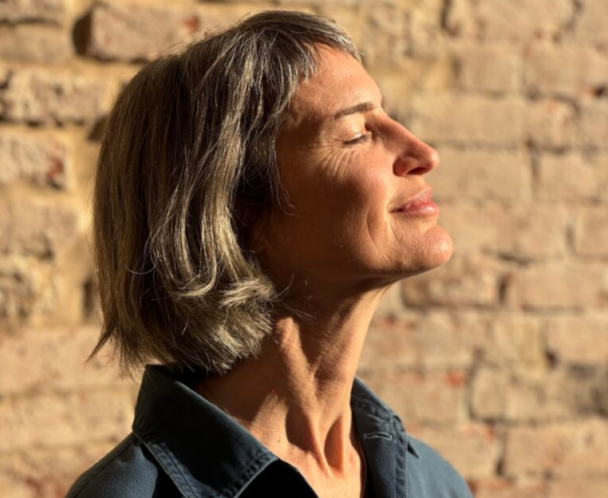
Poet and Visual Artist Jen Bervin Reads “Silk Poems” and “Love Ruth” at Russell House
The English Department hosted the second event of its Russell House Reading Series this school year with visual artist and poet Jen Bervin, though these two titles only touch on a portion of her work. On Wednesday, Oct. 14 at 6 p.m., students, faculty, and art lovers alike gathered in the main room of the breathtaking, historic building to listen to Bervin’s recitations from two of her works, the book “Silk Poems” and her manuscript “Love Ruth,” which has yet to be published.
“Silk Poems,” the New Museum’s “Book of the Year” in 2017, is a collection of poetry stemming from her research with Tufts University on liquefied silk from silkworms. In it, she effectively weaves together literary art and cutting-edge medical research to explore what her website calls the “cultural, scientific, and linguistic complexities of silk written nanoscale inside the body.” The book is written from the perspective of a silkworm speaking to a person who has had a biosensor implanted in their body, chronicling the worm’s life in conversation with a fictional recipient of the technology developed from its silk.
In another interdisciplinary blend, Bervin has been working on “Love Ruth” since 2020, during which the project has “looked like a lot of time in the archive.” At one point, Bervin spent three weeks at Stanford University, scanning and photographing around 3,000 pages of Ruth Asawa’s writings. This manuscript—Bervin uses this label loosely, saying “I’m calling it a manuscript but that is just fun,” which was followed by laughter—includes interviews, letters, oral histories, and other archival materials.
Ruth Asawa was a modernist artist widely known for abstract wire sculptures, and in Bervin’s poetry, she explores how these looping wire sculptures exist alongside language and physicality. Bervin says that she aims to find overlaps in language in an interdisciplinary context, a goal viewed in much of her work. Bervin described this work as a process, which is “a part of [her] practice.” She says she learned from her wife and collaborator Charlotte Lagarde that “Artists get to have practices, and it was something I did, but I wouldn’t name it. And part of having a practice is that you don’t have to make the thing all the time. You can do the things that get you through, or teach you the thing.”
Despite the warmth and beauty Bervin’s readings evoked, both in tone and spirit, there was a bit of a disconnect in the interdisciplinary context of Bervin’s work and the reading. At the start of the reading, Bervin said that usually, presentations of her work include “a lot of screens and images, [talking] to the intricacies of interdisciplinary projects,” and she quipped it was nice to just read for once.
However, some aspects of Bervin’s work that are so rooted in the conjunction of the physical and nonphysical were lost on the audience. At points, Bervin would have to explain that the pages of the “Silk Poems” were made from the same paper as Bible paper, thin and soft in a very distinct way, or that the poem she was reading off a certain page was written in all capitals with no spaces, making it difficult to read aloud. Such attention to detail is apparent in all of Bervin’s work, which is crafted with an intricacy that transforms what would otherwise be a book of poems into a multisensory experience that draws readers in. Being able to feel the paper or see the poem on the page might’ve helped listeners tap into the multisensory experience Bervin is known for.
That said, Associate Professor of English and Creative Writing Danielle Vogel’s poetic introduction to the series perfectly encapsulates the feeling Bervin’s reading incited. “[Bervin is] someone who teaches me about poetry’s capaciousness, of its ability to net and emanate worlds, archives, perspectives, histories, lineages, and the very material of my care and attention,” Vogel said. “For Bervin, poetry is a way of being with and in the world. At the core of her practice is a lifelong devotion to attending to the history intersections of texts and textiles.”
Avital Kessner can be reached at akessner@wesleyan.edu.


Leave a Reply