
How “Sunday in the Park with George” Painted the Portrait of a Complex Man
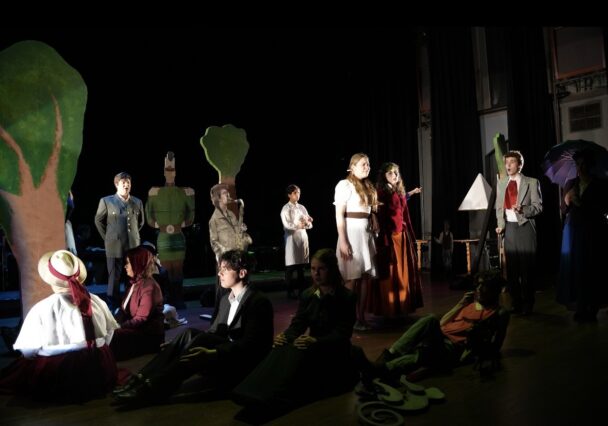
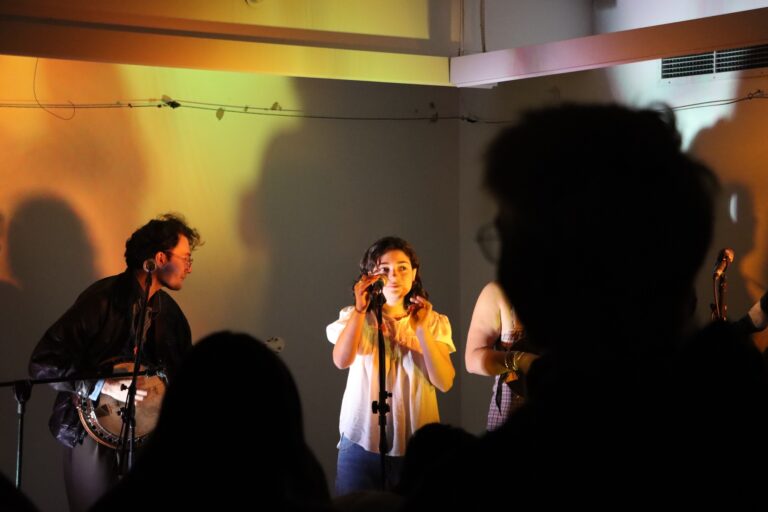
Georges Seurat’s 1884 masterpiece “A Sunday Afternoon on the Island of the Grand Jatte” began with a dot. A single point of color became part of a tree, a figure, and then an entire landscape. Spike Tape’s production of “Sunday in the Park with George” transformed the Patricelli ’92 Theater into a microcosm of an artist’s mind on Friday, May 1, and Saturday, May 2. The audience got to watch a work of art assemble itself in real time.
Stephen Sondheim and James Lapine’s Pulitzer Prize-winning musical traces the creation of Georges Seurat’s famous painting. The first act situates us in a Paris park along the Seine River where Seurat constructed his masterpiece. The second act jumps a century later to the 1980s art world, where Seurat’s great-grandson, also named George, grapples with his artistic identity in the contemporary, commercialized art world. There are worse things than staring at the water on a Sunday, but through Seurat’s character, Sondheim asks what happens when you never look up from your work at all.
Director Elsinore Palmer ’27 initially pitched the show to Spike Tape last Fall semester, and it was unfortunately rejected. Yet, in the past year, Palmer said that their connection with the material sharpened.
“This show has been in my life since I was like 12,” Palmer said. “But I didn’t fully understand it.”
It wasn’t until their sophomore year that the piece really clicked and their resolve to direct strengthened. “I was really able to understand it emotionally…and I knew this was what I wanted to direct.”
I was especially curious going into the show because “Sunday” is, in many ways, a meta look at art itself. At a university where creativity is so integral to our culture, it’s easy to admire the final product without ever seeing what went into it. Sondheim’s musical challenges that narrative. It invites audiences into the mind of the artist, and of the people who surround him. Through watching this production and learning about the efforts behind the curtain, it was clear to me that the musical was as much about the process as it was about the show itself.
“The show is about more than just those two people,” Palmer said, referring to Seurat and his muse, Dot. “It’s about communities and the way that art can’t happen without people.”
That ethos is palpable throughout the production, which brought together a team of more than fifty students. Even for a professional theatre company, a two-and-a-half-hour Sondheim score is no easy feat, so for a student organization to put on a production of this scale is impressive. Palmer described the process as a large collaborative effort.
“I put a lot of trust in my designers,” they said. “I really value an open and free-flowing creative process.”
The first act featured lush park scenes with 2D cutouts of trees, complete with an ambient soundscape and live music from the pit orchestra. The costumes were intricate and featured the classic lobster-tail bustle to accentuate the back of the skirt. At times, the characters froze, which reminded the audience that Georges saw others not as people, but as elements of his composition. In the second act, the set became starkly minimalistic and presentational, which paralleled the shift in art culture.
Oscar Hershkowitz ’28 played the titular role, Georges Seurat, whose portrayal captured the (necessary) detachment and brilliance of an artist who is consumed completely by his work.
“He has a mathematical sense of what painting is,” Hershkowitz said, emphasizing how Seurat’s priorities place him at odds with those around him, specifically Dot.
He said that Seurat operates “slightly out of the framework” of conventional life and mannerisms of the 1880s, prioritizing art over politeness. In the second act, as Seurat’s great-grandson, Hershowitz depicted the struggles of an ambitious artist who is stuck in a world of sameness and conventionality.
Opposite him, Aryia Banihashem-Ahmad ’28 delivered a dynamic and emotionally rich performance as Dot (and later Marie). Her performance was clearly technically demanding. Her use of humor almost masked her deeper frustration with being seen only as Georges’s muse, not as a full person. Banihashem-Ahmad, who has been in three Spike Tape productions before, described the role as “the most challenging” she has ever taken on, citing Sondheim’s famously intricate writing.
“It’s as if the character is thinking of the lyrics on the spot,” Banihashem-Ahmad said. “You have to be so immersed in the character.”
This sense of immersion was especially evident in “We Do Not Belong Together” and the final duet “Move On.”
The rest of the cast builds a vivid world around them. Jules (Quinn Tolman ’29), provided a compelling counterpoint to George as an established, traditional artist, while Gabrielle Walker ’28 brought emotional depth to their strained dynamic as Jules’ wife, Yvonne. Kiran Schatz’s ’29 Louis added a humorous and energetic energy to the stage.
Aviella Kibel’s ’29 character, Nurse, commanded attention with a lively, comedic presence, and Peyton Brill’s ’26 Old Lady (George’s mother) added steadiness and reflection, which kept the audience grounded. Clio Moock ’29 (Frieda/Betty) played with accents and timing, while Ian Wagner’s ’28 Boatman provided a gruff, anti-art counterpoint. Cary Tran-Trong’s ’29 Louise bridged the generational gap between acts.
Lily Lewis ’27 and Olivia Harley’s ’26 Celestes expressed discontent about their position within his painting. In the second act, Miles Weiner’s ’29 Dennis delivered one of the show’s most memorable comedic moments in suggesting that working at NASA is less stressful than working in the art museum world. Max Siskin’s ’29 Soldier added humorous romantic tension, and Jade Acker ’29 and Ethan Diamondstein ’29 shined in their sharp, well-timed humor that cut through the show’s more introspective beats.
Each element of the production was as intricately crafted as Seurat’s painting.
Molly Wynne can be reached at mwynne@wesleyan.edu.
Leave a Reply