
Senior Thesis “Tears of Gold” Offers Us A New Kind of Fairytale
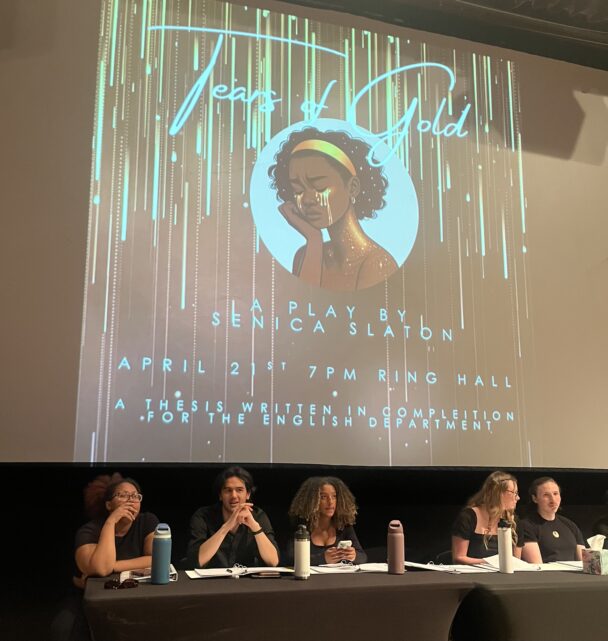
A staged reading of Senica Slaton’s ’26 “Tears of Gold” debuted at Ring Family Performing Arts Hall on Tuesday, April 21. Slaton wrote the play as an honors thesis in the English Department and was advised by Chair and Associate Professor of English Rashida Shaw McMahon.
The event opened with Slaton’s carefully written stage directions, read aloud by Rania Ahmed ’26. The directions reveal that Slaton has created two, simultaneous settings for the play: the American South and the interior of the main character Dorthy’s (played by M.J. Peters ’29) mind. Dorthy’s mind is a paradox in itself—the directions tell us that she considers herself both trapped in her own mind, but enabled to change the sequence of events taking place there through enchantments. Alongside Dorthy, a series of fantastical characters are introduced: queens, princesses, and princes who are all entangled in complex interpersonal relationships.
The staged reading’s lack of set by no means undermined the play’s embodied sense of place.
“I am from the South, and it really mattered to me that the fairytale itself was set in the South,” Slaton wrote in an email to The Argus. “I really wanted that personal connection to the location, and in so many ways, I feel like there is a sense of idealism in how Southerners, particularly white Southerners, live that mirrors our notions of fairytale land being perfect. I wanted that comparison.”
The contrast works strikingly well, as Dorthy continuously grapples with the inconsistencies of fantasy and reality.
In evoking the South, Slaton says she wrote three different versions of the play, including authentic Southern dialects “ranging between a Black Southern dialect, a relaxed Southern dialect, and a proper Southern dialect.”
Ultimately, Slaton submitted her thesis written in proper Southern dialect to represent the complex place of code-switching in each of the characters’ relationships.
“The submitted version, which I went with, has code-switching only between Josephine and her mother, Mattie,” Slaton wrote. “It felt really powerful and important, for when the two of them talk alone, they speak in a way that no one else would either understand or would judge them for. Really freeing them of the restraints that the space puts them in, for those brief moments.”
I was especially struck by the use of color in the play. Josephine, Dorthy’s imagined self, is described as wearing a white dress, while Dorthy herself wears black and watches from afar. When asked about the choice to specify the colors of these dresses, and to put these interconnected characters in opposite colors, Slaton connected it to Dorthy and Josephine’s relationship to spectatorship. Josephine is a character who “sticks out in a way that she would have no control over,” and also one with a perceived “innocence and purity that the other characters take advantage of.” On the other hand, Dorthy wears black to represent her unseen and out of place presence in this fantasy world.
“Dorthy can hide behind her invisibility to the other characters, but not to the audience, and Josephine is forced to only ever be seen by everyone,” Slaton wrote.
The most notable use of color in the script, though, is Josephine’s ability to cry tears of gold. A trait inherited from her family, these tears provide riches for those in less fortunate economic positions at the cost of Josephine’s own happiness. This skill puts her in a precarious relationship with those around her, keeping her and the audience wondering if the other characters are hoping to benefit from her pain.
“Gold, especially in a colonial sense, has always had strong ties to the way Europeans colonized the Americas and even how they have gone about treating countries in Africa,” Slaton wrote. “It is less about the color being gold and more about the economic meaning of gold. How expensive and rare it is, how much in history we have seen colonizers kill and commit genocides for it.”
Through Dorthy, Slaton asks the audience what it means when the most significant aspect of your being to other people is an aspect of your being that causes you pain? What does it mean when pain enters your fantasies?
Slaton listed multiple influences for this work, including Ntozake Shange’s “for colored girls who have considered suicide/when the rainbow is enuf” and Mitski’s “Washing Machine Heart.” I will leave the reader with what I consider to be an apt quote from the latter: “Baby, will you kiss me already? / And toss your dirty shoes in my washing machine heart.”
Julia Chadwick can be reached at jmchadwick@wesleyan.edu.




Leave a Reply