
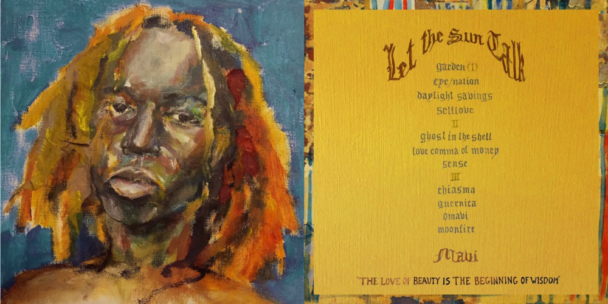
Album Review: Why Let the Sun Talk by MAVI Is My Pandemic Album
Everyone, I can imagine, has at least one “pandemic album,” an album that got them through the isolation and uncertainty of COVID. I had several pandemic albums, actually; two are Either/Or by Elliott Smith and Velocity : Design : Comfort by Sweet Trip. I listened to a lot of music during the pandemic. It was then that I got back into old hobbies, too, like gardening and piano. Anything to kill the time. Whenever I put on those albums, I feel nostalgia in both its forms: as a restorative force and a source of melancholy. These works represent, to me, the endurance of the human spirit in the face of overwhelming despair.
That period of my life, I find, is particularly defined by one album: Let the Sun Talk by MAVI, released in 2019. MAVI is a member of that cadre of late-2010s, early-2020s rappers—including redveil, Earl Sweatshirt, Maxo, MIKE, BK, billy woods, Cities Aviv, and Ivy Sole—who philosophize over low-key, drowsy beats. They wear their hearts on their sleeves and confront the condition of Blackness with shades of both helplessness and hope. With the exception of Earl Sweatshirt, this music, which some have termed abstract hip-hop or experimental rap, still remains on the fringes of the mainstream. But it is crucial to understanding our times. Pessimistic, mellow, and gritty, it bears out the deep frustrations of a young generation of Black people who continue to be handed false promises.
Released less than a year before George Floyd’s murder, MAVI’s album presaged a revival of Black Lives Matter. I read Let the Sun Talk as a layered, heart-rending vision for the future, a way out of the cultural and racial pit from which America seemingly cannot extricate itself. I also hear in MAVI’s lyrics crucial observations on the nature of individuality and society.
The first thing we hear in the album is MAVI’s manifesto on “Terms & Conditions,” which comes through as a young woman’s voice on a crackly stereo.
“To be pro-Black / Means to relentlessly pursue / Money, land, guns, and useful knowledge / For the purpose of creating and maintaining / Healthy and productive Black communities / It means the cultivation of a culture that reinforces a unified vision of Black well-being / And continuous advancement.”
MAVI begins the album with a mission. He enfolds the following music into that very “cultivation of a culture” of “a unified vision of Black well-being.” This art-as-politics framing shines new meaning on several of the songs that might not seem politically motivated on first consideration. On the gloomy dirge “Omavi” (which takes its title from MAVI’s real name), he raps, “Numbers on my mental healthcare / Blunders on my skin, it’s scraped and bitten singed by hellflare.” The phrase “mental healthcare” cleverly underscores the relationship between individual struggles and societal problems. However you slice it, the term “mental health” figures societal problems through the individual—one’s “mental health” problems can be understood as one’s incompatibility with expectations of how to function in the world.
By drawing a comparison between his own “scraped and bitten” skin and the broken healthcare system, MAVI shows his shrewd understanding of the relationship between individuals and institutions. His melancholy, which is connected to race, is not an object for him to covet. Despite how gloomy the song is—MAVI makes an allusion to suicide—he invites the listener in and creates solidarity through shared struggle.
Listening during COVID, this lyric immediately clicked with me. I resonated with the feeling of being all on my own, utterly disconnected from society, even though the whole world was still violently turning around me. I remember being so militant and desperate to be part of a larger movement. I remember my overwhelming frustration at American leaders, Republicans and Democrats alike, for their reluctance to address the demands of the Black Lives Matter movement. I remember how the milquetoast politicians would put together some feeble legislation about banning chokeholds and requiring bodycam footage while continuing to funnel money into the carceral police state and giving officers impunity to shoot protestors at point blank with rubber bullets.
I grew disillusioned with the Democratic Party—even more than I was already. And I thought I was completely alone in my dissent, completely alone in my anger at Joe Biden and his party, completely alone in my vigilant support for Bernie Sanders’ lost cause campaign. For many years, people were stubborn or in denial. Now, as the cost of living continues to rise and hundreds of millions of souls fight to hang on, will we wake up at last?
MAVI furthers this dialectic between the individual and society in the four-minute suite “Eye/I and I/Nation,” which stitches together three movements. In “Eye,” he examines the eye as a multivalent symbol. He talks about his poor vision, which results from a lack of sleep due to a tireless struggle. Some examples are “I roll two rosy eyes,” “Eyesore that old ass tag,” and “Eyes swollen closing.” Additionally, eyes are the source of suspicion and doubt: “I know I’ma catch a side-eye dashin’ out the door.” Yet his eyes also allow him to glimpse a brighter future: “Newer glint in my eye, another sunrise.” In “I and I,” MAVI uses “I” phrases significantly, taking advantage of the homophonic relationship between “eye” and “I” and relating the human eye to subjectivity: What information the “eye” gathers becomes the property of the first-person “I.”
Finally, in “Nation,” MAVI continues with the “I” statements, but his words conjure imagery of transit and the world at large. He mentions “women” (as a metonym for feminism), the “boss,” a “station,” a “plane,” the “law,” and “Baltimore.” Though he is still telling a uniquely personal story, and not without a dash of braggadocio, he subtly refers to that nation full of bustling individuals and their stories. Underneath his personal account is a fascinated investment in an intricate, interconnected world.
Conrad Lewis can be reached at cglewis@wesleyan.edu.



Leave a Reply