
Government Faculty Panel Demystifies the U.S.-Israel War with Iran
Government Department Chair Douglas Foyle invoked a dictum by famed Prussian military strategist Carl von Clausewitz to kick off a faculty panel hosted by his department on the political goals and repercussions of the U.S.-Israel war with Iran.
“War is a continuation of politics by other means,” Foyle said, quoting von Clausewitz. 250 years later, the sentiment remains strikingly pertinent.
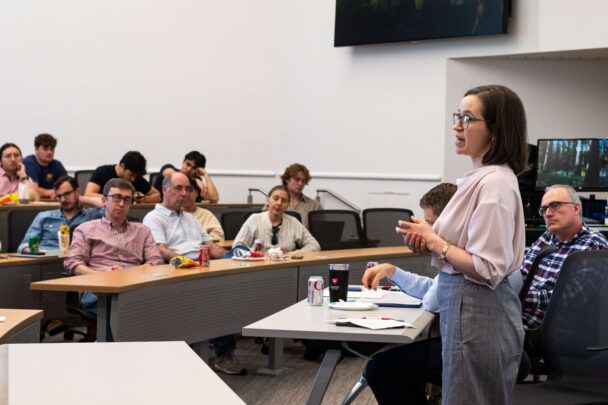
‘Understanding the Iran War: Politics, Economics, and Global Impact’ drew approximately 90 students and faculty members on Thursday, April 23 and featured International Relations faculty speakers including Foyle, Assistant Professor of Government Lindsay Dolan, and Assistant Professor of Government Kolby Hanson.
Foyle began by outlining what he sees as the four primary goals of the U.S. in this conflict: regime change, fostering an uprising, destroying Iranian missiles, and stopping the state from funding proxy wars through extremist groups. But, he argued, those goals are untenable without major changes to strategy or outlook.
This may be reflected in the data. 78% of Americans say the United States’ goals have not been met and 68% disapprove of Trump’s handling of the war in Iran, according to a new survey by Marquette University Law School. A mere 32% support military involvement as it stands.
Speakers noted how under Trump, conventional national security precedent has been shredded. In its wake, the President has carved out new roles for those who are loyal to him. National Security Council staffers were fired, and the workplace was condensed, which has made the circumstances of this war unique, speakers added. The National Security Advisor, usually a separate role, is currently filled by Secretary of State Marco Rubio.
According to Foyle, Trump’s handling of the war should be reason for concern, adding that it could backfire on American interests in the long-term. Foyle noted that prior to the war, the United States had an obvious advantage over the Iranian military. Now, however, Iran has gained leverage via the Strait of Hormuz, which is a key pressure point for the United States in the lead-up to the fall midterm elections, where affordability is a main concern.
Hanson discussed the challenge of coercion in bargaining positions, presenting three primary lessons: Regime change is unpredictable, coercion is both about past actions and future actions, and coercion is just as concerned with reassurances as it is with threats.
“People always think of who wins a war by who destroyed the most battleships and who killed the most troops on the ground,” Hanson said. “At the end of the day, the terms that you get out of a peace are about who needs the peace most.”
Dolan stressed that the future of the conflict likely depending on a negotiated peace, and the political and economic factors which may bring the United States and Iran to the table would be in play here.
Dolan further spoke on the financial consequences of the war, such as high inflation and possible recessionary conditions. 20% of the world’s oil and 30% of all fertilizer flows through the Strait of Hormuz, according to the Center for Strategic and International Studies, a nonprofit think tank. The strain on the American economy is magnified for developing nations more dependent on those resources. The financial pressure is also expected to heighten debt prices, a source of stress for countries that hold debt in U.S. dollars, Dolan noted.
“All of this is fallout from global inflationary pressures, global risk of recession, and then, in addition, the restriction of burden—as you can imagine, people in many countries are not happy with this,” Dolan said.
Economic uncertainty has been heightened, she suggested, and may even be permanent. Should the U.S. be perceived as a disloyal live wire, it would risk losing international allies and causing markets to flee the country.
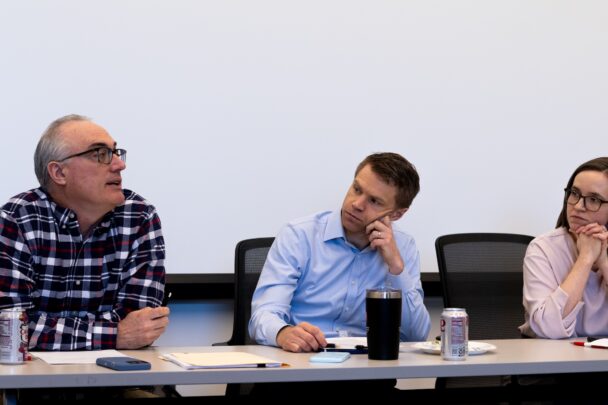
The second half of the talk was dedicated to audience questions. Students asked panelists how Israel’s lobbying and pressure on the United States might affect American involvement in the Middle East and how U.S. relationships with allies and international trade might change in the future due to this influence. They also raised questions about Israel’s ongoing conflict in southern Lebanon.
Kenan Cakir ’29, who asked whether Iran might serve as another case study for foreign energy crises, came away unsurprised by the lack of attention to the international sphere the panelists highlighted.
“The sheer scope of the U.S. is so massive…there’s so much domestic news,” he said.
Others noted that despite the war’s vast global political and economic implications, attention to it has waned.
“I feel like people are getting to a point of just pure desensitization when it comes to the U.S.’s role in doing things,” government major Ajooni Kaur ’28 said.
The long-term impacts are daunting. But the short-term ones may be less potent than they appear.
“Generally speaking, public attitudes about foreign policy are largely team oriented: Team Red, Team Blue,” Foyle said. “The public, for various reasons, aligns their policy attitudes with the party they associate themselves with. They look to the information and opinions from opinion leaders in that party to decide what to make sense of that thing. Unless there are major American deaths, foreign policy does not have an electoral influence.”
If the war is resolved soon, he said, all may just be forgotten.
Aarushi Bahadur can be reached at abahadur@wesleyan.edu.
Correction: An earlier headline for this story stated that the panel was the first event on campus to address the war with Iran. It was likely the second, the first being a talk by Distinguished Visiting Fellow Tim Sahay of the Bailey College of Environment on Apr. 13, in discussion with Professor of Government Basak Kus.





Leave a Reply