
Player of the Week Fisher Hirsch ’26 Talks Family Crash-Outs, 7 a.m. Yoga, and a Program Turnaround
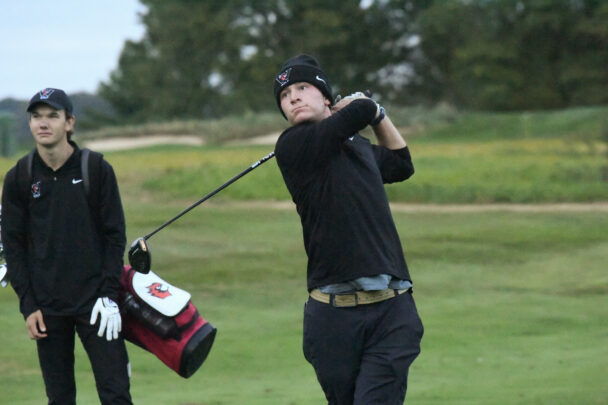
Fisher Hirsch ’26 is a film major and captain of the men’s golf team. Hirsch has been the leading scorer for both of the program’s tournament wins since 2008. In his freshman fall, he posted three straight top-20 finishes, highlighted by a second place at the Mitchell Invitational, which the Cards won. This past weekend at the RIC Spring Invitational, he captained the Cards to their two best 18-hole scoring days, with all five guys shooting in the 70s each day en route to a three-shot victory. Hirsch shot back-to-back 73s to finish second individually. The Argus sat down with Hirsch to discuss his golf upbringing, the mental side of the sport, and a historic weekend.
The Argus: Do you have a first memory of the game?
Fisher Hirsch: My dad would go out for these morning golf rounds. He’d get up at 4:45 in the morning before the rest of the family because he didn’t want to get in the dog house. At the course, they call him Robb the Rabbit because he gets the first tee time and literally runs, so he plays 18 holes in two hours. He’d stick a few clubs in his bag for me, and I’d run along and try to keep up.
A: Who was your favorite golfer growing up?
FH: Luke Donald. When I say that now, people are either like “who the hell is that?” or, “why the hell?” Growing up, I would track his shot-by-shot. And if I missed the shot-by-shot, to catch up, I’d quickly open the app and scroll all the way down, because it shows the leaders first, and slowly scroll up, hopefully not seeing Luke until the top of the leaderboard. But that didn’t happen often; I started following him through the decline of his entire golf career, so it was a lot of missed cuts.
A: I know you’re close with your dad and brother. What was it like competing with them? Was it more competitive or more fun?
FH: My little brother, Holden, is seven years younger, but he picked up golf and got dialed really quickly. He was better than every other person on my golf team in high school, so aside from tournaments, the most competitive matches I’d have were with him and my dad. Holden would crash out often. One time, I was leading the Club Championship, and Holden was one shot behind me. We were in the final group, and I decided that I wouldn’t talk to him. And he was really taken aback by this, and it started to really get in his head. And on 17, he hit a ball OB, and the first thing I said all day was, “you might want to hit a provisional.” He started tweaking out. He was so pissed at me, he refused to hit a second ball, and then four minutes later, he had to walk back and re-tee, and that’s why I ended up winning.
A: What was the recruitment process like, and how did you end up playing college golf at Wesleyan?
FH: I talked to coaches at other schools, but no one gave me the time of day, which I expected because I didn’t play in other, non-high school golf tournaments, which you have to do to get put on the map. I found Wesleyan because I was interested in doing film. I’d basically given up on college golf until I was touring Wesleyan and randomly reached out to Head Coach Jeff Gilarde, and he took a chance on me.
A: What was Wesleyan golf like when you came in as a first-year in 2022?
FH: I was the first recruit in two years. Luckily, there were two senior captains, Jacob Fain ’23 and Daniel Kraft ’23, whom I really looked up to. But freshman year was pretty sad because four weeks into the season, Gilarde left for a medical emergency and passed away later that year. We didn’t have a coach for a while, so Jacob and Daniel took over and coached us. But it was optional to go to practice, so sometimes I wouldn’t see some golfers for weeks. There were times we missed golf tournaments because the athletic department couldn’t find us a ride.
A: How has the program progressed since then?
FH: Head Coach Jon Wilson stepped in and took over both the men’s and the women’s team, and things started to turn around. But even in sophomore year, Wilson was basically the only coach for both teams. Junior year, Zach Liu ’26 and I became captains, and we decided we wanted to make it a fully committed team. Now, we start and end practice every day together, and we exercise in the morning a few times a week. So it’s been a real change in the amount of time we dedicate, and it’s now something that people can buy into.
A: You mention the early morning exercises. You’ve brought some unconventional fitness practices to the team. What do they look like?
FH: It took people a bit to warm up to this, but we do 7:00 a.m. yoga. No one else on the team liked yoga initially. I love doing it because I find the mind-body connection beautiful. Sometimes we go off videos, and sometimes I try to lead it, but I forget a lot of the poses, so we’ll end up just bouncing around for an hour. But it’s a great thing when you’re out on the course to fall back on your breath. People enjoy doing it now, and if they miss a session, like Alex Lee ’26 last week, he sent over a time-lapse of him doing an hour yoga session, which is hilarious. We’ve also called in my roommate to teach Pilates, and I’ve led Tai Chi a couple of times.
A: College golf is still an individual sport at its core. How do you build a team out of that?
FH: Golf can be so isolating at times. We’ve realized how special it is to have other people around who understand. For people who don’t play, there’s no way for me to describe all the ups and downs. You play a round just to get a number out of it, but no one sees any other part of how that happens. No one sees the process. No one sees that you had to grind, or that you got super unlucky, or that the conditions were bad, but your team does. We are all so grateful to have each other out there, because we all get how freaking brutal the game of golf can be sometimes, and how rewarding it can be at other times.
A: The margins are so slim in golf. What are some of the weirdest things you’ve tried to gain an edge?
FH: If I play well, I’ll often pick up a superstition with it. A weird one is that I bring my bag with me wherever I go. In the tournament two weeks ago, we had to walk 150 yards up like a cliff face, and everybody left their bag except me, and the other guys were like, “What the hell are you doing?” Another one is golf balls, I’ll have in my bag. Throughout the years, I’ve picked up loads of balls from different moments in my golf game, but I’m not allowed to play them. So now my bag is full and pounds heavier with balls that just sit there.
A: At tournaments, everyone’s got similar outfits, and your fit is a little different from other people. Can you give your fit philosophy?
FH: I’ve never understood why you have to dress up nicely and abide by all of these golf norms that don’t affect other people. So I try to look as non-preppy as I can. So I’ll wear this big, funny-looking bucket hat, and not worry about my belt and shirt. I’ve gotten yelled at for not tucking in my golf shirt a few times.
A: You’re known on the team for having some interesting equipment over the years. Can you share why this is?
FH: It takes a lot to get me to switch my golf equipment. I’ve always been a good putter, and I used my grandma’s putter that she gave me in seventh grade after having it herself for 13 years, and it was a really rinkity dinkity putter, but I had it in my bag through freshman year and was putting pretty well, but people were like, “come on Fisher, you need to get a new putter, that’s ridiculous.” So I finally got it tested, and it happened to be 13 degrees closed, which is unheard of.
A: You’ve played with a lot of different guys over the years. Is there anyone super memorable?
FH: Some guys will have insane crash-outs, and it’s pretty crazy because you have to sit there and watch guys lose it. Sometimes you’ll play with people who genuinely give up. There’s one time I was playing with a guy who wasn’t having a great round, and he asked us if there was any chance he could hit his weed pen. None of us knew what to say. And this was on the seventh hole. So he blinkered his weed pen and then proceeded to have 11 more holes of golf that he had to play, and of course, he played so terribly.
A: This past weekend was program-defining. You finished in second place, and the team won its biggest tournament in two decades. There was no live scoring all weekend, and half the team didn’t even finish Friday. How much did you actually know about where you stood?
FH: Nothing, really. The way we communicated was we’d see our coach and ask him how others were doing, but we were so superstitious that everyone would tell him qualitatively how it was going, but we wouldn’t say a score. The two guys who didn’t finish Friday because of a delay wouldn’t tell us how they were doing, so going into Saturday, we had no idea. When they finally finished Saturday morning, we had a chance to check the leaderboard before round two, but our coach made a good point that it doesn’t change anything; it only adds pressure. At the end of the day, golf is just a game against yourself.
A: What was the math when you finally looked?
FH: When we all finished, we finally compared and saw we all shot in the 70s both days, and after some tallying, we saw that if the kid on Suffolk who shot 66 on Friday shot a 73 or worse, we’d win. He was in the last group, so we watched him come in and play the last two holes, but we didn’t know what he was at; he could have been -5 or +5.
A: What happened when you saw the result? What was the celebration like?
FH: It was crazy because we couldn’t really celebrate because it’s golf. So we shook hands and took some photos and then got back to the van, and then we totally let loose. We got so fired up, and we always listen to “Swag Surfing” by Lil Wayne on the way to the course right before, so when we got the car, we immediately put on “Swag Surfing” and just had a really fun van ride home.
A: There’s a version of this weekend where you tighten up, and it all falls apart. How did you stop that from happening?
FH: On day two, I was feeling weird and groggy, so I was listening to hardcore rap on the range, trying to get fired up. That didn’t fully work, so I went in and chugged two coffees, and that somehow worked. On the course, I credit it to Jackson Hayes ’27 telling me to play match play against a bogey golfer, but starting the day 12 down. The birdies came when they came, but it was really just about trying to make pars. Golf is all about being able to reset, and I had a reset on every single hole and slowly chipped away.
A: What was it like celebrating that night?
FH: It was surreal. Not only getting this win but having it be on a Saturday night, because we’re always coming home and it’s Sunday night, and we have class the next day, but this was a Friday/Saturday tournament. So we came home, and since we’re not used to getting to celebrate on Saturday, we had a few absences at practice on Sunday.
A: What does this team mean to you after four years?
FH: I like to say we’re the most fun team in the NESCAC. We all have different interests, and for a lot of us, golf isn’t our first priority, but being on this team really brings people together who maybe wouldn’t be friends otherwise. I’ve fallen out of love with the game a little throughout college, but the reason I’ve stayed so committed is that I’m doing it for the team. This past weekend, finishing second individually meant way, way less than winning as a team. And I don’t think I would have been like that in high school. Sharing the successes is way more fulfilling, and this program has taught me that.
This interview has been edited for length and clarity.
Sam Weitzman-Kurker can be reached at sweitzmankur@wesleyan.edu.
Leave a Reply