
From the Argives: History, Rumor, and Myth of Wesleyan’s Underground Tunnels
The infamous network of tunnels under the University has remained a constant source of interest and cause of conflict since its installation in the 1920s. The University’s underground labyrinth has at times served a practical purpose but has also, more notably, generated its own esoteric lore, exposing the dark underside of the University and capturing the imaginations of mystery lovers across campus.
In the summer of 1920, the first tunnels were created under Olin Library and Clark Hall as a way to make steam pipe repairs more accessible. These early tunnels were famously used by Archibald “Arch” Colville Doty Jr. ’42, founder of WESU, who employed the tunnels to string wires throughout campus so that signals from his homemade radio transmitter could reach the larger student body. Although they were initially built for practical purposes, the tunnels quickly became part of student life.
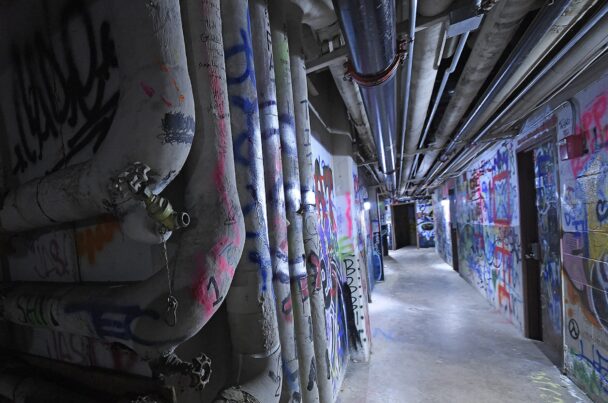
In 1957, the tunnels beneath Foss Hill were opened for student use, followed by the Butterfields tunnels in 1965. In October 1988, Brian Edwards-Tiekert ’00 wrote a description of the legendary tunnel system published by The Wesleyan Hermes, a magazine dedicated to political, critical, and creative thought at the University. In his article, Edwards-Tiekert ’00 wrote that these accessible tunnels were intended for recreational and practical student use, including ceramic studios, photography dark rooms, laundry units, and kitchen spaces. However, over time, the tunnels had become increasingly unstructured student territory. Edwards-Tiekert wrote that “every square foot of wall space” was marked with “slogans, tags, and bad poetry.”
In an Argus article published April 4, 1980, Jennifer Boylan ’80 reported on the possibility of the tunnels closing. Boylan explained that increased security measures in the upper levels of both West College (WestCo) and Butterfields dorms made the University anxious “that assailants and vandals may descend to the tunnels,” where security was relatively lax. Additionally, Boylan wrote that the administration saw “the possibility that the tunnels may be used by criminals as avenues of escape in the wake of increased security on the rest of campus.”
The University considered the tunnels a threat to campus safety, full of unknowns and ominous possibilities. They ultimately closed all tunnels in the 1990s except for the Butterfield B laundry room, which stayed open for student use until 2017.
Now forbidden, the tunnels took on an air of mystery and secrecy. Graffiti became the most distinct feature of these abandoned tunnels. Layers of spray paint depicted political speech, crude drawings, and funny slogans, turning the tunnels into a record of student culture on campus. Despite the University’s efforts to paint over decades’ worth of graffiti below the Butterfields in 2006, students have since retagged the walls from floor to ceiling, determined to claim the tunnels as their own. In an interview with The Argus published Oct. 20, 2006, Xue Sun ’08 explained that the graffiti was “a mecca of expression,” a “counterculture.” Boylan went as far as to claim that the tunnels were “psychically crucial to the students’ well-being.”
The history of the tunnels’ student use and administrative handling is relatively tame. However, this straightforward story has been supplemented by a patchwork of legends and myths.
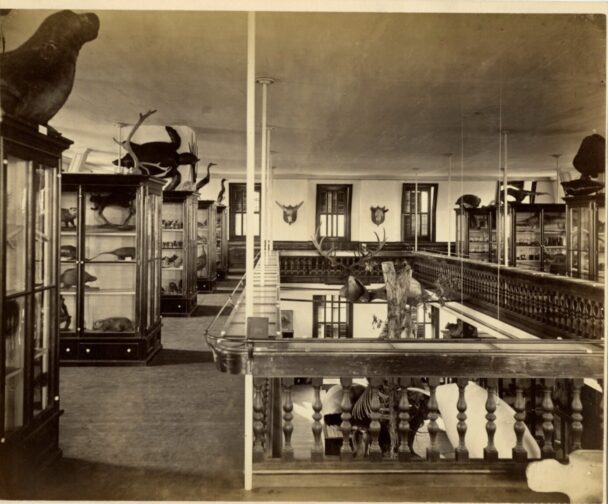
From 1871 to 1957, Judd Hall served as the Wesleyan Museum, which contained fossils, stuffed birds, fish, mammals, a two-story-tall cast of a giant ground sloth, and even a mummy. After the museum closed, some of its collection was given away, and the remainder was stored deep in the tunnels. Soon enough, students began finding these artifacts. As Matt Diblasi ’07 wrote in an Argus article published Nov. 16, 2007, “tunnels-aficionados found them—stuffed mammals, including a giant buffalo, began materializing around campus.”
For over a decade, historic taxidermy specimens have popped up around campus grounds. The University ultimately organized an expedition to retrieve these lost artifacts in 2017, which unearthed a hyperrealistic Glyptodon shell replica, now known as Shelley, and displayed prominently in Exley Science Center.
Those well-acquainted with the University’s lore may have heard of the tunnels beneath Russell House. This Greek Revival-style mansion was built between 1820 and 1830 for Samuel Wadsworth Russell, a prominent Middletown businessman and owner of the successful trading company, Russell and Company. He made his fortune importing fine silks, tea, and opium from China. Edward-Tiekert writes that Russell’s opium trade was where “a considerable chunk of [the University’s] endowment comes from.”
Edward-Tiekert wrote that “in the basement of Russell House, there is a large metal door built into an exterior wall facing east that has no fewer than four locks on it.” He also speculates that this door leads to a tunnel that runs all the way down to the Connecticut River.
Some say that the Russell tunnels were used to transport opium. This story has been largely discredited, as Russell only moved from China into his Connecticut house when he retired from Russell and Company in 1836.
The second legend of the Russell tunnels remains a viable mystery. Middletown was a crucial hub for the underground railroad in the early 19th century, and some at the University played an active role in the abolitionist movement in Connecticut. Supposedly, the Russell family used the tunnels to shuttle enslaved people down to boats on the Connecticut River. Finding this tunnel is a goal for avid tunnel-explorers; however, no one has been successful and made a report.
Whispers of myths surrounding the tunnel network have accumulated over the years, building up its reputation as haunting, hidden, and exclusive.
Students brave enough to explore deep into the tunnels have reported encounters with the supernatural. Claims have been made of “tunnel-monsters,” who can sometimes be heard wailing behind locked doors, and of other paranormal predators called the “Freakies,” who eat people’s laundry in the old Butterfield B laundry room.
American mystery author Richard Forrest P’86, who set his stories in Connecticut, discovered the University’s catacombs in 1987. In an archival article from Wesleyan’s Digital Collections, “Getting Away With Murder,” Forrest deemed the tunnels “the perfect place to commit a murder…or to flee one.” His description underlines the security concerns that first brought the tunnels to a close.
It has been rumored that, to avoid pricey housing fees or to escape their roommate conflicts, students once moved into the Butterfields tunnels, bringing their beds and desks underground. In some cases, the tunnels have even been utilized as an informal study spot.
“I used to teach in Butterfield, and some students told me that they would go into the tunnels in the basement there to avoid internet connectivity so they could concentrate more on their work,” Professor of Religion Peter Gottschalk told The Argus in an interview.
Although access to the tunnels is considerably more limited today, rumors still circulate as students find new ways to pick the locks that guard the underground maze.
In an interview, Butterfields resident Lily McNamara ’29 told The Argus that she knows people who are “expert” lock-pickers and frequently traverse the tunnels. Additionally, Jane Altschule ’29 has heard rumors of a key to the WestCo tunnels that is “passed down through generations.”
When asked about the current condition of the tunnels, McNamara recalled stories of one tunnel “where everything is red because people graffitied on the lights.” She added that pictures she has seen “show that there have been a lot of people in and out over the years.”
Tessa Chaet ’29, another Butterfields resident, said that she has friends who attempt to traverse the tunnels. Chaet described the tunnels as “scary, …like murderous,” and added that “a really good game of hide and seek could happen [down there].”
Beyond exploration, some students reportedly use the tunnels to host exclusive functions. Altschule has heard stories of an event called Fight Night being hosted in the WestCo tunnels. According to Altschule, “queer-femme” students “wrestle each other in the tunnels occasionally” in a large inflatable pool.
Although it is unlikely the tunnels will be reopened, the question remains: Should students have access to them? Chaet remarked that “there is something about the graffiti that is really kind of beautiful” because it is “shared across generations.” She wished that students could access the tunnels to honor this communal art form.
In contrast, McNamara thinks that opening the tunnels would be a “safety hazard” because it would invite a level of drinking and partying that could get “out of hand.”
Nevertheless, Wesleyan’s mystical underworld remains a time capsule and a testament to campus culture, a space shaped by generations and still attracting adventurous students through its forbidden allure, a piece of the past lying just below the surface.
Beth Huggins can be reached at bhuggins@wesleyan.edu.
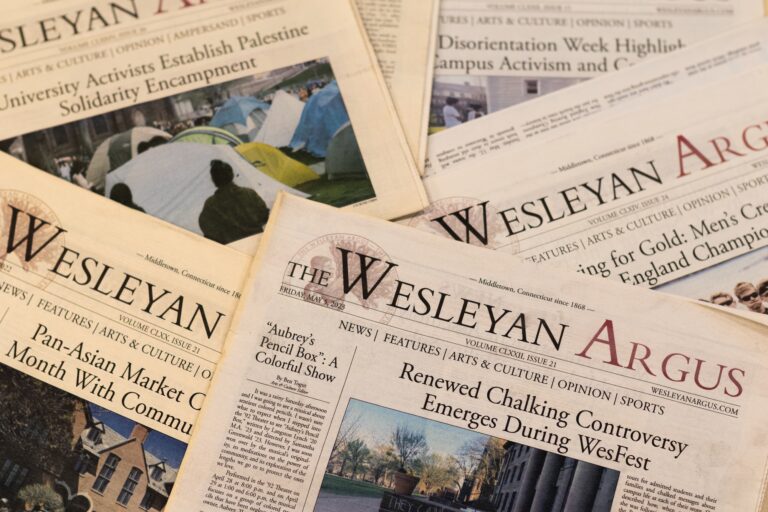
“From the Argives” is a column that explores The Argus’ archives (Argives) and any interesting, topical, poignant, or comical stories that have been published in the past. Given The Argus’ long history on campus and the ever-shifting viewpoints of its student body, the material, subject matter, and perspectives expressed in the archived article may be insensitive or outdated, and do not reflect the views of any current member of The Argus. If you have any questions about the original article or its publication, please contact Archivists Hope Cognata at hcognata@wesleyan.edu and Lara Anlar at lanlar@wesleyan.edu.
I recall that Dick Ort (Class of ’62 or ’63) ran for campus office on a slogan of “More Tunnels to Fewer (or maybe, More) Places. He lost.