
Week Three of Art Theses Exudes Individuality
Around 4 o’clock this past Wednesday, a certain corner of the University was bustling. The reason? Round three of the presentation of senior art theses. An open house was held at the Ezra and Cecile Zilkha Gallery, displaying the theses of six seniors, Anthony Crossman ’26, Greta Schloss ’26, Asher Weintraub ’26, Coline McEachern ’26, Katia Michals ’26, and Stella Oman ’26.
These theses were particularly audacious, with five showings that evoked deep emotions and profound thoughts from viewers to an unexpected extent. I was able to speak to the six seniors regarding their relationship to their work and how their experiences shaped it.
The exhibits were made in various media: photography, collage, architecture, projections, ‘glitter-welding,’ and drawings. True to the nature of the art and the University’s culture, it was weird. Weird as in heaps of symbolism and metaphysical thought lurking below a perplexing surface. Weird as in authentic, capturing the ineffable nature and naked thoughts of each artist. Weird, as in first impressions barely beginning to reveal the depths of meaning imbued in the pieces. Each exhibit told a unique story and served as a living representation of the feelings and emotions of the creator.
Crossman
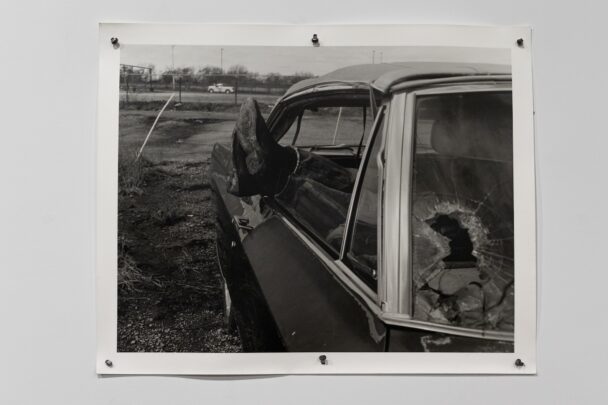
Upon entering the gallery, one’s attention is drawn to the room immediately on the right, where Crossman’s “COWBOYHOOD” was displayed. Crossman’s exhibit features over a dozen black-and-white photos—equally spaced—depicting the lives and actions of black cowboys. There are no words or labels; Crossman expressed that “the best photographs and photographs need little to no other context or information to be successful,” while also acknowledging the difficulties that accompany this approach.
Each photograph is fixed to the wall with six—admittedly serious-looking—nails, setting the tone of direct and powerful depiction. The photographs capture the cowboys going about their day-to-day lives, capturing their relationship to peers and their horses and land and immersing the viewer into their world. Crossman’s photos are highly attentive to detail; one can see the glint of water in the dark on a horse’s body or the rays of sunlight shining through windows. Crossman also employs misdirection, evidenced by his photo of a woman and a horse side by side, where the horse’s head appears to be occupying the woman’s neck. Undoubtedly, Crossman is quite talented with the camera in his hands, but according to him, “it’s often difficult to know when I’ve struck gold.” Crossman goes on to speak about the importance of genuineness and open-endedness in his work: “I photograph and document the lives of real people and take creative liberties within that.”
Despite touching on so many themes regarding identity within oneself and in a community, “COWBOYHOOD” cannot be “boiled down” to any one thing. Appropriately, Crossman said, “I reject the intellectual elitism that can make art inaccessible or interpreted ‘incorrectly.’”
“COWBOYHOOD” grapples with themes of masculinity, identity, black-determinism, and one’s own belonging to a place or culture, all of which Crossman himself has grappled with as a young man. Undeniably, Crossman’s “COWBOYHOOD” provides strong commentary, but it’s the unfettered nature of the exhibit that ultimately impacts the viewer.
Schloss
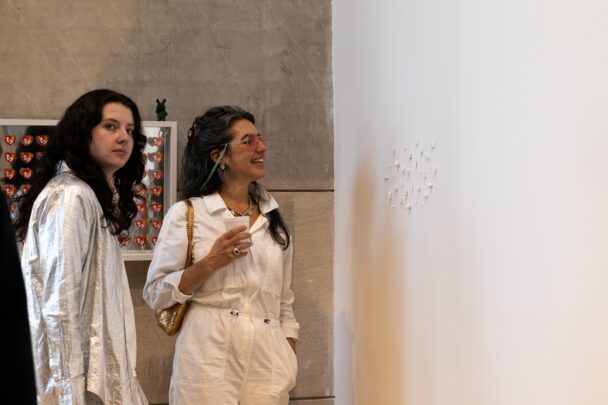
Schloss’ exhibit, “0. Universe,” is a collage of everyday objects “woven” together to create something remarkable. A lot is happening on the walls: Toy Story-style soldiers balance on the nearby fire alarm and cause trouble; hundreds of a seemingly random assortment of objects occupy the walls, some of which appear in a grid layout, others in a sizable “glitter-welded” plaque in the center of the exhibit. When asked about the choice of “ingredients” in her pieces, Schloss recounted that during childhood, she had a love for overlooked objects.
“When I was very little, around three years old, I was obsessed with spatulas,” Schloss said. “Sometimes I would choose to play with a spatula instead of my toys.” Her project was about highlighting and breathing life into the dormant flame of childhood novelty and wonder.
“One of the most important and incredible things about art is that every person who looks at something will have a completely different interpretation and take-away,” Schloss said on others’ interpretations of her art.
The underlying sensation that Schloss definitively wanted to spark was the recollection of relationships and experiences with each commonplace object. Indeed, when I stepped close to the plaque, I immediately picked out several familiar outlines: a lighter, a #9 birthday candle, Weswell-esque fidget toys, a stray nip bottle or two. As my eyes combed through the multilayered conglomeration, I began to drift into adjacent side worlds and the realm of my memories.
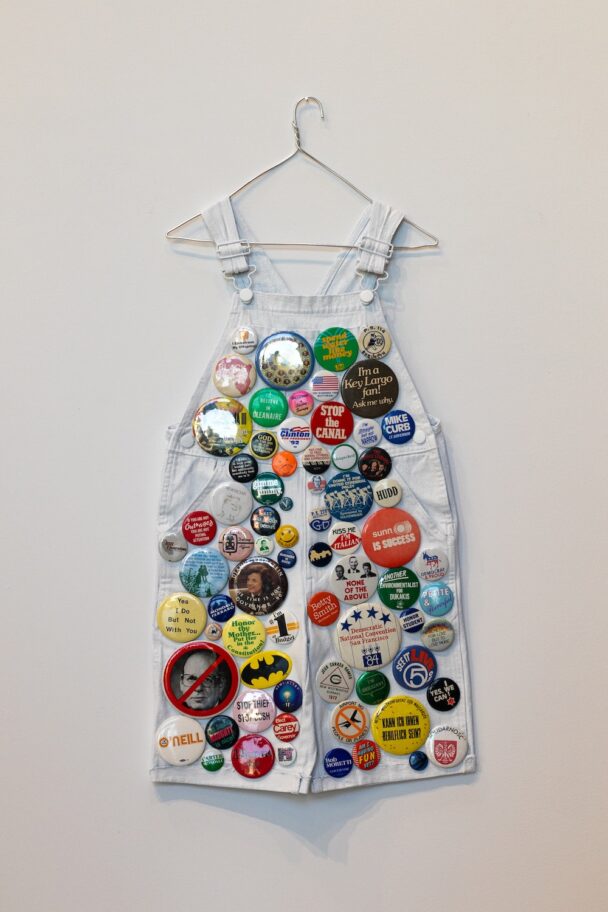
Experienced via this approach, the title of the exhibit makes sense. It evokes infinity and mundane exceptionalism, allowing one the utter freedom to return to worlds, some of which haven’t existed for years—or since last Saturday night—and above all else, to feel childlike wonder. Along with Mr. Hippo, standing sentinel in the corner, the tiny collared button-up and small white pair of overalls adorned with dozens of pithy, peppy pins hanging from the walls open the door to innocence and impressionability. They remind viewers of a time when small things were normal-sized, and everything else was bigger, including dreams.
Weintraub
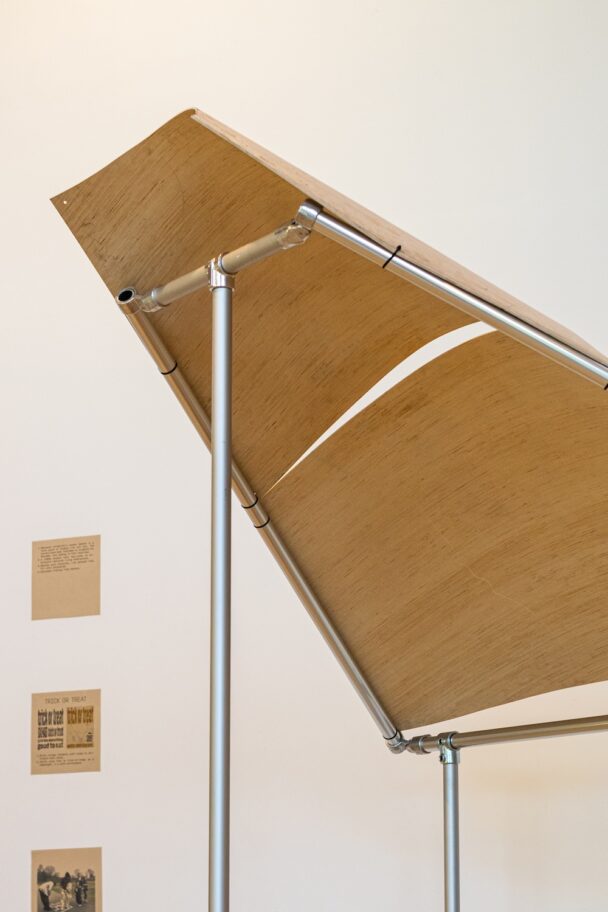
Weintraub’s “Interstice [Happenspace]” is a project that comments on the University itself and the notion of a sovereign identity. The exhibit is composed of scattered ramblings, facts, and diagrams that paint a picture of the University in the past and illustrate its shifting ideology. Weintraub notes how the University used to be weird by referencing the classic “Keep Wes Weird” slogan. As a whole, “Interstice [Happenspace]” isn’t overt in declaring anything; it points out how so much of the flavor and true nature of the University has been curbed steadily over the years. To Weintraub, hallmarks of its weirdness—the tunnels, the free-flowing, interconnectivity of the student body, and the general appeal towards mischief—have been quashed in the name of “credentialism and productivity.”
As I viewed Weintraub’s work, I began to formulate an image in my mind where the person writing all these ideas and collecting information about the legend of the “unknowable” character in efforts to understand the University eventually became the forever roamer of the tunnels.
An interesting component of Weintraub’s work is how they incorporate their architectural background into their art. I must admit, when I think about the University’s student body’s interdiversity and community, I don’t readily associate the layout and location of buildings as a strong factor. But this is truly the case. Aside from Foss, Weintraub notes there is no focal point of the campus and that prior ones, MoCon on Foss Hill and the OG quad, have been usurped by newer, sexier buildings that aren’t interested equally in all students. Weintraub also notes the heavy increase in rules, especially when it pertains to small, innocuous things, such as how chalking hopscotch on University property is prohibited. Furthermore, all the “traditions” that are listed in this ‘scheme’ —trick or treat, saved by the bell, hopscotch—are things that drive shared experiences between students, yet these customs have been falling by the wayside.
As much as Weintraub is commenting on the commodification of the University, they are also speaking a lot about the term “hidden networks,” which are things that cannot be defined in and of themselves. They can only be felt and processed to be understood, so to speak. This is another departure that has run rampant across not only other college campuses, but the country itself: the necessity to explain and commodify every last detail, to achieve domination over a sensation. Weintraub’s work warns against this, as doing so, making everything understandable, and leaving no room for the subliminal and indefinable, is curtailing the health of a university like Wesleyan, which has become less of its weird self and more like any other elite small college.
McEachern
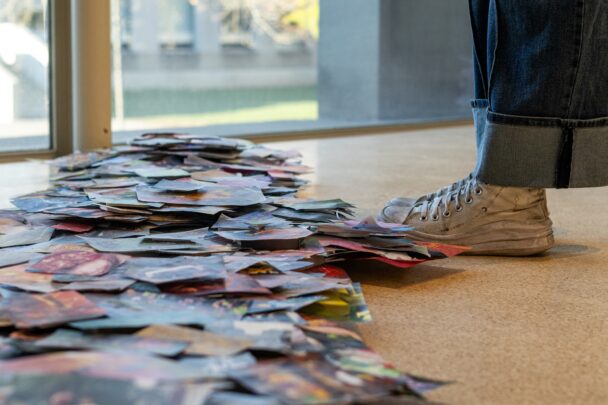
McEachern’s “Everything but the Kitchen Sink” is an exhibit that doesn’t shy away from the rougher corners of experience. One half of the exhibit is given to a massive swath of layered photographs in a roughly lemniscate shape on the floor. All sorts of notions—positivity and negativity, weirdness, dreams, failure—are evoked by the photos. It’s the kitchen sink. McEachern’s exhibit is the ultimate depiction of humanity—in the sense of what it means to be human—as it doesn’t curate or scalpel out the unsatisfactory parts: It champions them.
On the wall opposite the floor-photos array, one finds a few larger drawings. These are photos that have been altered or displayed differently: They’ve been woven together, projected, reflected in mirrors, and drawn. Another theme “Everything but the Kitchen Sink” contends with is something McEachern refers to as the “speed of reception.” As a result of the continued crippling of attention spans via ephemeral content, a general viewer is significantly more prone to judging a book by its cover and attempting to digest work quickly. This is dangerous, as one is likely to miss intricacies along the way. McEachern’s manipulation of the presentation and depiction of photographs slows down the time one can process each photograph, leading to more careful viewings and impressions.
Another crucial part of McEachern’s thesis is about exploring her relationship with photos and how her relationship with photography informs her relationship with people. To McEachern, photography speaks in “new visual languages” that transcend limitations of words. Though McEachern says she has specific points when she sets out, the feelings experienced by viewership in new, subjective ways are a source of enjoyment for her. After all, “Everything but the Kitchen Sink” bears the poignant question of “why” that cannot be simply dispelled.
Michals
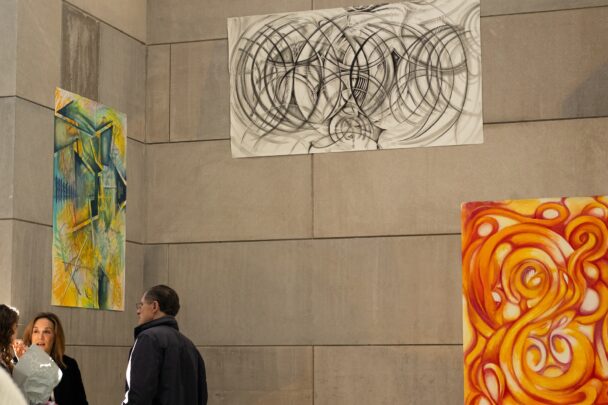
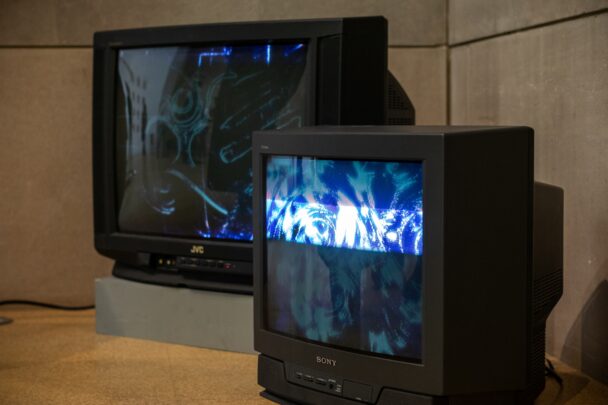
Michals’ “Choreoglyph” is a collection of drawings in a surrealist-automatism style. The exhibit is mounted on the far wall of the Zilkha Gallery. TVs display these swirling, calligraphic drawings on the movie screen, playing with depth and the shifting of perspective; large drawings vary from the sensitive, introspective colors of black and white, and plume-like shapes and swirlage hang on the wall. Not all the drawings are theoretic nor introspective. Some are orange, and the brightly colored swirlings invite the viewer to explore them, to be pushed back in the same way one wades through the brush in the woods, towards the ever-distant center.
But there is no discernible “answer” or destination in these drawings, and that is intentional. Michals notes how the choreography resembles dancing, and with one’s body as the compass, the lines that flow are all part of an authentic experience and fluid motion.
To Michals, spontaneity, accidents, and the forces of chaos are what cause art to become meaningful and take on a life of its own that does not fade. Indeed, Michals noted that her process of creating it is akin to dancing, where one “needs to move and feel it.” This is what the televisions do directly—they make the drawings dance and play with their lighting and scope, pulling a viewer deeper into the tendrils of swirling similitude.
To Michals, there is no one thing her art is trying to say. Rather, it bears “dream-coded” messages. The goal of the exhibit is to actualize oneself into the world of art and to navigate such a world with one’s mind. In this plane of existence, one feels tranquil as they allow words to stop limiting their understanding and instead allow the feeling to seep into their mind, spreading through their body and being expelled as movement. The subtle and undefined is what gives wonder and possibility after all, and Michals wants these feelings to be complemented by sensations of calmness, inspiration, and the compassion to give friends a hug. Michals wants the viewers to feel as if they are “floating in the ocean on their backs with their eyes closed,” a serene visual.
Oman
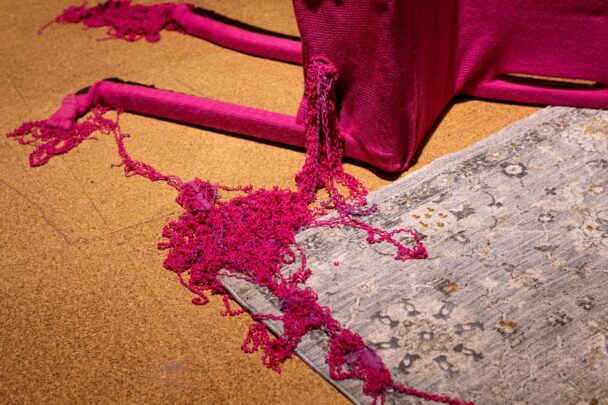
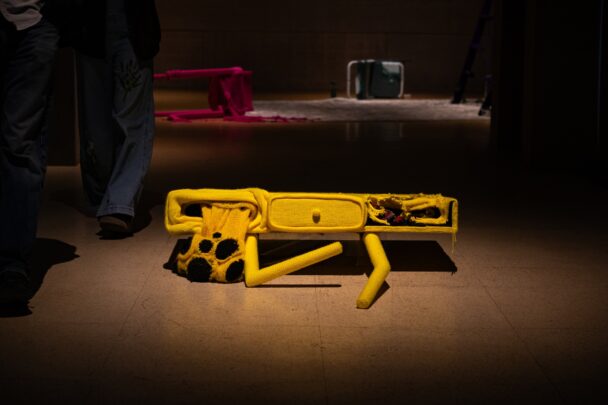
Oman’s “C-ouch!” has an unusual cast of characters. The exhibit boasts anthropomorphized furniture cloaked in yarn and provided with new appendages. The tone of “C-ouch!” is quite surreal, as the furniture bleeds and belches out yarn as if indicating that this yarn “necromancy” isn’t quite right. This dovetails with a broader theme of the exhibit, which is the sense of degradation—the consumption and irrevocable changes the furniture has gone through, now rendering it obsolete for normal use.
There is also a sense of decay and a limit of control. Yes, the yarn has admittedly breathed life into animate objects and given them some humanlike physical capabilities, but the pieces themselves cannot handle this. They lie upon their sides, their legs splayed out from their bodies or as far as the ceiling, their gaping mouths open as if in silent screams. The vibrancy of these colors also allows the pieces themselves to stand out more and demand attention and therefore, thought. It also furthers this disjointed, unnatural feel that is present in the entire exhibit. The furniture has lost its sense of being fit for humans, but has gained its own sovereignty. Oman’s “C-ouch!” leaves this interesting notion unresolved and non-partialised, leaving the viewer alone to mull it over.
As a whole, these six theses overlapped extensively on the themes of identity and togetherness. Art reflected the ongoing actualization of each artist. Every exhibit was unabashedly authentic and spurned superficiality. These themes discussed in the six theses illustrate the importance of one’s journey of humanity.
Ryland Breen can be reached at rkbreen@wesleyan.edu.

Leave a Reply