
Omri Riss-Chbarbi ’26 on His Thesis & Passion for Julius Eastman: “There’s a Lot More I Want to Say”
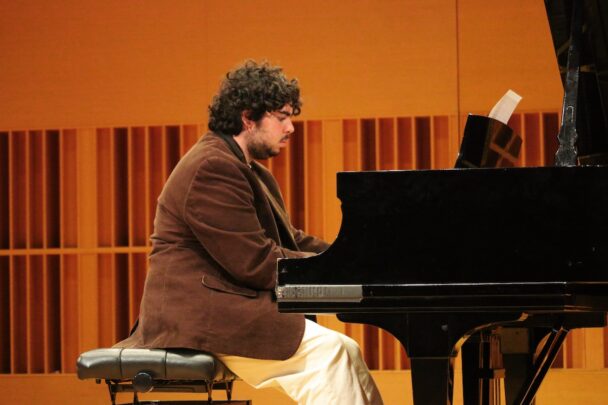
On Friday, April 10, music major Omri Riss-Chbarbi ’26 performed four electrifying improvisational pieces based on score sheets of experimental music pioneer Julius Eastman in the Crowell Concert Hall. Riss-Chbarbi spoke about Eastman between several of the pieces and introduced everybody to his dog before the performance began.
I recently sat down with Riss-Chbarbi and interviewed him about his passion for all things Julius Eastman, who he has already written about here at The Argus. But he’s still got more to say.
The Argus: Your concert was timed perfectly to watch the gorgeous sunset shining into Crowell as you were performing. Was that intentional? Was that space just free at that time?
Omri Riss-Chbarbi: God, I wish it was intentional. 7 p.m. is just a very standard starting time for student recitals. So it worked out that way, but Crowell was a place that I wanted because I love the dichotomy of a space that is so institutional on one hand, and a concert that in its intention is supposed to be very anti-institutional. Eastman was part of an institution. He taught at SUNY Buffalo for a while, but he forewent that to be in the avant-garde scene in downtown New York. It feels weird to perform it in such a sanitized space, but I also like the idea of bringing my energy of being a weird, odd guy. I mean, I brought my dog on stage to start the recital because I didn’t really know how to start.
A: I was gonna ask about the improv because you mentioned that you sort of adapted these pieces with improvisation.
ORC: So, one of Julius’ biggest—I guess I’m just referring to him as Julius, I’ll keep referring to him as Julius—[innovations] was the implementation of freely improvisatory material into this kind of world in the context of 1970s experimental music. Improvisation was really common, but Julius found a way to blend the written and improvisational materials in a way that didn’t really exist prior. And so in my performance, the piece I played first was based on his piece “Buddha,” which we played after, but I decided to make a set of variations where each variation was an improvisatory framework in the style of one of Julius Eastman’s previous compositions. In the last piece “Stay On It,” there were tons of opportunities for each person to kind of improvise using the written material given. His friends said that Eastman allowed everyone to improvise off of the material that was given and these little aspects like, freely based off of that. So there’s a lot of room for improvisation.
A: So it seems like there’s a lot going on with bringing this music to the stage. How did you choose what instruments you wanted? What people did you want to play those instruments? Simply put, how did you decide on the setup?
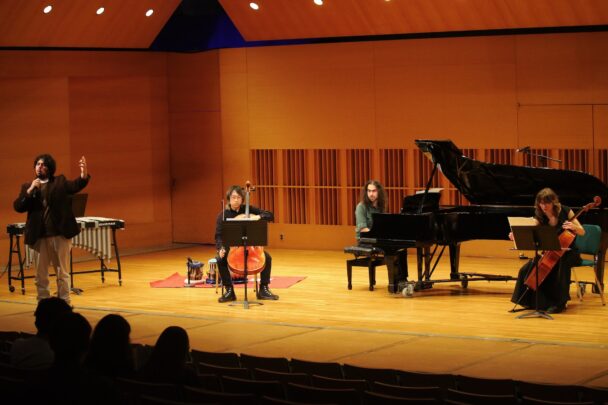
ORC: So for “Stay On It,” we had nine people, making it the biggest one. Looking at the idea of transgressing identity, transgressing categories, and borders and boundaries, I really wanted to emphasize the different communities that exist at [the University]. At [the University], we have a really strong history with ethnomusicology, non-Western music traditions. We have a really strong student music group. We have strong musical theater, strong jazz. We have tons and tons of different people on this campus, and I wanted to specifically choose people who meant a lot to me. Throughout my years here, I’ve really had a chance to get to know so many different people. If you look at the performance, Samvit [Singhal ’27] was playing tabla. Some of it is that he’s part of Atman. That’s a group on campus that does fusion between Indian classical music and, like, Western art music, which I love. Ameen [Mokdad MA’26] was there. Ameen is past just being a phenomenal violinist. A lot of his music centers around his personal experience in Iraq as an Iraqi violinist and his life experience. [Assistant Professor of the Practice in Music] James Praznik, amazing pianist, amazing professor, someone who really inspires me and who’s been a rock for my time at Wesleyan, is very familiar with experimental music. Stuart [Conrad ’26] is a jazz trombonist, does a lot of musical theater, and is a great composer. Gavin [Cui ’26], everyone knows Gavin on this campus if you’re in the arts.
A: Yeah, I worked with him on “A Chorus Line.”
ORC: Yeah, exactly. Everyone knows Gavin on this campus. […] Look at Alec Pedersen [’28], who is also a staple musician on this campus as far as it comes to student groups. Emma [Mistele MA’25 was] a grad student. She graduated last year. She’s not a grad student anymore, but she’s someone who was part of the more academic side of music on this campus. Miguel [Lathrop ’28] is the banjo for “Whiskey Rebellion,” so in this group of musicians, you really see a big mix between the more academic music scene on this campus and the student-led, and I wanted that to be present. I wanted to transgress those boundaries of academics. We had grad students, undergrads, graduates, and different genres. Each person has their own really unique blend of genre experience. I think that it very much embodies the type of multiplicity of expression that you see in the goal of “Stay On It,” through the instrumentations, through the musicians, as far as the order of it.
A: When did you first get interested in Eastman? Were you this level of passionate about other musicians before? It sounds like you went above and beyond talking with his friends and relatives. It feels like you could be his biographer.
ORC: I would like to, yes. I haven’t met his relatives yet. I’ve met a lot of his friends. I am hoping to meet his ex-boyfriend soon. I shot him a few emails, and we’re hopefully going to meet. So, originally I got into Eastman around one year ago. It was March 2025. So, I was on leave, and I was at home. I originally found out about him as he kind of came up in the periphery of tons of people’s stories. One of the things he’s most known for now is through this thing called the “Song Books Incident,” which is very famous. He was performing John Cage’s “Song Books,” and he did something that John Cage hated. You even see him as part of the disco scene with Arthur Russell. I knew a few people who were engaged with Arthur Russell, and I was like, oh, this is interesting. There’s this guy who has a relationship with him. Although I’m not the biggest Arthur Russell fan, it was interesting to see.
I was looking up composers who composed music, not as leisure, but as something core to their being, like it was, to borrow Eastman’s words, a form of self-actualization and resistance, and when I discovered him, I didn’t understand him. And I still don’t. To say that I understand now is very naive, but I think that there was, when I started to read his biography, something that really bit me. I read it in August and September, and it just hooked me. I remember I was so frustrated last semester because I was trying to write about him and every statement that I tried to make as a fact, everything I tried to say that is a fact about him just got disproved by him. He finds some way to resist any form of categorization, and that just intrigued me beyond no end. Like, I wish that I had the courage to be so unapologetically myself in a way that—well, I mean, he hurt a lot of people through it. His ex-boyfriend has a lot of stories about how Julius would act harmfully at times. Eastman would do things like leave the door to their apartment unlocked and invite homeless people in the homeless community to sleep in the house. When Eastman would steal from his boyfriend, Eastman would just be like, “It’s just things. It’s just shit. It’s physical material. Why are you complaining about something that’s just materialistic?”
A: How did you choose the order of the concert?
ORC: I really was struggling with this for a while. The one thing that I really think that Eastman does well in “Buddha” specifically is that he blends the idea of beginning and end. I also like silence between the Buddhas. That’s why I tried to maintain a lot of silence throughout the evening. […] I wanted the silence to more so highlight that these are not distinct starts and endings, but the silence is a very intentional part of the playing of “Buddha” in that “Buddha” is growing out of the silence and then fading away into silence.
A: Where do we go from here in terms of your passion for Eastman, your music interests in general, and anything you want after leaving the University?
ORC: You mentioned the idea of me being a biographer. The truth is that I am the weird type of ADHD guy who has had other obsessions for musicians like this. Yet none have ever lasted this long, literally over a whole year now. I wrote an article, then I did a listening party for Julius, now I did a concert, I’m writing a thesis, I will be giving a seminar about him [during] commencement week for alums, and we’re trying to do a disco night about Eastman. In the future, I hope that I learn more about Eastman. There’s so much more to be said about him, about his engagements with music, and past his identity. That’s one thing that I got when talking to his friends. The idea of tokenization in the world of classical music runs rampant. I think one thing that people tend to do that gets a lot of criticism, and rightfully so, is reducing Julius to an identity, reducing him to the idea of being a black queer composer. Don’t do that. Let him be his whole person. My thesis in particular is specifically looking at how he didn’t limit himself to one form of spiritual and religious engagement, and my next project, I hope, is some type of paper PhD research study. I want to be a professor or a choreographer at an arts institution, because I love lecturing and talking about people like Julius Eastman, and what I would hope to do is to undergo this kind of full taxonomy of religion and how Julius engages with religion throughout his life. God, theses are due on Thursday, and I am still finding things I want to add. Last night, I didn’t speak much because it would have turned into however long we have been talking for…30 something minutes?
A: Yeah, 37 minutes.
ORC: Last night it would have turned into this, and there’s a lot more I can say. There’s a lot more I want to say, but for your sake, I won’t.
Omri will be speaking on Julius Eastman for Commencement Week on Friday, May 22 at 1 p.m. in the Gribbel Room in the Art Library.
Henry Kaplan can be reached at hrkaplan@wesleyan.edu.

Leave a Reply