
Artgus Artist Spotlight: The John is Doing Baptisms and Confessions
The John Wesley Methodist Charter has made a name for itself in recent months. Since its founding in 2023, the satire publication has steadily earned a reputation around campus. Today, its Instagram account has climbed to nearly 900 followers. Their recent April Fools’ joke—two John writers in a trench coat attempting to swipe into Usdan as one person—did numbers on social media and garnered lively discussion on Fizz. A meme has spawned from a picture of John Co-founder Thomas Lyons ’26 wearing a bright yellow raincoat, squatting and watching the prank in disbelief.
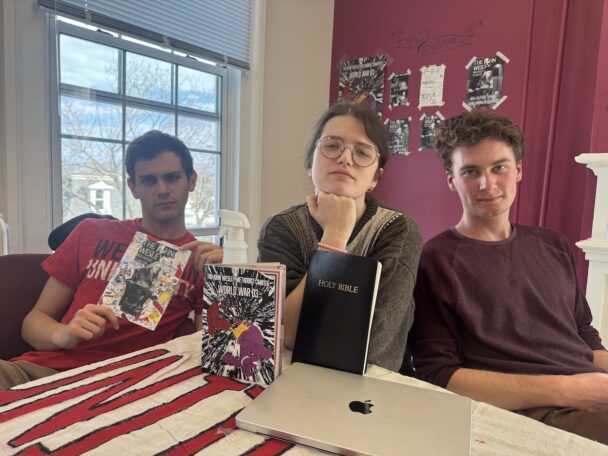
The Argus recently sat down with the campus provocateurs (Thomas Lyons ’26, Adam Wilan ’26, and Liv Rubenstein ’26) at their new outpost in the renovated University Organizing Center. Co-founder John Earling ’27 was unable to attend the meeting. The group discussed their history, Lyons’ staph infection, NESCAC military strategy, and more.
Thomas Lyons: I have a doctor appointment to get to later; how long do you expect? I have a raging staph infection, is that going to affect my convalescence?
The Argus: Could you guys tell me about this most recent edition that you guys have just published? What do you think are some highlights, some things we should know?
Adam Wilan: We went for something a little different in this issue. Usually we have kind of a loose theme, like orientation, “The John Sells Out,” you know, death and graduation. For this issue, World War D3, we went for more of a storyline.
A: What does this conflict look like?
AW: We imagined this war between Wesleyan and then Amherst and the Maine colleges, sort of mapped out the conflict. I think every article is in direct relation to that broader storyline, so it’s more of a narrative than most of our issues.
Liv Rubenstein: It starts with the bombing of—well, really, it starts with the incident where I believe it was a Tufts student and an Amherst student, they do murder each other. And thus begins the war, and it ends with peace.
AW: So Amherst bombs Tufts to oblivion because Wesleyan is allied with Tufts. Wesleyan declares war on Amherst and Amherst’s allies, which are the main schools: Bowdoin, Colby, and Bates. Then Wesleyan allies with Connecticut College. Trinity as well. But then there’s all this drama with Williams, Middlebury, and Hamilton. Will they join? Which side will they join? Won’t they join? You can read the issue for yourself, but it gets pretty complex.
A: Sure.
TL: I just took away last semester for ethical issues [Lyons was one of The Argus’ editors-in-chief during that time]. But when I came back in January and they’re wrapping up the production of this issue, it was super inspiring to come back into the space and have there be like 30 people in this room, all super excited about putting this together. And so that was very special and inspiring for me.
A: Would you say you felt like you had birthed something?
LR: Our eggs have really hatched.
TL: We’ve had a number of different baskets over the years. My sophomore year, I wanted to start a humor magazine. I felt like it was something that was really lacking at Wesleyan. And I think I was in a period where I was kind of critical of Wesleyan institutions. I thought, I just have to put something out into the world. And I had just come from an eye doctor appointment, and I ran into Adam. And I said Adam, “We’ve got to start this humor magazine.” And he said, “Great, I’m already on board.” So that’s how it came to be. And then Liv joined almost right away. I forget exactly how.
AW: My father was on the humor magazine when he was in college, which he was really into. So was my grandfather. And so, I always had their old copies lying around the house. My freshman year, my twin brother—identical twin brother at Tufts, Jack—he couped the existing leadership of the Tufts humor magazine, the Zamboni. I’m not one to be beaten by my brother. We’ve had some humor magazines in the past. None of them have really gotten much steam, unfortunately, or they’ve closed for a variety of reasons. And then yeah, sophomore year I connected with Thomas. And we constructed what we have today.
TL: Adam and I were in the College of Social Studies. And that’s really formally how we met. And The John’s the best thing the College of Social Studies has ever produced.
A: So it seems there was a power vacuum in the sense that there were no really prolific [satire publications].
LR: This year has been sort of a banner year. We have a lot more followers on the Instagram and there’s a lot of young people who are a part of it. The first meeting we had back after Winter Break, there were 35 or 40 people. Far more than we had space for.
AW: But that was good. It was perfect. And we have some really phenomenally talented people on board and just writing for us as well, which is great. Talking about the humor magazines we’re looking at, you’ll notice this image right here. That’s borrowed, not from an old humor magazine, but from an old magazine at Wesleyan. It was old.
LR: Actually, it was a songbook. It was an old songbook of old college songs. I think it was honestly [from the] 19th century. It might’ve been an old ADP songbook.
AW: Oh, so also, our relationship with Route 9. First semester we actually were digital. We have thejohn.org as our website. It’s still up. We do post stuff there because we didn’t have any funding. Second semester through Jane Weitz [’26], who was our head writer at the time, [we] got connected with the Route 9 organization. Now we get some sweet, sweet funding through them. I think the Fray is also Route 9. There’s Lavender, Pre-owned Good Condition, and The John. I think those are the three.
A: They also do a lot of one-run zines, I think.
LR: Yeah, so we’re a part of that larger organization and that’s where we get our funding and there’s some crisscross between our members. We poached Mel Cort [’27]. That was a boon. We said, come on over. We have commodities.
AW: We also do all kinds of schemes, happenings, if you will. We had a punk show last semester, a snowball fight this semester. We’ve been buying our toilets around the area. The plan is to convert this room, all the chairs to become toilets. What else have we done? We absolve people’s sins at Pumpkin Fest. We’re doing baptisms and confessions. We do Garden Fest every year.
TL: We have a table. Last year, we sold water balloons to inculcate panic and chaos. And to fundraise money. But mostly inculcate chaos.
AW: I think we’re making a ghost hunting documentary this semester. So we’re a multimedia organization.
A: I was about to say, you guys have a multimedia enterprise going on, it seems.
AW: The magazine is at the core of it. This is how we organize ourselves. This is our routine. This is our schedule. It’s built around the magazine. But we have so many creative, so many funny people in the room at once. And the John is a platform for all of that to release into the world. So videos, digital stuff, Instagram, social media stuff. We have a wonderful website. We got to pay $12 a year for our domain name.
A: Are you paying that still?
LV: Yeah. I was kind of impressed that we were able to find that.
AW: We had a member, Little Pimmy Pocket.
A: Pimmy Pocket? Is this a real person?
AW: She was a John writer, but then her article was just panned across the board. And so she, uh, she built this car out of sand and concrete, called the Pimmobile, and then just drove away.
A: Into the sunset.
TL: Well, into the river, obviously. I mean, it was ugly. Body’s still out there.
LV: There have been dark days in this magazine. But it’s going really well now, and something that I am very proud of is that we have a really fun culture as a magazine. I don’t think it’s very judgmental. You don’t have to audition to be a part of this club. It’s very independent. If you come to the meeting, there’s just an expectation that throughout the week you will be working on your article. And what’s fun is that we consistently have enough work to publish. People care and want to help each other. And it’s the way that I’ve met the most underclassmen.
AW: I’d also say one thing that distinguishes us from other magazines on campus, we’re attendance based. We don’t take anonymous submissions from outside the school. If you want to get published in The John, you’ve got to come to our meetings. Some other magazines have different structures: You submit your work, you hear back from them, maybe they’ll edit it with you. We’re all about the process and the community that comes through the process.
A: Do you have a credo? Do you guys want to, maybe, inaugurate one?
TL: I don’t want the pressure of that.
LV: I will say a thing I’m very proud of is that we have broken news stories on this campus.
TL: There was this moment with Ben Shifrel [’25]—former WSA member—last year, when the human rights minor, there was all sorts of buzz about it getting axed. There was this big WSA meeting, and Ben Shifrel writes something like, “We haven’t received a written statement on why this is actually happening, but I found out about it from the school’s parody newspaper named after a toilet, and that would be more informative than anything else I’ve seen.”
AW: I think one of our most cherished images is somebody learning about, like, the Trump assassination attempt.
LR: The Pi thing [about Pi Café closing] I think was big. That’s how one of my friends who works at Pi found out about it.
A: So you guys are quick.
AW: We have a WhatsApp chat so that whenever there’s some breaking news on campus or in the world, we get to brainstorming right away. Try to get out a post as soon as possible.
A: So you’re like a good TMZ, a TMZ that doesn’t hurt the people.
TL: No, don’t dare describe us [that way]. Not a tabloid.
LR: We like to comment on celebrities’ bodies but it’s not in the way you think.
A: And if we’re using a basic categorization of low, middle, high brow, where would you put yourself on that…continuum?
All: I think middle brow. Middle brow.
TL: I would say in a real way, we put a lot of thought into things like sentence structure and even our Instagram headlines. They go through numerous iterations of trying to figure out how to be the most succinct and pithy, to squeeze out the humor. So there’s a lot of thought that goes into it, even if we’re making jokes about cocaine every now and then. Yeah. Not to mention our mascot. It’s both a toilet and also, you know, a renowned historical figure that Wesleyan is intimately connected with.
Before it was the the “John,” the leaders of the organization were considering several names. Some of them include: Maroon and Charcoal, The Little Third Parenthesis Leg, Men with Large Penises Writing Comedy, WesHits, Sword and Stone. Peanut and Jelly time, The Ohio Wesleyan Tribune, and Wellesleyan.
The John says they might publish a blackout poetry version of this interview. Their upcoming issue is “Play John,” a play on Playboy.
Open meetings for The John are every Thursday at 5 p.m. on the second floor of the University Organizing Center.
Conrad Lewis can be reached at cglewis@wesleyan.edu.
Thomas Lyons is an executive editor for The Argus.


Leave a Reply