
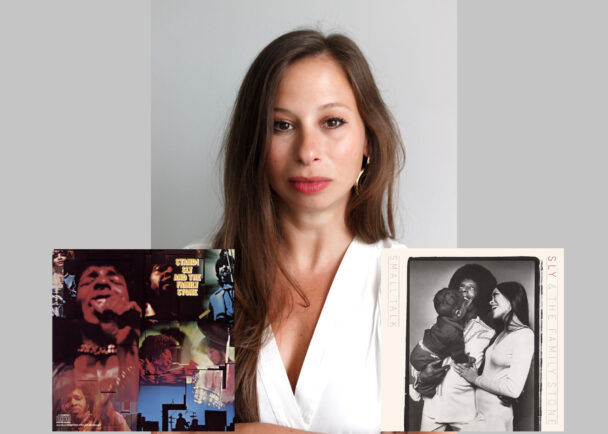
On the Record: Professor Veronica Brownstone on Sly & the Family Stone and the Album That Moves You When You Need It
On the Record is a column about getting to know our professors through their music taste, built around a deceptively simple question: What’s your favorite album of all time?
For Assistant Professor of Spanish and Latin American Studies Veronica Brownstone, the answer begins in her childhood living room at 7 a.m.
Before anyone else in the house was awake, her mother would play Sly and the Family Stone quietly and dance alone, just enough for the music to drift upstairs.
“It gave her energy,” Brownstone said. “The same way it gave me energy later.”
Brownstone, in her first year as a professor at the University, is still someone many students are just getting to know—whether through courses like “Racial Capitalism and Resistance in Central America” (SPAN285) or brief conversations after class. This column, at least in part, is an attempt to do that differently.
As Brownstone grew older, that early-morning music became something else, something closer to structure, or even guidance. The only full discography she ever downloaded off LimeWire was Sly and the Family Stone. She listened to everything. The music followed her through childhood and college, and into the way she thought.
So when I asked her what her favorite album of all time was, her answer came quickly. Stand! by Sly and the Family Stone. But like most answers in this column, it didn’t stay simple for long. It would be easy to leave it there, to treat Stand! as the definitive answer and move on. But what makes Brownstone’s answer interesting is that she doesn’t actually listen to Stand! the most anymore.
“It’s not the one I feel most connected to now,” she admitted.
Instead, she kept circling back to a different album by Sly and the Family Stone: Small Talk, as “it just makes [her] happier.” At first, this discrepancy feels like a contradiction. But over the course of the conversation, it became clear that it’s something closer to a distinction.
Stand! is the album that moved her; Small Talk is the one she returns to. And those are fundamentally different things.
For Brownstone, Stand! is inseparable from a specific moment in her life. As an undergraduate in Montreal, she found herself surrounded by student movements, political organizing, and a kind of energy that felt new: more urgent, more charged. As a result, Stand! began to take on a different meaning.
“It was formative, politically, for me,” she said.
Part of that had to do with where the album sits in Sly and the Family Stone’s discography. Earlier records leaned more toward optimism: utopian, even. But Stand! carries something else.
“It has a bit more grit to it,” Brownstone explained.
That shift mirrored something in her own life. Growing up in Toronto, a city often described as one of the most multicultural in the world, Brownstone was raised within a version of diversity that felt seamless, almost ideal. But as she got older, that image began to crack. The tensions beneath it became more visible, more difficult to ignore.
And Stand!, released in 1969, in the wake of the Summer of Love and alongside the rise of the Black power movement, captures that same tension. It’s not that the optimism disappears: it’s complicated, pressured, forced into contact with reality.
“It picks up on the tension,” she said.
At the same time, the album never loses its simplicity. That’s something Brownstone kept returning to: how direct the music feels, even when it’s doing something complex. “The complexity and brilliance of simplicity,” as she called it. Songs like “Sing a Simple Song” aren’t trying to overwhelm you. They’re almost disarmingly straightforward: joyful, repetitive, and easy to latch onto. And yet, somehow, they hold everything.
That balance between simplicity and tension, optimism and grit, extends beyond the album itself. It shows up in the way she thinks, teaches, and structures her courses. When I asked her how her academic discipline affects her music taste, she told me, “I think my music taste…influences what I work on.” Not the other way around. That distinction feels especially visible in Brownstone’s classroom.
Students (like me) in her course on racial capitalism and resistance will recognize the same interplay between lived experience and theory, between personal history and political analysis. Her approach to Latin America, she explained, comes less from abstract frameworks and more from her own background growing up in a diasporic city, navigating multiple cultural contexts, and paying attention to the everyday forms of culture that shape how people understand the world.
“I think a lot of my belief system comes from the music I listen to, the people I interact with,” Brownstone said.
And that belief system—like Stand! itself—is full of tension: between the personal and the political, between optimism and critique, and between where you come from and what you come to understand later.
Which brings us back to Small Talk, the other Sly and the Family Stone album in competition for Brownstone’s favorite album of all time.
“Honestly, it’s the one I come back to more,” she said.
But the difference isn’t just about how often she listens to it. It’s about what the album does.
Where Stand! is tied to a specific moment—student movements, political awakening, a shift in how she understood the world—Small Talk feels less anchored to a single time. It’s not about being moved forward. It’s about being held.
That happiness isn’t superficial. It’s quieter, more durable. The songs feel warmer, softer, more overtly nurturing: not in a way that avoids tension, but in a way that absorbs it. If Stand! confronts the world, Small Talk makes it liveable.
Because if one album teaches you how to see—how to recognize contradiction, tension, and political urgency—the other teaches you how to stay, how to exist inside those contradictions without being consumed by them.
Brownstone kept returning to this idea of music as something that nurtures: not just expresses, not just critiques, but sustains. The band itself, she pointed out, is called Sly and the Family Stone. Their music, for her, has always been tied to that sense of collectivity: of people coming together, taking care of each other, creating something shared.
It’s the sound of her mother dancing in the morning.
It’s the sound of people gathering in a living room.
It’s the sound of something being passed down.
At the end of the interview, I asked Brownstone the question I always like to end with: “What would you want students to understand about you through your choice?”
She paused for a moment.
“I think my courses are a mixture of a lot of personal things,” she said. “I try to approach teaching…as a reflection of my own encounters in life outside of academia.”
It’s an answer that makes the relationship between Stand! and Small Talk feel less like a contradiction and more like a progression.
What she found in Stand! didn’t disappear, it settled in. It became part of how she listens, how she thinks, how she moves through the world.
Small Talk meets her there. Together, they don’t cancel each other out. They explain each other in a way that makes her answer clearer.
Later, when I asked her to sum it all up in a sentence, she said: “Love your mother.” Not literally, she clarified, but as a way of understanding where you come from, what gives you life, what nurtures you, what keeps you going. I found that to be her most poignant point: not just about the music, but about how she teaches, how she thinks, and how she moves through the world.
Have a professor you’d like to see featured for their music taste next? Shoot me an email!
Griffin Abdo can be reached at gabdo@wesleyan.edu.



Leave a Reply