
From The Argives: On Keeping Wesleyan Weird—Graffiti & “Vandalism” at the University
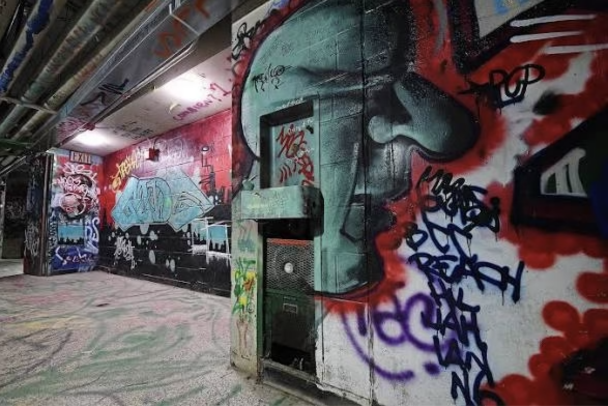
Based on the many forms of student expression on campus that align with the University’s liberal arts description, it is not a reach to say that students here take pride in their quirks. In the mid 2000s, students who wished to use their eccentricity to leave a mark on the University campus especially enjoyed spray painting the tunnels. Unsurprisingly, this graffiti was not viewed favorably by the administration, which opted to paint over some of the alleged vandalism.
The Butterfield (Butts) B laundry room was particularly treasured by students as one of the last areas of the tunnels they were allowed permission to enter. Creative students would spray paint their art on the walls, contributing significantly to the University’s artistic student culture. However, this method of expression went south when the University decided to paint over the graffiti in the Butts laundry room, erasing years of student expression and history. A student at the time, Collin Cutrone McMichael ’09 MA ’10, took to The Argus to voice his frustration to former University President Douglas Bennet ’59.
“The latest decision to paint over the graffiti in the Butts’ tunnels is outrageous,” McMichael wrote in a letter to the editor published in The Argus on Oct. 20, 2006. “The tunnels were one of the few things that gave the Butts their unique culture. Without them we are just another dorm on campus. Are we really going for complete campus homogeny? Doesn’t that completely defeat the purpose of what Wesleyan is? Wesleyan should be proud that it can support such a creative student body, not act aggressively oppressive towards them.”
McMichael emphasized the point that Wesleyan, being a university that takes pride in its forward-thinking approach to student expression, should be uplifting students’ creative minds instead of stifling them. The decision to paint over the students’ graffiti in the Butts laundry room seemed especially aggressive, effectively effacing years of artwork integral to student culture and belonging at the University.
McMichael went further to compare the culture at the University to that of other liberal arts colleges.
“Without WesCulture we are just another New England school,” McMichael wrote. “If I were a white bread, middle of the road, moderate with few opinions I would not have applied here. Wesleyan IS extreme. Wesleyan IS opinionated. Wesleyan IS unique.”
Much of what drew students to the University at the time of this conflict can be attributed to the outspoken and free-spirited culture of Wesleyan students, a feature of the University that the administration is said to encourage even today. Evidently, McMichael felt cheated by the University, asserting that the decision to paint over the graffiti went against what Wesleyan supposedly stood for.
In light of this clash between students and the administration, students mobilized to form the Facebook group “Keep Wesleyan Weird,” which gathered over 900 members by October 2006.
On Oct. 20, 2006, in another article published by The Argus, Matt DiBlasi ’07 wrote, “Many students feel that removing tunnel graffiti is not a necessity, as evidenced by the newly-formed Facebook group ‘KEEP WESLEYAN WEIRD.’”
This group notably went beyond the graffiti (also known as tagging) feud and also commented on the chalking scandal of 2002, as well as the increased police presence on campus at the time. Many students felt that the banning of chalk on campus, alongside police shutting down their parties, was indicative of a growing trend of suppressing student culture.
The group ultimately aided in retaliatory efforts against the University, painting new graffiti over the erased original tagging of the Butts laundry room.
“Students have mobilized to replace decades’ worth of graffiti after the University recently repainted tunnel walls under the Butterfield B dormitory,” DiBlasi wrote. “Almost immediately after the fresh coat of paint dried, the walls were retagged with spray paint and sharpies.”
While the University made its opinions clear in painting over the so-called vandalism of the Butts B laundry room, that evidently did not discourage the students from fighting to keep Wesleyan culture alive.
“For many students, the white washing destroyed one of the University’s hallmarks,” Kim Segall ’10 wrote in the same Oct. 20, 2006 issue of The Argus. “Many students were attracted to the University’s quirks, including the graffiti in the Butts tunnels, as high school students.”
Thus, the art of self-expression from the notorious graffiti in the tunnels was a selling point for prospective applicants, only further proving that the University was seen as a place where one could practice self-expression in a multitude of forms.
Many saw the graffiti as a way to mark specific moments in University history and pass memories on from generation to generation.
“Senior Class President Arjit Sen ’07 feels the graffiti in the tunnels was also a way to connect current students to past ones,” Segall wrote. “Several students were upset to see history erased.”
The movement to “Keep Wesleyan Weird” was once a united front of students fighting to preserve Wesleyan culture. Today, Wesleyan’s culture has not dampened, and students remain enthusiastic in expressing themselves through various forms of art, just as student predecessors in the ’00s did.
McMichael ended his letter to Bennet with four words, and I, too, will end this article with his call:
Please Keep Wesleyan Weird.
Lara Anlar can be reached at lanlar@wesleyan.edu.
“From the Argives” is a column that explores The Argus’ archives (Argives) and any interesting, topical, poignant, or comical stories that have been published in the past. Given The Argus’ long history on campus and the ever-shifting viewpoints of its student body, the material, subject matter, and perspectives expressed in the archived article may be insensitive or outdated, and do not reflect the views of any current member of The Argus. If you have any questions about the original article or its publication, please contact Archivists Hope Cognata at hcognata@wesleyan.edu and Lara Anlar at lanlar@wesleyan.edu.
Leave a Reply