
Against Pragmatism, Against Hope—For Desire
This piece is part of Letters on Pragmatic Hope, an essay series in which Wesleyan professors and administrators reflect on a daunting question: How can students act with purpose and efficacy amid an increasingly authoritarian environment? The series aims to gather responses from a diverse group of Wesleyan faculty, offering a vision for how students can turn despair into pragmatism and action.
I was going to say no to the invitation to write a Letter on Pragmatic Hope in these horrifying times. After all, I don’t believe in pragmatism—or hope, exactly. Nor do I want to impart a tidy “vision for how students can turn despair into pragmatism and action.” As if I know. As if anyone knows. But then, I thought, perhaps that’s the point. Maybe there are students who, like me, want to hear something other than advice about vision or pragmatism or hope. And so if that’s you, hi.
Perhaps it sounds perverse to be against hope or pragmatism (then again, what’s wrong with a little perversion?). But my queer sensibilities leave me skeptical of both. I think about what Lisa Duggan told José Esteban Muñoz in their dialogue on “Hope and Hopelessness”:
“As a queer feminist anti-imperialist and utterly contrary and cranky leftist, I have my doubts about the political valences of hope. I’m suspicious of it. I associate it with normative prescriptions about the future I ought to want, with coercive groupthink, with compulsory cheerfulness, with subtly coercive blandness. I find a lot of pleasure in bitterness, cynicism, depressiveness, and bitchiness. I raise my defenses against earnest optimism and its normative compulsions. It is within this framework of temperament and politics that I defend myself as a specifically queer leftist.”
Hope can be a projection, a falsely unified vision that “suppresses the messy vitality of political longings” of a marginalized elsewhere. “I immediately associate [hope] with race and class privilege, with imperial hubris, with gender and sexual conventions,” Duggan writes.
Pragmatism is even worse. In 2009, when Lisa and José had their dialogue, what seemed “pragmatic” was the fight for marriage equality. In “Cruising Utopia,” Muñoz warned of the “anemic political agenda that dominates contemporary LGBT politics in North America,” in contrast to the revolutionary dreams of gay liberation. Masquerading as “non-ideological” and opposed to the “impractical” or “utopian” left, pragmatic LGBT politics presented marriage as the correct, perhaps only, fight to have. In queer activist Ryan Conrad’s words:
“People want to be pragmatic and identify marriage as the winnable thing, but this seems ideologically ridiculous to me. Why would you compromise a vision of the world you want to live in for crumbs from a table you don’t want to sit at? I get frustrated with this concept of gay pragmatism, like we just have to be pragmatic and invest in incremental change. Incremental change towards what? A world that sucks? A world that is totally classist and racist, and hetero-supremacist? I’m not working towards that.”
So if not hope or pragmatism, what else?
I’m writing a book right now based on long-term ethnographic and archival research with queer left activists, called “Desire Against Visibility: Queer Left Pedagogies for Liberation.” This project has taught me that what we need is not hope, much less pragmatism, but rather desire.
The book is about the intellectual and pedagogical work of queer left activists in the 2000s–2010s—groups like the late, great Queers for Economic Justice (QEJ), in New York City. As Amber Hollibaugh, one of QEJ’s founders and their last executive director, reminds us, “everyone’s told always about politics, ‘you have to be practical,’ but I actually think that’s not true, you actually have to hold to a dream…and desire is part of that dream.”
The period during which QEJ was active—the “long 2000s”—is typically characterized by both scholars and activists as bereft of left political organizing. The decline of a revolutionary horizon, the aftermath of Clinton-era welfare “reform,” the structural adjustments of late neoliberalism, and the solidification of the “nonprofit industrial complex” (NPIC) left us with what Jodi Melamed calls “neoliberal multiculturalism,” a logic of uneven recognition that both props up and obscures racial capitalism. This logic has dominated LGBT politics since gay liberation: an emphasis on seemingly “pragmatic” rights and legal representation, visibility and consumer citizenship, “winnable” goals and measurable outcomes. The a priori politics of what is visible and visualizable.
In contrast, QEJ and other queer left organizations challenged visibility with a politics of solidarity and liberation. They organized in homeless shelters, analyzed intersections of welfare and sexual politics, critiqued state surveillance and queer immigration, and argued for queer kinship beyond marriage. They produced countervailing knowledge that insisted that erotics are central to racial capitalism. They grounded their work in the expertise of poor and working class queer people (often trans and gender expansive, of color, HIV+, disabled, and immigrant)—the very people erased from the (neo)liberal and homonormative LGBT movement. They built a “Queer Left” alongside other queer racial and economic justice organizations.
Then, as now, this work was often dismissed as impractical. It was sometimes ridiculed as “utopic,” or overly “radical”—not pragmatic. It was also work that, to be frank, simply did not matter to the cis, white, professional middle-class LGBT movement. Jay Toole, who worked at QEJ after living most of her life on the streets, told me a story about how once, seeking some kind of safety, she slept out on the steps of the new LGBT Center on West 13th. In the morning, when the Center opened, staff violently ejected her and trashed her stuff. Most queer people, Jay explained, “don’t even see homelessness, they never look down, or if they see a homeless person, they never think of them as queer.” In the 2000s, as now, the lives (much less the expertise) of poor and working-class queers are not valued.
And still, queer left activists centered desire.
“No political movement succeeds without desire,” Amber reminds us—because the erotic is necessary to liberation. “I longed to build a new revolution,” she says, with everyone left out of the single-issue campaigns the LGBT movement prioritized: working-class queers, sex workers, street kids, Black and Brown trans people, unhoused and incarcerated queers, precarious workers, basically everyone. “I’m fighting for the possibility of having a kind of desire and possibility” for everyone, and “I wanted everything—differently,” Hollibaugh says.
Desire does not have a goal—it is the desire for a future for those left out of futurity, not a vision of that future. It is a yearning for what we want but cannot know. In the Lacanian formulation of Joan Copjec, desire is not a “determinate object or goal for which we can aim,” it is rather “a striving for something else or something more.” Of course, a lack of concrete vision or goal is the major criticism of U.S. radical activism since the World Trade Organization protests in Seattle. But I take this lack seriously; liberation cannot be known in advance, visualized—that is what makes it possible to desire. Desire, then, I argue, is the start of queer left politics.
Is there a lesson for us in this bit of history? In 2009, Barack Obama was awarded the Nobel Peace Prize for “inspir[ing] hope for a better future.” We might describe his eight years in office as a high point of neoliberal multiculturalism: the passage of the Matthew Shepard and James Byrd, Jr. Hate Crimes Prevention Act; the White House-funded campaign “It Gets Better”; the repeal of Don’t Ask, Don’t Tell; and, in 2015, the Supreme Court’s Obergefell v. Hodges decision. Of course, during the Obama presidency, ICE deported more immigrants than any other president in U.S. history (up until 2025), earning him the nickname “Deporter in Chief.” He also earned the nickname “Drone President,” as he greatly expanded the use of armed drones for “targeted killings” in Pakistan, Somalia, and Yemen—strikes that killed record numbers of civilians. Hope, then as now, is not enough.
It is not my pedagogical style to provide a prescriptive moral, a neat takeaway, or lessons learned. Nor is that how activists teach. Instead, they attempt what Gayatri Spivak called the “non-coercive rearrangement of desire” to provide some possible openings for an otherwise. Some days, I will confess, I feel a little nostalgic for the diversity politics of the long 2000s. Each day, a new front opens in the war on trans people, immigrants, queers, people of color, women, [and] poor people. Each day, more people are killed in Palestine, Lebanon, and Iran. There is no longer even the pretense of disguising the ferocious white nationalism that has always undergirded U.S. politics. And yet it is because the “political Right maintains a laser-like intensity on sex”—a decades-long culture war intertwined with racial capitalism and imperialism—that, as Amber insists, “desire matters now more than ever…as an essential component of our liberation struggle.” Desire “gives people the possibility of not giving up”—a possibility for a future for us all. This erotic-political yearning toward another future, for something more, a future that cannot be visualized, is, for me, politics. Then, and now.
Perhaps that sounds like hope—and I will admit that it is a bit polemical to come out “against hope.” Many activists, including Amber, insist on hope—in the Gramscian sense of “pessimism of the intellect, optimism of the will,” or hope as a “discipline,” as Mariame Kaba puts it. Duggan notes that the opposite of hope is not, in fact, hopelessness, but rather complacency, the acquiescence to compulsory (homo)normativity. What allows some of us to turn away from these compulsions, toward an otherwise? For me, that is desire: “to want something else, to want beside and beyond the matrix of social controls…despite an emotional/world situation that attempts to render such desiring impossible,” as Muñoz describes “feeling revolutionary.”
So rather than hope, or vision, or pragmatism, I lean into desire. Desire for something else, something off script, something better than this. Desire doesn’t tell us what to do or how to act. But wanting otherwise, and insisting that desire matters, well, that is an opening—perhaps the most important one. We want, and we want together. After all, that’s really all we have.
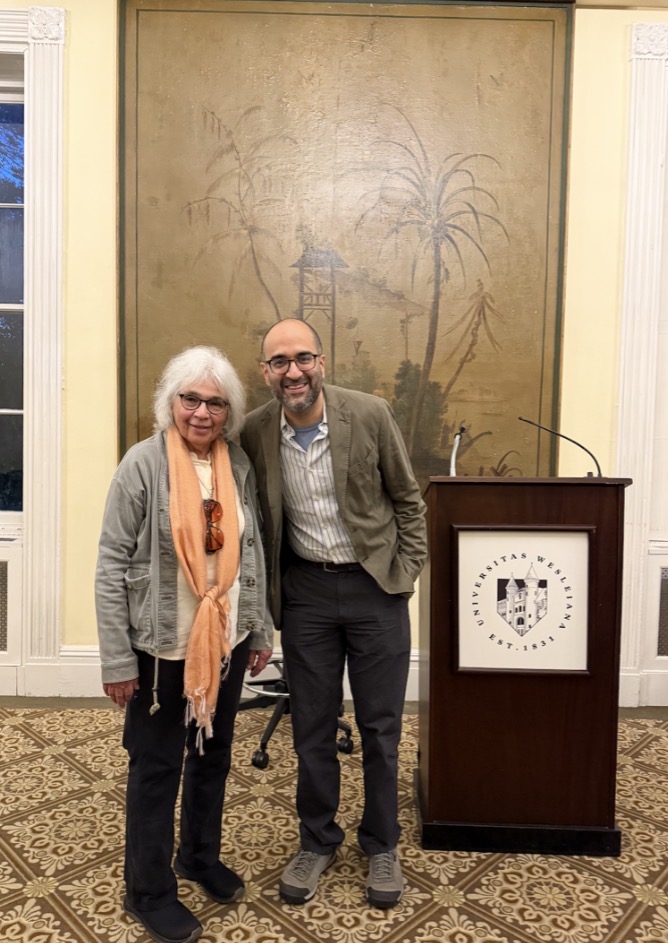
Margot Weiss is an Associate Professor of Anthropology and American Studies, Affiliated Faculty in Feminist, Gender, and Sexuality Studies, and Queer Studies Coordinator, and can be reached at mdweiss@wesleyan.edu.
Leave a Reply