
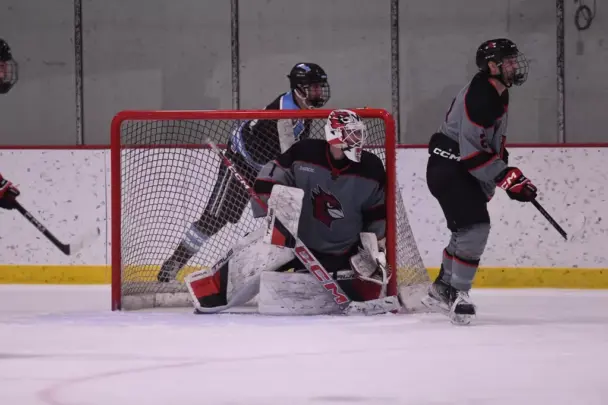
Player of the Week: Patrick McDevitt ’28 Talks Pregame Rituals, Hockey Culture, and Goalie Technique
Patrick McDevitt ’28 is a government and psychology double major from Sainte-Anne-de-Bellevue, Québec and is the starting goalie for the Wesleyan men’s hockey team. In each of his two seasons in Middletown, McDevitt has posted a save percentage above .900. He has started 42 games and logged 2,501 minutes in goal across both campaigns. McDevitt led the NESCAC with 738 saves this season, 73 more than second place, despite playing two fewer games.
In the Cardinals’ playoff game against Amherst, he made history recording 73 saves in a heartbreaking 3–2 double-overtime loss, breaking both the program record and the NESCAC Championship record. The Argus sat down with McDevitt to discuss his journey, what it takes to play goalie, and Wesleyan’s tight knit community.
The Argus: When did you start playing hockey?
Patrick McDevitt ’28: I started playing from a young age, probably around 8. I also played soccer, rugby, and swam, but hockey was always the one I loved. From the jump, I was a goalie. We used to take turns playing goalie, and one kid really didn’t want to play, so I got an extra rep, and I didn’t leave the goal from there.
A: What was the hockey culture in Canada like?
PM: I grew up in the suburbs of Montréal, so it was a way of life there. Montréal, in my biased opinion, is the hockey capital of the world. I was lucky enough that my grandfather worked for the CBC (Canadian Broadcasting Corporation), so he was always in the locker room interviewing Habs (Montréal Canadiens) players. There was a hockey rink within 10 minutes of everywhere in that area, so it was really easy to become obsessed with the sport.
A: Do you have any favorite hockey players and goalies you looked up to growing up?
PM: Definitely. Carey Price and Jonathan Quick were my two favorites. I always go onto YouTube and watch their playoff highlights back. Growing up, the games were on the West Coast, and my parents made me go to bed early, so I couldn’t see them live. But Price is just such a legend, and the 2012 to 2014 years were so special.
A: What was the journey like to high school, then ultimately Wesleyan?
PM: I went to middle and high school in Montréal, and then all of the hockey guys there started looking at prep schools, so I did too. I ended up going to Portsmouth Abbey in Rhode Island, and that was great because there were a lot of guys from Montréal there. Then, I was lucky enough that [Head] Coach [Chris] Potter offered me, and it was a no-brainer. Everything I heard and saw about the culture and atmosphere was great, and obviously, it’s also a great academic school, so I couldn’t have been more excited. It’s been the best group of guys I’ve ever been around.
A: You came in and started right away. What was the transition from high school to college hockey? Did anything kind of catch you by surprise?
PM: Oh, for sure. I mean, the biggest thing was the speed. A lot of the guys played Juniors, so they’ve had time to adjust, and some of them were like five years older than me, so it took a bit to settle in and build up confidence. The schedule [is different], too, because we play back-to-backs every weekend. In prep school it was one game a weekend, but here you play Friday and then you have to immediately turn around and get ready for the next day. Whatever happens [on] Friday, you need to forget about and turn your attention to the next day.
A: What’s it like to be a goalie? Is it isolating? Does it get tiring always being in an athletic stance?
PM: Yeah, you have to love it. The biggest part is staying even-keeled, not getting too high or too low. You have to be able to bounce back from whatever happens. It’s not as isolating as you would think, especially with a team as great as this one. There is a goalie room of three of us, so we have each other, and the entire team is always hanging out.
A: How much of goaltending is technique versus adapting?
PM: This is a bit of a cop out, but it’s a mix of both. Something I’ve realized is everyone here has elite technique. You need to keep working on it though and making sure your reactions stay sharp. Where the difference shows up [between] overperforming and underperforming individually is the mental aspect.
A: What’s a skill you need or a drill you do that someone who doesn’t know much about hockey wouldn’t expect?
PM: Yeah, there are a bunch. Visualization is a big thing. Jacob Fowler, the goaltender for the Habs, is always meditating before the game and visualizing what he wants to happen. That’s something I do too to try and help me calm down and stay present. Another big thing is throwing balls off the wall and catching them; it’s almost like juggling, but it helps a lot with reaction time and reflexes.
A: You won NESCAC Player of the Week with 73 saves, but the team ultimately lost that game. How did the game unfold from your perspective, and how do you come to terms with having a great performance but falling short?
PM: We were all obviously so disappointed that we lost. It was a good experience for us to go through. I have never been pushed like that before. And at the same time, that’s just the way the sport goes; it’s a small piece of rubber, and it takes weird bounces that often determine the game, and they just didn’t go our way that day. A big part of that game is how much everyone wanted it and how much we were playing for each other. I saw from my vantage point that everyone was throwing their bodies on the line and using every last ounce of energy. That’s part of what made the loss so tough because we put in our best effort. So it’s disappointing, but it’s going to make us all better.
A: What has been your favorite, unexpected part about Wesleyan outside of hockey?
PM: The way the teams show up for each other. Our team always makes an effort to go to the football and volleyball games, and we take a lot of pride in the energy we bring. And other teams return that to us and show up at our games. It’s really cool to see the scale of athletics here.
A: Do you have any pre-game rituals or superstitions?
PM: A big one is we do a big lineup read before the game. A couple of guys come and read out the starting lineup, and it gets everyone fired up. Then we go to the tunnel, and there are like five or six different chants we do. For example, with a minute to go, when the refs hit the ice, one of the guys will yell hot coffee. The first time it happened, I remember thinking what is going on, but it’s a funny thing, and it gets me prepared. Once I hear that, I’m like ok, it’s go time. So it’s awesome, and it really gets the energy up.
This article was edited for length and clarity.
Sam Weitzman-Kurker can be reached at sweitzmankur@wesleyan.edu.


Leave a Reply