
WSA Debates Controversial Bill to Raise Senators’ Pay, Vote to Follow
This is a developing story.
Should your student representatives get a pay raise?
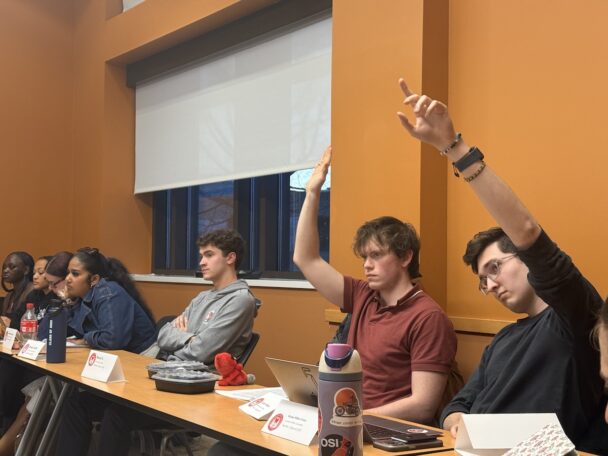
Last Sunday, March 29, the Wesleyan Student Assembly debated just that at the weekly General Assembly (GA). The contentious proposed amendment looks to raise the semesterly senator stipend from $850 to $1000, the semesterly leadership stipend from $1300 to $1500, and enact changes to the attendance policy for senators.
Half of the funds would be drawn from the Student Activity Fee (SAF), while the other half would be drawn from the WSA’s endowment. The bill has yet to be voted on and is undergoing changes.
Critics argued that the amendment doesn’t seek adequate student input via referendum given that it draws from student body funds and that it doesn’t limit the WSA’s power to arbitrarily raise pay in the future. Proponents of the amendment argue that it adjusts senator pay to match inflation and serves to retain senatorial participation, especially for representatives who are First Generation Low-Income (FGLI), international students, or on work-study.
“I think it looks bad because it is bad,” WSA senator Nicolas Millan ’27, one of the sole vocal opponents of the amendment, said.
The heated debate that followed on Sunday re-invoked the questions of whether pay incentivizes higher attendance and retention and whether senators should be paid at all. Current senators are only paid for the three hours they attend GA weekly and not for the time taken up by Committee meetings and other administrative tasks.
Impetus for the amendment came as the 2023 pilot program that first approved compensation for WSA senators by student referendum is set to expire at the end of 2026.
How did senator pay begin?
WSA senators weren’t all always paid. Senators on work-study were compensated beginning in 2015, but it wasn’t until 2023 that a student body referendum found support for compensating representatives, with 82% in favor.
The legislation added that this stipend program would be adjusted as the WSA saw fit after three years. However, only 165 of the 3069 undergraduate students who were enrolled as of Fall 2022 voted in the referendum.
Two main funding sources have so far supported senator pay: the Student Activities Fee (SAF), a mandatory $390 charge that is part of tuition, and leftover SAF funds arising from a COVID-19 budget surplus while clubs requested fewer funds. The SAF was last raised via WSA amendment in Nov. 2025 to match rising inflation, increasing 4% to $405 for the 2026–27 academic year. According to the Student Budget Committee (SBC), this fee raise did not affect financial aid recipients.
Currently, three-quarters of the senators’ funding is drawn from the SAF, with the COVID-19 surplus picking up the rest. The stipend was first established by pulling entirely from the COVID-19 surplus for the Spring 2023 semester.
“The surplus was the SAF from [COVID-19] years that just was sitting there,” SBC Chair Zain Punjwani ’26 said. “Previous SBC chairs [were kind of] pulling from it as was needed. We could still pull from it very immediately, as opposed to our separate endowment, which is investments we have made.”
Over the following academic years, the SAF gradually replaced the COVID-19 surplus as the primary source. Only one-fourth of the stipend came from the SAF in the 2023–24 academic year, but 25% more was taken from the SAF each year, with three-quarters taken from the SAF in the 2025–26 academic year and only 25% taken from the COVID-19 surplus.
What’s happening to senator pay now?
The majority of the residual COVID-19 surplus was re-invested into the endowment this summer by the SBC, meaning there is no more surplus to rely on anymore.
The WSA’s endowment was formed in 2008, with an initial investment of $100,000 that grew to $1.1 million by the end of the last academic year. The WSA endowment has not been used since its establishment. If the proposed senator pay increase comes to pass, funds would be drawn from the endowment for the first time.
This bill would reapportion funds for the stipend by equalizing the amount pulled from the SAF and the endowment. If it passes, 50% would be pulled from the SAF, as opposed to 75%, which proponents argue lessens the financial burden on student pockets. This has convinced some senators to get onboard.
“After seeing the logistics behind the way we would fund that [raise], I was a lot more in support of it,” Chair of Academic Affairs Committee Andrea Herrera ’27 said.
Millan argues that the distinction between drawing from the SAF and endowment is semantic.
“It’s all student money,” Millan said. “It doesn’t matter. The endowment is invested WSA surplus, as in student money, right? Like any surplus that we might have this year…it’s all student money. So I personally don’t see the difference…. I’d also argue, if we take money out of the endowment to pay senators, then, we’re obviously not re-investing that either in the student body or in the endowment again, which is a loss overall.”
Senator Lucas Holman ’29, who is on the SBC, argued that this reapportioning of funds could take place without the pay raise, maintaining that the WSA can draw less money from the SAF by relying more heavily on the endowment.
“You don’t need to have the [reapportioning] in tandem with the raise in pay,” Holman said. “Those are fundamentally different. We could do it right now with another amendment.”
Who’s against the amendment, and why?
Holman and Millan, two opponents of the bill as it stood, voiced strong dissent at the GA, albeit on different grounds. The meeting last Sunday drew just two non-senators, Argus reporter included.
On the floor, Millan criticized how the amendment was communicated to the student body, and the ways in which students have been given opportunities to provide input on it. The only communication prior to the bill’s discussion was the weekly email sent before the GA by the Chief of Staff. Opponents of the amendment noted the lack of attendance at the GA and have raised the possibility of a campus referendum to more directly involve students in the process.
“If [it] were true [that raising senator pay is acceptable], we should be able to convince the student body that that is true,” Millan said. “Therefore, theoretically, a referendum would be absolutely no roadblock to the WSA in terms of implementing this bill, right? So my question is, why are we being undemocratic about it?”
Millan is currently working to drive support for a grassroots student petition or poll, with the eventual goal for a referendum.
Punjwani disagreed that a referendum is necessary or helpful for this particular proposal, arguing that students are aware of the amendment and that the lack of student attendance at Sunday’s GA reflected student non-attitude as opposed to opposition.
“I have a few issues with referenda for this specific [bill],” Punjwani said, “One is, we already did it once. And if you go back and look at those numbers, [165] students voted. So to me, the referendum is not very representative of the student body’s thoughts. I think there are better ways for us to kind of focus our capacity that would solicit greater feedback.”
Millan pushed back, stating the original referendum was voted on by students who have since graduated and that the currently enrolled student body should be re-surveyed.
Holman diverged there.
“I think we do have a legislative mandate from that 2022 referendum, so I don’t think we need it for the sake of argument, because it’s the same thing,” Holman said. “That’s how the government works. It’s impossible to survey a population every single time. This is why [precedent] is important. Like, we look at what populations agree to prior: We don’t vote on taxes every single year just because new people are getting taxed.”
Nonetheless, Punjwani noted that the WSA is making an effort to increase student awareness via social media, as well as scheduling drop-in hours open to the student body to be held in the following week.
“That’s kind of also the justification behind [waiting] the two weeks [before voting on the amendment],” Punjwani said.
Amendments are usually voted on the week after they are proposed. The WSA is waiting an extra week before voting on this amendment in order to gather more student input.
Does the pay affect everyone the same?
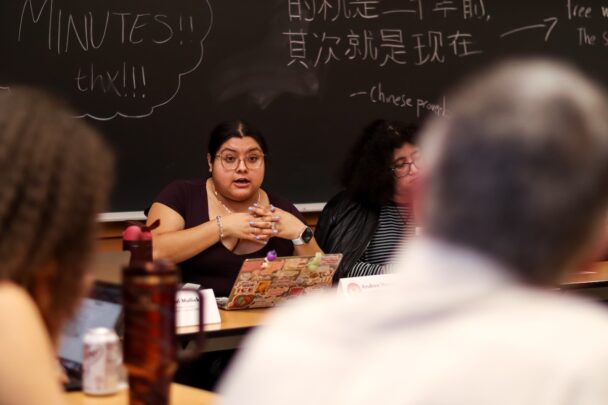
It’s clear that compensation for representing the student body affects senators differently across the board.
“I sometimes do send money home,” Herrera said. “I have to support myself through college, and the WSA is a huge passion of mine.”
Punjwani echoed the sentiment, while justifying why the bill doesn’t only propose a pay raise for low-income senators.
“As a student of color, my worry is that if we incentivize [only] our labor, then it will create a power dynamic that, in turn, harms the crowd,” Punjwani said. “Because then people will be asking, ‘I’m doing the same labor as you are—maybe even more—[so] why is my labor not getting paid?’ The last thing we want to do is to create that sort of dynamic in a space that finally seems to be getting to be much more representative of the student body.”
On the floor, many senators argued that, although their work is driven by a passion for serving as student representatives, the compensation makes a huge difference for international students, FGLI students, and students on work-study.
Holman and Millan both agree that compensation for these demographics is essential and increases equity and diversity in the WSA.
How is the bill changing?
Following ongoing debate and input from the WSA, Punjwani and proponents altered the proposed amendment to include restrictions on how compensation can be raised by passing an amendment. At the time of publication, the changes being discussed include language limiting increases to senator compensation to no more than the inflation rate has increased since the last year the WSA increased compensation.
“Since [the GA], I reworked the language a little,” Punjwani said. “I’m unsure how people will receive it, but there was concern about potential corruption in the future, where [the WSA could] just raise the budget by quadruple, whatever. So, now we [have] tweaked the language so that it can go up by no more than the inflation rate difference between the current year and the year [compensation was last raised].”
What’s up with attendance?
A majority of senators agreed on the floor that the WSA needs a stricter attendance policy. The original amendment called for a cap on the number of unexcused absences by senators, which is currently informally tracked by the Chief of Staff.
“Stricter attendance, even [apart] from the payment conversation, I think is important to [getting] the work that the WSA does done,” WSA Chief of Staff Corinne Dicpinigaitis ’26 said. “And as Chief of Staff, I try to enforce that the best I can.”
Dicpinigaitis shared her experience as a freshman senator in Fall 2022, when senators did not have pay and the WSA had a higher turnover rate. She stated that the GA was fractured, with the regular turnover ultimately amounting to an lack of institutional knowledge.
“I really noticed that the turnover rate has dramatically decreased [after pay was instituted],” Dicpinigaitis said. “People stay because they realize, like, ‘Hey, it’s a lot of work, but I’m getting paid for it.’”
WSA President Paul Quach ’26 spoke more on what motivates senators to participate.
“It is really hard to pinpoint exactly what incentivizes all senators’ work for the WSA,” Quach said. “I will speak on behalf of myself, and other senators can choose to agree or disagree, but my incentive has always been to better the lives of my peers and future peers on this campus.”
What’s next?
The vote on the amendment may be further delayed. Dicpinigaitis noted that the April 5 meeting falls on Easter Sunday, and the WSA may be unable to gather the requisite numbers to hold the meeting.
“If [we’re unable to form a quorum] the following Sunday, [April 5,] we’re not voting on this legislation [then],” Dicpinigaitis said. “We’re still consistently making changes…seeing what works for people, what doesn’t work for people, and trying to listen to as many perspectives as we can.”
Punjwani maintains that the amendment will be forward facing.
“My thoughts right now [are] institutionalizing a mechanism, so that we stop operating off a pilot and more so off a constant re-evaluation that would have to occur by the WSA, that not only would force us to consider whether we have the financial capacity to pay ourselves, but also to ponder whether we even deserve to be paid,” Punjwani said.
Dicpinigaitis agreed, adding that student input is crucial to the process.
“You can hate the compensation, you can love the compensation,” Dicpinigaitis said. “[But] I want to hear it all. Please, please come.”
The WSA is planning to hold drop-in hours next week to gather student feedback on the amendment.
Janhavi Munde can be reached at jmunde@wesleyan.edu.
Peyton De Winter can be reached at pdwinter@wesleyan.edu.
This story has been updated.



Leave a Reply