
Senior Theater Capstone “The Seventh Fire” Offers Audiences an Eerie and Engaging Escape Room Experience
A very unique theatrical project premiered in the Theater Studio from Monday, March 2 to Friday, March 6: an escape room. Avivi Li ’26 and Liang Liang ’26 presented their final theater capstone, an unconventional theatrical experience called “The Seventh Fire,” in which the audience participated in the story itself, all under the guise of solving an escape room. I had the pleasure of solving the room with a group of five others on March 4, and though “escape room” was certainly the right description for it, it was also a satisfying narrative and, yes, theatrical experience in its own right.
“Around this time last year, I was struggling with my theater capstone proposal,” Liang wrote in an email to the Argus. “I knew I wanted to create something that combines interactive design, games, narrative, and performance, and, most importantly, something where the audience is not just watching, but actively shaping the experience. But at that point, I didn’t yet know what form that would take. After talking with Avivi, the other project lead, we started exploring the idea of an escape room as a format that could bring all of these elements together.”
In creating the escape room, Liang described how she and Li worked with other majors and Theater Department faculty to “[design] how each room reveals information, and [make] sure the puzzles and narrative were tightly integrated so players aren’t just solving things, but actually uncovering the story through their actions.”
Uncover we did. When we stepped into the room, all we saw was scattered newspapers (an Argus archive sourced from my house by project manager Hannah Sodickson ’26) and a mess of other objects that a performer, Marcos Arjona ’26, told us we should help him archive. Initially, he seemed fairly inconspicuous, just the person setting up our goals for us, but he turned out to be a fully formed character in his own right, carrying the story through his monologues. This factor was a crucial element that differentiated “The Seventh Fire” from other escape rooms: Having an actor performing for us made the production feel more like a real-life video game, complete with cutscenes.
Once Arjona left us to our own devices, we got to examining the room and sorting all the objects we could find. We had a couple of false starts, but soon enough, we found a ledger that prompted us to answer how many of a given object were in the room. From that, we were able to get the code to unlock a box containing a note telling us to stand in a circle and recite words to begin a ritual. At this point, we were off to the races. We became aware of the translucent curtains all around the room, as Arjona practically jumpscared us from behind them.
I don’t know what my expectations were for the scale of the project, but they were certainly exceeded when we got into the next room, designed as a puzzle where we had to match objects to their mentions in blurbs under photographs, an experience that established much deeper lore than I was expecting. The general story, as I understood it, was that Arjona plays a ghost who needed our assistance in remembering his lost friends after a tragic fire in North College. I wasn’t able to get every detail, but that added to the experience—it felt mysterious even as it was solvable. This was all part of Liang and Li’s aim.
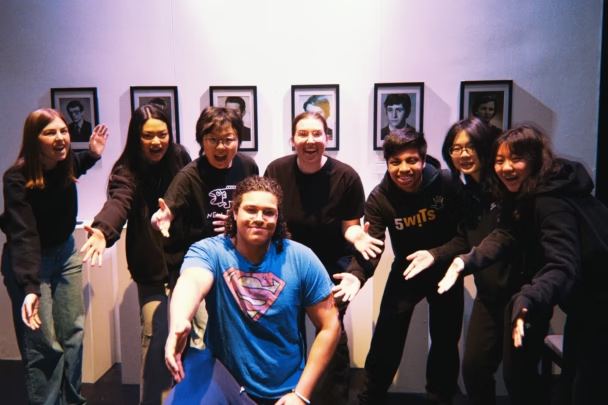
“The most challenging part was balancing clarity and ambiguity,” Liang wrote. “We wanted the story to unfold through fragments, but not to the point where players feel lost. Designing puzzles that are both functional and narratively meaningful, especially across multiple rooms, took a lot of iteration.”
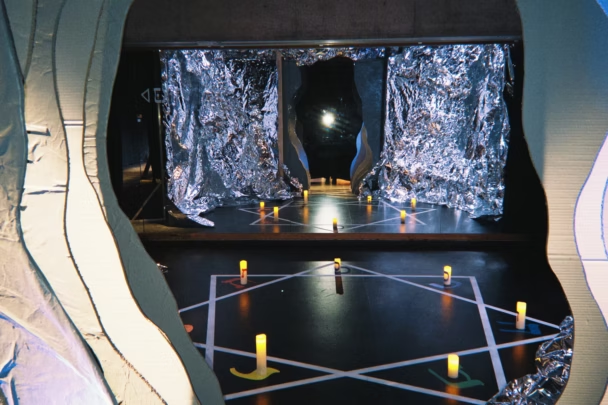
They succeeded with flying colors, while also making a project that was sensorially stunning. A particularly standout moment came when we solved the second room, when the lights slowly came on to guide us through a tunnel to a room entirely covered in tinfoil. Think the pathway-between-worlds of “Coraline” leading to the blue motel room of William Friedkin’s “Bug.” It got an audible response out of everyone in my party, setting us up for a satisfying conclusion in which we performed a ritual to free Arjona’s soul, a moment of grace for his character’s haunted confusion.
“The most rewarding part was watching… players slowly realize what they’re actually doing,” Liang wrote. “Those AHAAAA! moments are incredibly satisfying.”
She certainly got that satisfaction from our group; we were incredibly excited at every stage of the process, which translated to an outcome we were all pretty happy with. We completed the escape room in around 15 minutes, beating the record time.
Louis Chiasson can be reached at lchiasson@wesleyan.edu.




Leave a Reply