
Frederick Wiseman’s Eyes Were Indispensable
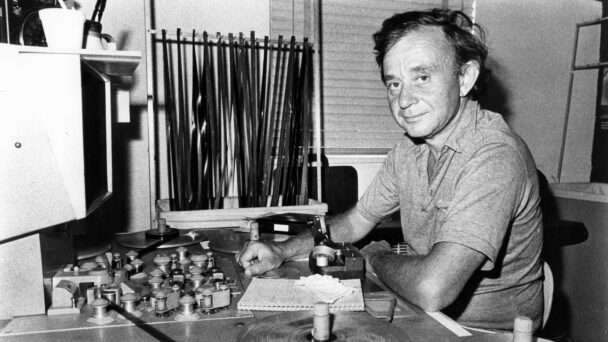
Two weeks ago, American cinema lost one of its most vital voices. The documentarian Frederick Wiseman died at age 96, leaving behind 47 feature films. Last year, spurred on by a tour of restorations of his entire body of work, I watched 36 of them. Wiseman’s cinema was unlike any of his contemporaries; though he gets lumped in with vérité greats like D.A. Pennebaker and the Maysles brothers, his work differs from theirs in his complete lack of concern for individuals as subjects. A human interest story like “Grey Gardens” or rock-doc like “Don’t Look Back” or “Gimme Shelter” would have no place in Wiseman’s catalog; for almost 60 years, Wiseman’s unwavering concern was for the functioning of institutions.
A cursory look at the names of Wiseman’s films gives you a sense for how broad a swath of American life the filmmaker bore witness to: “Welfare,” “High School,” “Juvenile Court,” “Aspen,” “Domestic Violence.” His purview even expanded beyond America, with stops at London’s National Gallery and a Michelin 3-star restaurant in the south of France for his final film, “Menus-Plaisirs — Les Troisgros.” His process involved embedding himself into these institutions, shooting hours upon hours of material before he edited it together as a sort of record of what he saw.
“You hang around, shoot a lot of film, figure it out on the editing,” Wiseman said of his process. “There’s a wide variety of human behavior out there…. One of my interests is in documenting as much of it as I can.”
As Wiseman said, “Shooting is the research,” meaning that he didn’t enter any space with a pre-conceived judgement. His films are not didactic, even as many of them depict astounding systemic failings. He uses the language of editing to build arguments about a given place, while still offering ample space for an audience to form their own opinion. His films are consistently described as being objective works, but he insists that that’s missing the point. Wiseman took major issue with the incessant critical label of the filmmaker as a “fly on the wall.”
“It’s an insulting term,” Wiseman said. “Most flies I know aren’t conscious at all, and I like to think I’m at least two percent conscious.”
Indeed, if you attune yourself to the rhythms of Wiseman’s editing, you get a feel for where his perspective comes through. The power of watching any of his films—especially the ones with intimidating lengths—is how moments from earlier in the film are recontextualized later on, a technique that in a shorter film might read as more simplistic. His films are a curated accumulation of details. Take, for example, the sequence of MBNA workers in sleek cubicles that comes towards the end of “Belfast, Maine;” after an entire film depicting with dignity the daily, traditional life of Mainers—as well as both the labor and poverty that define the city—we recall that the film was made in 1999, that the 21st century was encroaching. In roughly five minutes of a four-hour film, Wiseman makes us think about the moments we’ve witnessed as scenes of a culture nearing its end; the last shots of the film are of a cemetery.
There’s another obvious reason why Wiseman’s films cannot be construed as purely objective: his camera itself. Working in tandem with his regular cinematographer, John Davey, Wiseman didn’t make films using hidden cameras. He was present in the rooms he shot, and so his subjects were all, on some level, aware of his camera’s presence. In a film like “Juvenile Court,” you can imagine that perhaps the subjects were so caught up in the pressing matters at hand that they didn’t regard him much, but in most of his films, there’s a strange feeling of wondering how the footage he captures feels so true to life. Could these performances be expertly calibrated for the cameras? In a sense, they are; Wiseman described his films as “reality fictions,” as he embedded himself in very real spaces but allowed his subjects to represent themselves as they chose. Of course, there is a truth to that choice, too; how someone decides to present their real-life situation to a camera is important. One might imagine that the man monologuing ad nauseam about “Waiting for Godot” at the end of “Welfare” is doing it somewhat for the camera’s benefit, especially when he stops directing his words at anyone in particular, but it still serves as a potent thesis for the existential hell Wiseman constructed of the film’s welfare office. The man said it in that space, so Wiseman was free to use his words as a concluding note. The reality of that moment is irrelevant; Wiseman wasn’t a journalist, he was a filmmaker who thought about the art of his films as much as any great director.
I suppose that all explains why I became so obsessed with him last year. Once you submerge yourself in his filmography, it becomes somewhat hard to watch anything else. The traditional mechanics of documentary—interviews, narration, archival material—become particularly uninteresting. The answers are all out there in the world, though it takes only the most humble and curious among us to sequence them in a way that feels honest. I have kept myself awake in boring meetings or classes by imagining Wiseman training his eye on them; his implicit insistence that no material is below him, no scene without drama, has substantially changed how I exist in the world.
There is no better time to acquaint yourself with the work of this great artist. His films can be daunting, but they are self-evidently rewarding for anyone interested in how individual mobility is constrained by institutions, how good people adapt themselves to do good on an interpersonal level under the banner of an institution’s mission. At their best, his films can feel like plays writing themselves in real time, shockingly direct expressions of dispossession taking the form of remarkably complicated dynamics between people. If you’re looking for a place to start with his work, I would recommend “Welfare” or “Juvenile Court” as the purest example of the complexity of Wiseman’s scenes. If the lengths of those two seem daunting, go with “Hospital,” which simultaneously contains some of his most heartrending and absurd moments. My single favorite scene of his comes midway through “Deaf,” one of four films he made at the Alabama School for the Deaf and Blind, when the principal of the school tries for 45 minutes to translate the irreconcilable conflict between a mother and her deaf son. “Aspen” shows his capacity for disdain, “Domestic Violence” and “Domestic Violence 2” his capacity for radical empathy, and “Crazy Horse” his eye for bodies. His cinema is a world unto itself, and it’s one we are immensely lucky he took the time to assemble for us.
Louis Chiasson can be reached at lchiasson@wesleyan.edu.

Leave a Reply