
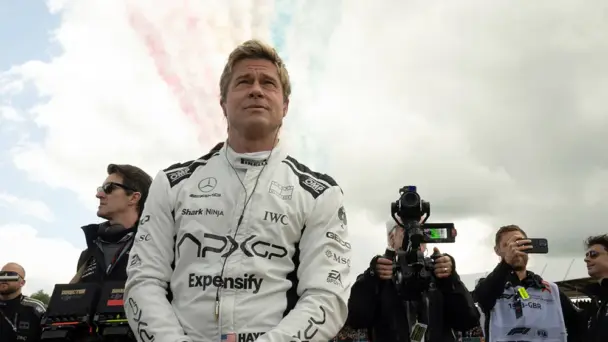
A Case for “F1: The Movie”: Why this Racing Blockbuster Deserves Its Nomination for Best Picture
“F1: The Movie” was a box office hit in 2025, raking in over $600 million in global box office sales—but it has earned the Academy harsh criticism for its nomination for Best Picture. While it may not be a perfect movie, I believe it is too strong of a film to receive this much flak for its Oscar noms.
With the Formula 1 season kicking off on March 8 and the Academy Awards slated for March 15, one week after, it feels like an adequate time to defend “F1 The Movie.” Here’s my case for why it was rightfully nominated for the award, and while it most likely won’t win, why its presence is significant.
Before getting into it, let me put things in perspective: I am not a film critic. The closest thing I have to any film credibility is six semesters of living with my film major roommate and the fact that this will be edited by at least one more film major. I am a sports editor and writer for The Argus, and I have covered Formula 1 twice (soon to be three times) as a member of this paper. As a fan of the sport, I watched this movie with skeptical eyes. But needless to say, I wasn’t at all disappointed. Regardless of whether its place is justified, I’m just happy to see the sport continue to grow. Okay, let’s get into it.
Why It’s Justified
The reasons I believe “F1’s” place in the Best Picture lineup is justified boil down to four main factors: its visual achievement, accessible presentation of an incredibly complicated sport, the strong portrayal of teammates in Formula 1, and its general entertainment value.
The incredible visuals created for this movie start and end with the film’s director, Joseph Kosinski. His directing prowess is highlighted by “Top Gun: Maverick,” which played a major role in getting people back into movie theaters in 2022 for its combination of nostalgia and breathtaking sequences. Kosinski, lead actor Brad Pitt, and the producers of “F1” worked directly with Mercedes to create a filming environment and experience unlike any racing movie we’ve ever seen.
Mercedes supplied six Formula 2 cars to Kosinski and company, which were remanufactured to hold the rig of transmitters and cameras needed to capture the visuals that the film required. Through extensively planned scenes filmed during actual Grand Prix weekends during the 2023 and 2024 seasons, they were able to create an environment that put the audience in the middle of the action with the movie’s stars—Pitt and Damson Idris—as they seemingly maneuvered their way through races.
In an interview with Formula 1, Kosinski discussed how they had to develop a completely new system of filming in order to achieve some of the visuals he envisioned.
“We had to develop a new camera system, taking everything we learned on ‘Top Gun: Maverick’ and pushing it much further,” Kosinski said. “You can’t put 60 pounds of gear onto a race car and expect it’s going to perform the same way. So we took those ‘Top Gun’ cameras, and we worked closely with Sony, sizing them down to something about a quarter of the size.”
Because of this capability, “F1 The Movie” sets itself apart from its auto racing movie counterparts by capturing the essence of the sport in as much detail as possible for a film of this magnitude. It’s no surprise that, along with Best Picture, the movie was also nominated for Best Film Editing and Best Visual Effects. The atmosphere the visuals create are enough to put “F1” in conversation for Academy Award consideration.
Its next strong point is how it makes the sport accessible to an outsider. Formula 1 may seem simple on the surface, but if you dive just slightly deeper, you start to realize all the nuances and intricacies that make the sport so fascinating. There are infinite aerodynamic factors that make up the calculus of car design. Running a team and choosing drivers can be a dramatic task for any team principal or owner. Valuable seconds, even tenths or hundredths of a second, can be determined by one slight mistake by a 24-person pit crew. These don’t even get into the various financial and political decisions made to form a team or deal with changing regulations.
“F1 The Movie” brilliantly weaves technical aspects of the sport with explanations about how F1 works so that the greatest of superfans and the newest of newcomers will both enjoy it. Fans of the sport, like myself, know the rules of qualifying and understand the role of the Fédération Internationale de l’Automobile, but the script does a strong job inserting brief explanations that make it easy for new fans to comprehend all that is going on. As a big F1 fan myself, there might have been one time I noticed the script being overly explanatory to cater towards the average viewer, but in general, it gives the audience enough context while not distracting from the plot of the movie.
The dynamic between two drivers on a team can be contentious, and certainly has been throughout racing history. F1 fans know that each team on the driving grid has two drivers each, making for 20 total drivers competing at the highest level (it will be 22 starting this season). In the case of the fictional APXGP, upstart rookie Joshua Pearce (Idris) is joined by Sonny Hayes (Pitt), a former driver who experienced a near-death accident during the beginning of his career. It’s a typical experienced vet and young rookie teammate pair, but as the movie properly portrays, it can get tense as both drivers compete to win races.
In one race during the movie, Hayes refuses to let Pearce pass, forcing the two cars to collide and knock both out of the race. After a shouting match in the team garage, Pearce poses proudly in front of the press before Hayes scolds the rookie in a moment of growth for the pair’s relationship and for Pearce as a driver. While I’m not sure something like this would happen in a real race, it accurately captures the clashing egos of two drivers—egos that are appropriately high for the fever pitch of racing—and the struggle of not contributing to the team. It creates what I think is the most interesting character relationship not only in the movie but in all of sports.
Real-life instances of rivaling teammates reaching the point of nail-biting conflict are endless: Nico Rosberg and Lewis Hamilton’s title battle as a part of Mercedes in 2016; Ayrton Senna and Alain Prost for McLaren in 1988. Even in last year’s title race, Lando Norris and Oscar Piastri for McLaren experienced tense moments determining races throughout Norris’ run to the Drivers’ Championship. It is part of what makes the sport so fascinating. If there is nothing plot-wise that this movie does well, the one thing it accomplishes, in my opinion, is a realistic portrayal of this rivalry.
Lastly, to offer probably the most reasonable explanation for why it was nominated, it’s a fun film to watch. In the same way that “Top Gun: Maverick” got nominated for the Best Picture Oscar for being a fun time in the theater, “F1” achieves the same sense of euphoria. It is entertaining, thrilling, and stressful; ultimately, it puts butts in seats at movie theaters across the world. It gets the adrenaline pumping, just like many sports movies do. I wouldn’t categorize this movie with other high-achieving auto racing movies—“Ford v Ferrari” (2019) and “Rush” (2013) still capture character development and more compelling stories to me that this movie doesn’t, yet it still keeps audiences entertained, which is what movies are all about. I perceive this reason as the cop-out answer, to be sure, but it still needs to be mentioned.
The Significant Drawbacks
Most of my concerns with the movie have to do with the plot, which I think had seeds of promise that were never sown. The romance between Hayes and team technical director Kate McKenna (played by Kerry Condon) felt rushed and poorly executed. Additionally, the use of APXGP board member Peter Banning, played by Tobias Menzies, as a corporate villain in the third act of the film felt unnecessary, as I saw adversity and his own physical state as more compelling antagonists for Hayes. The two big drawbacks for me, though, involve a sidelined plot point that strengthens a team owner–driver relationship and an objectively more interesting ending to the final race of the season and the movie.
Sonny Hayes returns to F1 because APXGP owner Ruben Cervantes, emphatically played by Javier Bardem, needs a driver and looks towards his former teammate, whom he mentored during his driving career. Cervantes and Hayes were teammates in the 1990s before Hayes’ crash that knocked him out of the sport indefinitely. Now, Hayes makes his return to racing’s greatest stage, and his boss is his former garagemate. If this were a real occurrence in Formula 1, their relationship would be covered nonstop, as an owner having an incredibly personal relationship with one of the drivers transgresses multiple levels of team hierarchy. Lance Stroll, driver for Aston Martin, stays in the headlines every time he disappoints because his dad, Lawrence Stroll, owns the team. That personal relationship, many seem to think, is what keeps the junior Stroll in the sport despite his disappointing performances. There could have been a really fascinating story arc that properly examines what their interactions look like, but unfortunately, that relationship takes a backseat to other plot points. It doesn’t help that Bardem’s character on the whole is poorly written.
The climax of the film takes place at the final race of the year, where both Pearce and Hayes are in podium position. Pearce is gaining on the race leader, Lewis Hamilton, but Hayes is right behind both of them. It becomes evident that one of them would need to sacrifice the competition with Hamilton for an APXGP car to cross the finish line. Ultimately, Pearce does so in violent fashion, as a collision with Hamilton at a late-track turn knocks both cars out, clearing the way for Hayes to complete the season with a race win. I wasn’t surprised by this ending. Pitt has been developing this movie for the last five years; there was no way he wasn’t going to win the last race, assuming that there’s a happy ending.
However, this movie is so much more interesting if Pearce wins the final race. Hayes spends the first half of the season essentially playing bumper cars with the bottom of the grid to help Pearce out, and his character development from questioning his aged teammate to adopting his team rituals to help build camaraderie with all members of the garage is well portrayed. It’s a large part of why Idris is the standout performer out of a stacked bill of actors in this movie. His character arc is the strongest, and he’s likely the most accurate portrayal of a Formula 1 driver that the movie could have gotten. While I didn’t detest his “I’ll stick with my team” moment when Toto Wolff (Team Principal for Mercedes) approached him after the final race, it would have been a much more worthy ending if Pearce emerged victorious.
This movie is not, by any account, peak cinema. “F1 The Movie” won’t be mentioned in any conversations with “Citizen Kane” (1941) or “The Godfather” (1972), but in terms of visuals, entertainment value, and making the sport available for any audience, it knocks it out of the park. I have confidence saying it won’t win Best Picture, but it would not be egregious to call it one of the best to come out of 2025.
Max Forstein can be reached at mforstein@wesleyan.edu.





Leave a Reply